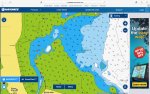
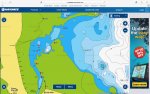
Navionics SonarChart - no depths in drying areas

BelleSerene

Well-Known Member
Joined
19 Sep 2005
Messages
3,423
Visit site
Navionics' 'SonarChart', the bathymetry crowd-sourced from your and my depth sounders as we traverse the seas and data-cleansed by some algorithm somewhere, is brilliant. Turn it on in their online web app, or download it to your chart plotter as an optional layer of information, and you have much more accurate and much more up-to-date depth information than you can get from any chart.

But. For some reason that beats me, they turn it off over drying features - the green areas on your chart. So once you're in shallower water than the chart datum contour, SonarChart gives you no information at all.

Why on earth would they blank out depth information that boats have experienced above the drying contour?!
 
Because they don’t understand tides? :)

Navionics is an Italian company; in Italian waters presumably nobody can sail on the green bits.

Pete
 
I'd seriously doubt the "much more accurate" bit, too! In an area well travelled by contributing boats, no doubt it is OK. But in an area traversed by few boats (e.g. drying areas!) I'd expect it to be of a quality varying from OK to dangerous. Other threads on these fora have noted places where the Sonar Chart data is clearly wrong in dangerous ways (e.g. marking channels across drying areas that do not, in fact, exist). PRV has alluded to the problems of tidal corrections; these can really only be done from a nearby tide-gauge to take account of meteorological effects. I doubt Navionics take that much trouble! There is no way crowd sourced depth data can be compared with marine survey data, and I'd only regard it as acceptable if there was no other data available.
 
Countless documented examples of the sillyness of those Sonar charts.
Suppose an "acqua alta" (surge) episode in Venice, a firemen rib moves over Place st marks while recording depths, all the Square appears as navigable in a Sonar chart: there are no official data for "depth" of st mark square, the crowded one becomes the real one.
They even correct official data with user provided "content": of course one can only register depth when there is enough water under the keel, no one can provide "underlined depths", as a result many green/cover-uncover areas have sonar depth indication which are totally false.
Countless other examples
 
Most of the "increased accuracy" of Navionics charts, namely the amount of depth contours, derives from mathematical treatment of official data. Starting from depths figures from official charts, they rebuild a mathematical surface, which is in turn cut by closely spaced planes parallel to the water surface, which provide the new contours. "Oh look how detailed they are"
Of course this makes no sense: a 2m and a 10m depth in two points do not mean at all that halfway between them one has 6m, which is precisely what their chart is showing.
 
They even correct official data with user provided "content": of course one can only register depth when there is enough water under the keel, no one can provide "underlined depths", as a result many green/cover-uncover areas have sonar depth indication which are totally false.

Really? Are you saying that above the drying contour there's never water under the keel to sail in?! That you can't sail above CD? Do you sail in a lake?

Of course this makes no sense: a 2m and a 10m depth in two points do not mean at all that halfway between them one has 6m, which is precisely what their chart is showing.

It doesn't seem to show that when I look at it. If the finer contour lines were merely interpolations between certain cruder ones, they'd be parallel. They're not.

Clearly as you say there's a mathematical model being created, and clearly there's some joining of the dots between points of the same known depth (ie orthogonal to your suggestion of interpolating between contour lines). But it's based on finer x-y granularity than the published charts, because contributing yachts are traversing the whole place whereas survey vessels can't. And it's also based on finer depth granularity than published charts, whose contours are a whole metre apart and much wider than that in deeper water.

It seems obvious that the data-cleansing software realises the offset of the sounder of every contributing data stream by comparing its experience of depth at a certain point with the expected value. Given that offset, data from the same boat in different areas provides fresh information, which all gets pooled with data on the same areas from different boats, and averaged.

Which means that data provided by contributing depth sounders are just as accurate in depths above the drying contour as in depths provided the other side of it. So why would Navionics blank them out?
 
Really? Are you saying that above the drying contour there's never water under the keel to sail in?! That you can't sail above CD? Do you sail in a lake?


It doesn't seem to show that when I look at it. If the finer contour lines were merely interpolations between certain cruder ones, they'd be parallel. They're not.

Clearly as you say there's a mathematical model being created, and clearly there's some joining of the dots between points of the same known depth (ie orthogonal to your suggestion of interpolating between contour lines). But it's based on finer x-y granularity than the published charts, because contributing yachts are traversing the whole place whereas survey vessels can't. And it's also based on finer depth granularity than published charts, whose contours are a whole metre apart and much wider than that in deeper water.

It seems obvious that the data-cleansing software realises the offset of the sounder of every contributing data stream by comparing its experience of depth at a certain point with the expected value. Given that offset, data from the same boat in different areas provides fresh information, which all gets pooled with data on the same areas from different boats, and averaged.

Which means that data provided by contributing depth sounders are just as accurate in depths above the drying contour as in depths provided the other side of it. So why would Navionics blank them out?

First of all, there have been known issues with Sonar Charts in areas well known to yacht. Channels shown across drying areas being one I remember.
Second, contours are derived by interpolating measurements. However, it isn't a straightforward process, especially for soundings where the data are dense along track but where tracks may well be sparse. Several possible solutions, but none are really ideal.
Third, Without tide-gauge data, you CANNOT correct for meteorological effects, which may be of the order of a metre. While historical tide-gauge data are available FOC, current data are less available.
Fourth, how many of us set the offset on our depth sounder with centimetre, or even decimetre accuracy? I don't - I want to be sure that when the sounder reads zero I'll still have a margin of error!
Fifth, in most areas round the UK, HO charts are based on a LOT more data than are shown on the charts; the soundings are a representative sample of the far denser sampling used to compile the chart. In heavily trafficked areas, I would imagine that swath bathymetry is used, giving a very dense and accurate picture of the seabed. A few extra tracks from leisure craft isn't going to make a difference, and if applied to existing data might well mess it up.
 
Really? Are you saying that above the drying contour there's never water under the keel to sail in?! That you can't sail above CD? Do you sail in a lake?
Sorry I haven t made myself clear: if a location in the green area does not show any drying height figure, once a user sends a recorded depth -because of course the height of tide was sufficient for his boat to float above that point- they correct the official absence of data with a depth figure. This often happens even when there are official data indicating drying heights

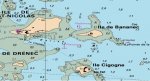
Example (since corrected)
Shom for Glenans
shomgln.JPG

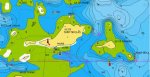
Sonar navionics, now there is a blue/always covered area between the two islets
glen2.JPG

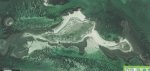
Satellite image wipes out any doubts
glenphoto.JPG


It doesn't seem to show that when I look at it. If the finer contour lines were merely interpolations between certain cruder ones, they'd be parallel. They're not.

Not necessarily: depending on the number of parameters and the order of the equation surface, they need not be parallel.


So why would Navionics blank them out?

I suspect it is because of user reports.
Sonar charts (and their regular charts as well) show a huge number of discrepancies: a lot of "cases" have been submitted to Navionics by their chart users, most often their so!utions has been to revert to official HO coarse data, or simpy blanking them out.
In terms of industry behaviour, selling a product with your own added "data", asking then your customers to provide you with real life corrections to the data you sold them... I find it rather questionable practice.

Should anyone have an idea of the number of real life cases with their charts:
http://www.hisse-et-oh.com/forums/n...ionics-faire-confiance-aux-nouvelles-versions
http://www.hisse-et-oh.com/forums/e...res-a-boating-de-navionics-evoluent-doucement

and plenty other threads with the search function
 
Sonarchart is very useful for getting in and out of marinas/anchorages where you know the data is good. In my case, this is usually because it's data from my sounder for my home marina, which I know to be good and recent. In areas where you don't know the provenance of the data, proceed with caution, especially because some people probably haven't set their sounder depth.

And yeah, would be nice if it showed drying heights.
 
Most of the "increased accuracy" of Navionics charts, namely the amount of depth contours, derives from mathematical treatment of official data. Starting from depths figures from official charts, they rebuild a mathematical surface, which is in turn cut by closely spaced planes parallel to the water surface, which provide the new contours. "Oh look how detailed they are"
Of course this makes no sense: a 2m and a 10m depth in two points do not mean at all that halfway between them one has 6m, which is precisely what their chart is showing.
Some years ago we developed a hydrographic survey system for a rigid sidewall hovercraft. During trials on the St Lawrence a colleague saw an anomalous depth, about 2m, in the middle of the river. Easy to dismiss as a glitch in the system, but they went back and found there REALLY was a spike of rock that was 2m below the surface. There are several in the St Lawrence but this was new.

Lesson is, don't believe your charts if there's any chance of an anomaly; certainly not one that's been produced from a mathematical surface.
 
Some years ago we developed a hydrographic survey system for a rigid sidewall hovercraft. During trials on the St Lawrence a colleague saw an anomalous depth, about 2m, in the middle of the river. Easy to dismiss as a glitch in the system, but they went back and found there REALLY was a spike of rock that was 2m below the surface. There are several in the St Lawrence but this was new.

Lesson is, don't believe your charts if there's any chance of an anomaly; certainly not one that's been produced from a mathematical surface.
Soon after I bought Capricious, I was out in the Clyde with my brother on a "familiarization" trip. I was asking about depths, and he said words to the effect of "No worries - it's all this sort of depth (30-40m) around here". A few minutes later, the depth sounder was showing decreasing depths, going down to about 5m! Yes, there is an isolated patch of shallow water (the Skelmorlie Bank) in those parts. Not a danger for yachts - it is never much shallower than 5 m - but disconcerting when you've just been told it's all deep water, and in an area where tacking on the 10m contour is usual in the sea lochs!

Anywhere with glacial topography can exhibit anomalous shallow patches; features that on land would show up as "Crag and Tail" formations will come up very steeply on three sides, and be of substantial height above the surrounding area. There may well be rapid changes in depth when going from a main channel to a side channel as well (think hanging valleys).
 
Soon after I bought Capricious, I was out in the Clyde with my brother on a "familiarization" trip. I was asking about depths, and he said words to the effect of "No worries - it's all this sort of depth (30-40m) around here". A few minutes later, the depth sounder was showing decreasing depths, going down to about 5m! Yes, there is an isolated patch of shallow water (the Skelmorlie Bank) in those parts. Not a danger for yachts - it is never much shallower than 5 m - but disconcerting when you've just been told it's all deep water, and in an area where tacking on the 10m contour is usual in the sea lochs!

Thank God then for the crowdsourced latest depths. Firstly they give you a far more accurate portrayal of the submarine topography than the regular chart, and secondly they show that the minimum depth is <4m under CD, not 5.6m as otherwise shown! And that being a rocky bottom, it hasn't even moved! In areas of shifting shoals, the more recent and more localised information is all the more valuable.
 
Navionics' 'SonarChart', the bathymetry crowd-sourced from your and my depth sounders as we traverse the seas and data-cleansed by some algorithm somewhere, is brilliant.....

Thank God then for the crowdsourced latest depths. Firstly they give you a far more accurate portrayal of the submarine topography than the regular chart.....

Nope, sorry, I disagree. There have been too many instances for my liking where the crowd sourced data has turned out to be rubbish. Navionics has been showing deep channels in places where none exists. That is just dangerous.

I prefer to us data sourced from HOs. In some places, they may not have done a survey in the last 100+ years, but I would rather that, and to know from the chart to give it a fair degree of scepticism, than to have depths randomly changing as people traverse the waters with poorly calibrated depth gauges.

I am never going to buy another charting device that can only use Navionics. I just don't trust them any more. (I raised this with them at the Southampton boat show a couple of years ago and they totally denied there was a problem. That made me even more wary of them).
 
Nope, sorry, I disagree. There have been too many instances for my liking where the crowd sourced data has turned out to be rubbish. Navionics has been showing deep channels in places where none exists. That is just dangerous.

I prefer to us data sourced from HOs. In some places, they may not have done a survey in the last 100+ years, but I would rather that, and to know from the chart to give it a fair degree of scepticism, than to have depths randomly changing as people traverse the waters with poorly calibrated depth gauges.

I am never going to buy another charting device that can only use Navionics. I just don't trust them any more. (I raised this with them at the Southampton boat show a couple of years ago and they totally denied there was a problem. That made me even more wary of them).

+1 and Newtown Creek is a perfect example; the only difference in my case being that Navionics accepted their 2016 "Sonar Chart" of the area was a load of rubbish - now amended.

The cost of error here could be significant, which is why I personally use a combination of Navionics (MFD), C-Map (iPad) and Admiralty (paper). Perhaps it's a problem with data sufficiency, perhaps it's a stats/algo issue, but Sonar Charts while a good idea in principle do not yet seem fit for purpose.
 
Nope, sorry, I disagree. There have been too many instances for my liking where the crowd sourced data has turned out to be rubbish. Navionics has been showing deep channels in places where none exists. That is just dangerous.

I prefer to us data sourced from HOs. In some places, they may not have done a survey in the last 100+ years, but I would rather that, and to know from the chart to give it a fair degree of scepticism, than to have depths randomly changing as people traverse the waters with poorly calibrated depth gauges.

I am never going to buy another charting device that can only use Navionics. I just don't trust them any more. (I raised this with them at the Southampton boat show a couple of years ago and they totally denied there was a problem. That made me even more wary of them).

And on another thread on here, it was quite clear that they were applying changes without there being adequate time for proper QA procedures to be followed. I trust their base data (more or less) as it is repackaged HO data, but Sonar Charts demonstrate all the bad points of crowd sourced data with insufficient control to demonstrate the good.

Crowd sourced map data CAN work - OpenStreetMap, is generally pretty good, for example. But OSM works because you can be fairly sure that if a road exists, more than one user will travel along it and check it, and that special interest groups (e.g. cycling organizations) will contribute good quality information because it is in their interests to do so. But OSM is essentially 2D; charts are 3D, adding an extra degree of freedom, multiplying the potential errors substantially. Further, boats are not constrained by a road network, so you can't discount a measurement because it isn't where you expect it to be. Measuring the depth of the sea with respect to a fixed datum is NOT a trivial task, and frankly, very few if any leisure craft are equipped to do it with anything like a good enough standard. When you bear in mind that even data from fully equipped survey vessels is rejected by hydrographic survey organizations if the vessel is on passage rather than being in survey mode, this may give insights into the problems of marine survey. In shallow water the problems aren't too great - but then the issues of changes in water depth induced by surges and atmospheric pressure are magnified. In deep water, changes in the salinity and temperature of the water column can easily produce offsets that can only be corrected using CTD measurements throughout the water column. Navionics simply don't have the basic data they would require to correct the data they are collecting. Finally, once in a while my depth sounder gets confused and registers much shallower depths than actually exist. It can persist in this for several minutes; I don't know the cause and it only occurs in deeper water. As my depth sounder is the widely used ST60, I doubt it is unique to me! I can discount those readings because I know the area and know that the ST60 is telling porkies. But how can Navionics discount these readings, especially in an area like the Clyde where there are steep features coming close to sea level?
 
I prefer to us data sourced from HOs.


I am never going to buy another charting device that can only use Navionics. I just don't trust them any more. (I raised this with them at the Southampton boat show a couple of years ago and they totally denied there was a problem. That made me even more wary of them).

You realise that Sonarchart is a separate chart from standard Navionics, right? Their main chart uses the same surveys that anyone else uses. The Raymarine Lighthouse II plotters default to not using Sonarchart.
 
Last edited:
In deep water, changes in the salinity and temperature of the water column can easily produce offsets that can only be corrected using CTD measurements throughout the water column. Finally, once in a while my depth sounder gets confused and registers much shallower depths than actually exist. It can persist in this for several minutes; I don't know the cause and it only occurs in deeper water.

Knowing that you have sailed quite a bit in the Clyde, that couldn't possibly be called a submarine, could it?

Measuring the depth of the sea with respect to a fixed datum is NOT a trivial task, and frankly, very few if any leisure craft are equipped to do it with anything like a good enough standard... Navionics simply don't have the basic data they would require to correct the data they are collecting.

Several of the comments on here seem to discount that you don't need the individual sounders to have a correct depth offset if you compare their data against that already 'known'. Nor even to know the height of tide at the time of their experience: the same system of deducing a relative offset per sounder source, data stream and local area based on the difference between sounder reading and received depth, even though it changes with time, still provides information on areas of passage that concur with received depths and those that don't. After averaging, you'd still find a 'centre of gravity' of the depth of particular locations, which would shift over time as sand bars shifted - and that's where the value lies in having it.

Nonetheless, I bow to your and others' far greater experience than mine of both depth results encountered and the data-processing options. I am grateful to learn from this thread that I should be discounting much of what I see on SonarCharts - or at least, not taking false comfort that it's giving me a dependable picture! Thank you. I'll be turning my C120 fishfinder layer (which holds the downloaded SonarCharts bathymetry) off!
 
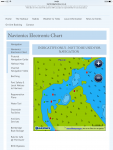
I asked a similar question to this a while ago. It was prompted by the Navionics chart that is shown on Bembridge harbour's website which has loads of detail on drying heights. I can't get this on my Navionics chart and I am still none the wiser about how to get it.
 

Attachments

  • IMG_0068.PNG
    IMG_0068.PNG
    367.6 KB · Views: 4
I asked a similar question to this a while ago. It was prompted by the Navionics chart that is shown on Bembridge harbour's website which has loads of detail on drying heights. I can't get this on my Navionics chart and I am still none the wiser about how to get it.

That's almost certainly just the standard Navionics chart, not Sonarchart. The standard chart has drying heights, Sonarchart does not.

How you get it depends on your plotter. On my Raymarine I go to presentation->chart selection from the menu and select which chart I want (standard Navionics, Sonarchart or Imray raster in my case). Don't know about other plotters.
 
That's almost certainly just the standard Navionics chart, not Sonarchart. The standard chart has drying heights, Sonarchart does not.

How you get it depends on your plotter. On my Raymarine I go to presentation->chart selection from the menu and select which chart I want (standard Navionics, Sonarchart or Imray raster in my case). Don't know about other plotters.

It is, yes. A great example of where you want the information on depths that are less than (above) CD as well as deeper than it. There's loads of ground there that you can sail over in half the tide - but Navionics' SonarChart overlay removes it all.

Regular Navionics chart... ... and SonarChart.
Screen Shot 2017-10-17 at 21.37.46.jpg Screen Shot 2017-10-17 at 21.37.52.jpg

Now why would they do that?!

If you download SonarChart info onto the CF card in the old ('classic') Raymarine plotters, it's visible by turning on the fishfinder layer under the Data menu (presumably unless you've installed a fish-finder sonar).
 
Top