Nasa paddle log

Crinan12

Well-Known Member
Joined
6 Mar 2019
Messages
606
Visit site
Having a strange issue with my nasa speedo/log thing

It doesn't ever work at all when sailing /motoring. Just registers zero.

But when i swim down under the boat and spin the log i get a speed registering no problem

I've pulled the log and when spinning the wheel it works fine

I've checked the alignment - arrow facing forward, turn 180 degrees etc. But nothing. And i hadn't touched it since it was working previously anyway, it's not a new installation

Anyone know what the issue might be?

Everything is clean

Thanks
 
I used to find that after I'd replaced the log paddlewheel at the beginning of the season, or after cleaning it, it sometimes did not spin, but if I turned the paddlewheel in its housing very slightly (i.e. a millimetre or two one direction or the other from the alignment arrow/line) it would get going. Despite careful inspection I never could find any obstruction which would explain why it sometimes wouldn't spin when first inserted but did once tweaked slightly one way or the other, but that action did the trick.

(P.S. Once it was actually spinning the reading seemed correct (given such things are never going to be very accurate), including more or less consistent with an electronic trailing log's readings with which I once compared it.)
 
Last edited:
Spin it and get a speed registering .... mmm but are you spinning it faster than boat would ?

The Nasa Clipper paddlewheel has 2 magnets ... its not unusual for errant pressure washer or whatever to cause one to dislodge and fall out. That then means that at boat speeds - the paddle may register half the speed it should ... when you spin it by hand - you are spinning it faster ... display registers ..

I realise that if boat is doing a reasonable speed - then it should display even with one magnet - albeit half speed ... but some quirk actually can mean it doesn't.

Next time you pull the log - check for both magnets ...

Also having fitted quite a few speed logs over the years ... one thing that I have found - rarely does alignment truly fore-aft mean best ... due to keels and way boats move / part the water - often log needs to be a few degrees of true fore-aft ...
On my previous boat - if I put dead fore-aft ... it really dropped the speed indicated ... (triple keel boat) but turn it slowly from Fore-aft and speed came up to correct.
 
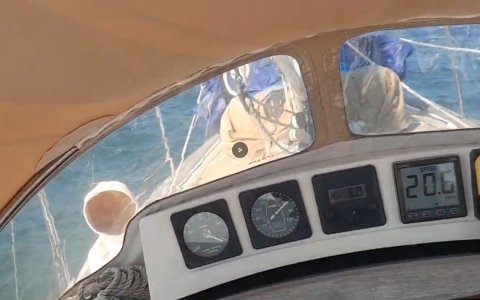
Not any help , however your not alone with boat gremlis. Here's a snap from the other day . I may ignore this fault just to impress. Although ime usually solo lol
 

Attachments

  • Screenshot_20230608-170422_Photos.jpg
    Screenshot_20230608-170422_Photos.jpg
    731.9 KB · Views: 34
Thanks all
I'll have someone turn it when underway and see if i can get a reading

If not will investigate futher

Ta
 
The little paddle wheel is very easily stopped. The tiniest lump on the thru-hull fitting can do it. Lump of A/F? Bit of barnacle? Feather of plastic after too agressive cleaning? Have all happened with my Raymarine. I just leave the thing stopped, and use a trail log. I notice that NASA do an electromagnetic log. now - I wonder if it works as well as the old Seafarer one?
 
I notice that NASA do an electromagnetic log. now - I wonder if it works as well as the old Seafarer one?
It works very well and doesn't foul as easily as the old paddle wheel. It does become less accurate as growth starts but I can usually clear mine with a deck scrubber from the dinghy. It does use a different diameter through hull fitting so not a plain swap.
 
It works very well and doesn't foul as easily as the old paddle wheel. It does become less accurate as growth starts but I can usually clear mine with a deck scrubber from the dinghy. It does use a different diameter through hull fitting so not a plain swap.
This is good news - have one ready to be fitted.

Did you worry about the orientation of the three little pins? Maybe it doesn't matter or they would have mentioned it in the manual. Not getting much luck from the 'info@....' mail address (enquired about current draw - can't be much though).
 
This is good news - have one ready to be fitted.

Did you worry about the orientation of the three little pins? Maybe it doesn't matter or they would have mentioned it in the manual. Not getting much luck from the 'info@....' mail address (enquired about current draw - can't be much though).
The three pins need to be oriented as specified in the installation instructions but the exact orientation isn't critical. The transducer has got an arrow on top that must be oriented 'forward', i.e. in line with the keel. The reading can be calibrated quite easily from the instrument display. Current draw is negligible when compared to the other instruments/gps/autohelm etc. Just noticed the supply current is specified as 80 mA.
I actually use the EML-3 transducer and box (which is the 'pulse' version) with a Clipper Duet display head.
It's worth antifouling the face of the transducer, but keeping the pins clear, to further delay growth.

Instructions...
 
Our stoped working the other year, it was a missing magnet. A new paddlewheel is £8 from Nasa Marine. perhaps worth changing it out and seeing if that fixes it.

If nothing else it gives you the chance to disassemble and give a good clean.
 
Our stoped working the other year, it was a missing magnet. A new paddlewheel is £8 from Nasa Marine. perhaps worth changing it out and seeing if that fixes it.

If nothing else it gives you the chance to disassemble and give a good clean.
If you do buy another paddlewheel, chop the cable off the old one and remove the wheel then you can use it as a plug in the housing instead of the cap. I was never very happy with the screw-on cap as a seal because that relies solely on a thread. If I leave the boat for a week or two, I put the old paddlewheel in then change it back before setting sail. That way I keep the wheel weed free.
 
My NASA log is bonded inside the hull and works fine most of the time. However, when I cross the wake of another vessel it goes haywire and takes e few minutes to settle down. I wonder whether using the NASA in- hull fitting kit will improve things. The location inside the hull is not the problem as an older log in the same place worked fine until old age killed it. Any thoughts?
 
My NASA log is bonded inside the hull and works fine most of the time. However, when I cross the wake of another vessel it goes haywire and takes e few minutes to settle down. I wonder whether using the NASA in- hull fitting kit will improve things. The location inside the hull is not the problem as an older log in the same place worked fine until old age killed it. Any thoughts?


?? Are you talking about speed log or Depth sounder ??
 
The three pins need to be oriented as specified in the installation instructions but the exact orientation isn't critical. The transducer has got an arrow on top that must be oriented 'forward', i.e. in line with the keel. The reading can be calibrated quite easily from the instrument display. Current draw is negligible when compared to the other instruments/gps/autohelm etc. Just noticed the supply current is specified as 80 mA.
I actually use the EML-3 transducer and box (which is the 'pulse' version) with a Clipper Duet display head.
It's worth antifouling the face of the transducer, but keeping the pins clear, to further delay growth.

Instructions...
Great info thanks.

I'll be using the pulse output as well - hooking up to Raymarine i50 tri. That 1k resistor you're supposed to use takes some finding - just taped to the plastic bag as it is!
 
I had a spare new paddle wheel so just fitted that one and wired it up and it works fine
Don't know if my other one wasn't aligned properly or a fault. . I'll try it again sometime but i hate changing them over so it's a job for another day - probably when my current one next breaks.
 
I had a spare new paddle wheel so just fitted that one and wired it up and it works fine
Don't know if my other one wasn't aligned properly or a fault. . I'll try it again sometime but i hate changing them over so it's a job for another day - probably when my current one next breaks.
There are four reasons they fail :

Lost magnet(s)
Worn spindle
Cable fault
Lost paddle or crud

The Cable fault is the worst as it can be a right b***** to find
 
Top