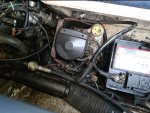
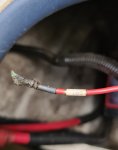
My first boat - buying tomorrow fingers crossed (advice pls)

Red wire possibly was going to battery +ve but your pic does not quite show that terminal to see if there has been something connected. Really need to see where it goes to, possibly the same cable to the right of "2" in pic 2?

Have a check at both the battery and under the rubber caps on the isolator for a broken ring terminal that may have belonged to that wire.

I personally wouldn't go reconnecting it anywhere until you've had a good look at what it could be and checking what does and doesn't work on all the boats systems. If the boat has a bilge pump there will be a level switch to activate it, test that to see if it works, ie lift the switch and the pump should kick in. The picture below shows a typical setup, bilge pump is on the right and on the left is the level switch that activates it (basically the arm floats when the bilge fills with water, a bit like a toilet cistern, and activates the pump. Simply lift that lever and it should set the pump off. As has been said this is probably the only permanently wired connection. There may also be a manual bilge pump switch on the dash.

View attachment 129332

It may also be for something that has been removed so see if you have any stray wires anywhere in the dash/engine bay. You can always check for continuity using a multimeter which would be a useful tool to buy when you own a boat.

There appears to be no inline fuse which should always be quite near the battery/isolator. It was a good call above that it is probably for something that draws quite a few amps, maybe the wire went to an inline fuse originally, strange there is no fuse there, trace it back, it may go to a mini busbar/distribution box. Need a further away pic really to see if it's anything to do with all those relays.


That red wire if it goes straight to the battery could be for a bilge pump or radio memory, whatever it is for it should have a fuse inline if not taken from the isolator switch output side.
It looks like it has just corroded off, see what don't work to start with and if it starts working when dabbed on the battery +, if a bilge pump it will likely have a float switch somewhere close to the pump so won't do anything unless there's water in the hull (or lifted with a finger to test), if the stereo won't hold a radio station when powered off and back on that will be the memory feed.
An isolator key is just that, brand is pretty irrelevant but the ones with a brass pin are less likely to break than a plastic pin, keep a spare on board hidden somewhere.

Yes standard battery isolater key as has been described and the red thin wire will just be to some piece of equipment possibly now removed. Or once you have the red key see what does not work. Have you a depth finder, fish finder or chart plotter on the boat

As for the wire, it probably came off the battery isolator so the circuit becomes live when you throw the switch. You'd need to trace that wire back or see what isn't working to find out what it was for. It might have been for something that has been removed in which case you wont want to liven it up!

Edit: I see the answer has already been posted above!

Posting more photos to try and establish where the wire may go below....
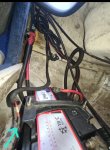
 
Could be anything ,but it looks like it was there when the boat was new rather than added later due to the fact that it goes into that run of cable sheathing.

I'm going to guess at bilge pump at that always needs a power supply regardless of whether the main breaker is on or off.
 
Last edited:
Hi there...great to see you got the boat home safe and sound. looks like lots of great advice given so far too. Excellent to read guys being patient and accommodating to new boat guys.
Please don't take this as a killjoy moment, but looking at your pictures just there...there are a few tell tale signs that this boat may have had a fair bit of water sitting in the engine bay, at a much higher tide than anything normal or expected. There are a few signs of this and water marks around areas, that perhaps shouldn't show it. Don't panic, but I would just double check everything for signs of water ingress. All the electrical connections should be looked over and greased or treated perhaps. If you haven't already, make sure there is no water made it's way into the engine oil or auxiliaries like starter and alternator too.
Make sure she is winterised properly too, given the inevitable February cold spell, we may see. If you need guidance on this, let us know. Plenty on here familiar with these engines. very important to do this, if not done already.
 
QBhoy is quite correct I would give as many of those electrical connections that you can get at a good clean and coating of grease. Loosing a connection when out at sea is not fun. Also spray the engine electricals with WD40 or similar. Some electrical contact cleaner spray is also a useful thing to own.
 
That number tag on the wire was placed by the manufacturer
If you can access the wiring diagram you will get your answer.

Screenshot_20220129-134531_Gallery.jpg
Screenshot_20220129-133942_Gallery.jpg
Screenshot_20220129-134053_Gallery.jpg
Screenshot_20220129-135331_Gallery.jpg

Thanks epic advice.

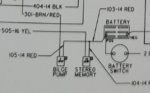
So I've delved through the box of paperwork the boat came with and there are some from 1999 ?. ... found these two manuals too... flicked through and guess what... a wiring diagram...

so 103 appears to branch out into 104 and 105, the stereo memory and the bilge pump respectively (who guessed that already ?).

So I can simply connect it to the positive terminal of the battery?
 
View attachment 129506
View attachment 129507
View attachment 129508
View attachment 129509

Thanks epic advice.

So I've delved through the box of paperwork the boat came with and there are some from 1999 ?. ... found these two manuals too... flicked through and guess what... a wiring diagram...

so 103 appears to branch out into 104 and 105, the stereo memory and the bilge pump respectively (who guessed that already ?).

So I can simply connect it to the positive terminal of the battery?
Yay,my guess of bilge pump was right.

In theory yes,just connect it up. But in practice there may have been an issue with the pump or stereo which is why it was disconnected . Or maybe one of the previous owners wired something else up to the bilge pump wiring.

Because it's factory fit it will already be routed via a fuse, so connect it up ,but be ready for issues just in case. But if all is good ,you should be able to switch the pump on at the override switch or by lifting the float switch.

Sometimes the override switch only works when the main battery breaker is switched on, but the float switch should work regardless of whether the main breaker is on or off. So I'd test it by lifting the float switch.
 
Last edited:
The Stereo Memory would have been wired directly to the Battery so that the Stereo maintained all its tuning once the main Isolator was switched off. In all honesty not that important and that is if you still have the original Stereo which I doubt. Unless boat Stereos are bespoke marine ones they tend to only last 3 - 5 years due to the salt air. I say this because if a new stereo was ever fitted the end of that positive could well be connected or might just be laying loose (hopefully) insulated near the stereo.

What I would do is before you connect the red wire. Switch on the Bilge pump assuming you have a switch, Pour some water into the Bilge so that if the bilge pump has a float switch it will activate. Then just touch the red wire to the Battery terminal and see if the pump fires up.

Please remember however that with boats of this age both the Stereo and Bilge pump could have easily been replaced at least once since it was new and sometimes people wire the new stuff up in completely different ways.

As for maintaining radio tuning and automatic bilge pumps etc my thoughts are that when I leave my boat I want all electrical items turned off.... Why because it can easily be many weeks or indeed months between use and the last thing you want is turning up to your boat turning the key and you have a very weak or flat Battery........ As a friend once said to me you cant push start a boat ;) .

Also if a Battery ever goes completely flat it can be revived to a degree for certain uses but that is a 'damaged' weak battery which is not a good thing to have on a boat.

On my boats of this size one of which is kept on a mooring I have a second battery on the opposite side of the main battery sitting there doing nothing, connected to nothing should I need it.
 
Last edited:
As for maintaining radio tuning and automatic bilge pumps etc my thoughts are that when I leave my boat I want all electrical items turned off....

Hmmm, of course its a free world and that is your choice, but I'd rather the chance of coming back to a boat with a flat battery because the bilge pump drained it by pumping water from a leak overboard than a boat 6 feet underwater but with a fully charged battery. Appreciate its not as black and white as that really, and a single boat battery wont be able to run the blige pump for long, but I'd still rather give the boat a fighting chance of being floating still (or possibly just being floating for longer would be enough for someone to notice a problem and sort it ) in the event that it springs a leak, rather than sunk because I disabled the bilge pump to save the battery.

Thats why the bilge pumps are wired to bypass the breaker switch, so they always have power should they be called upon.

The stereo - fair enough ,thats optional.
 
Hmmm, of course its a free world and that is your choice, but I'd rather the chance of coming back to a boat with a flat battery because the bilge pump drained it by pumping water from a leak overboard than a boat 6 feet underwater but with a fully charged battery. Appreciate its not as black and white as that really, and a single boat battery wont be able to run the blige pump for long, but I'd still rather give the boat a fighting chance of being floating still (or possibly just being floating for longer would be enough for someone to notice a problem and sort it ) in the event that it springs a leak, rather than sunk because I disabled the bilge pump to save the battery.

Thats why the bilge pumps are wired to bypass the breaker switch, so they always have power should they be called upon.

The stereo - fair enough ,thats optional.

Or you could of course have covers that fit your boat properly so that the water sheds off the boat. This is what I have done now for about 6 years on a swing mooring. Never got to the boat and there is water in it. Seagull crap yes plenty on the covers but no water in the boat.
 
Or you could of course have covers that fit your boat properly so that the water sheds off the boat. This is what I have done now for about 6 years on a swing mooring. Never got to the boat and there is water in it. Seagull crap yes plenty on the covers but no water in the boat.


I wasn't really thinking of rain water, that can be mitigated against by decent covers as you say, I was thinking if a thru hull fitting fails ,or the outdrive bellows fails letting in water.

I know it's unlikely but these things do happen.
 
Ref post592
Do not as suggested "just touch the wire to battery."
All items in the engine compartment were originally supplied "spark protected" fuel vapours + spark = boom!.
Seen it happen several times.
Be careful make sure there no vapours in bilge.
 
I wasn't really thinking of rain water, that can be mitigated against by decent covers as you say, I was thinking if a thru hull fitting fails ,or the outdrive bellows fails letting in water.

I know it's unlikely but these things do happen.
I had a 22ft sterndrive boat sink in 20ft water because the bilge pump was not working .
 
I had a 22ft sterndrive boat sink in 20ft water because the bilge pump was not working .
Yep, it does happen. Fortunately it hasn't happened to me,but I would never disable the bilge pump ,I'd always want the boat to be given a fighting chance.
 
Top