Musings on anchor trip line

I'm always surprised at how many of noelex's anchor photos show some sort of stainless swivel attached directly by its jaws to the anchor. Generally accepted as very bad practice. Not suggesting that they are photos of his own anchor.....
 
I'm always surprised at how many of noelex's anchor photos show some sort of stainless swivel attached directly by its jaws to the anchor. Generally accepted as very bad practice. Not suggesting that they are photos of his own anchor.....

Yes, attaching the swivel directly to the anchor is very common. As you point out this is bad practice for most swivel designs. The problem is that the jaws can be subject to a high side load in some situations.

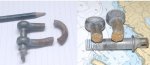
You can see on this swivel a previous side load has distorted the swivel jaws. This swivel should be replaced and connected with a few links of chain between the swivel and the anchor to allow some articulation.

If the swivel breaks, not only is the anchor probably lost, but the resulting drag will be much more rapid than a normal drag where the anchor is attached and still providing some resistance. The risk of damage is higher.


IMG_0639_zpsydls59uj.jpg
 
Last edited:
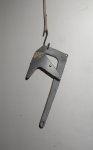
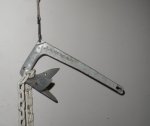
This is a common system that has advantages such as keeping the trip line away from props, but if anchoring in foul ground it is not quite as reliable as a conventional trip line attached to an anchor float. There are times when the above method will not work.

Consider these two real life underwater situations where an anchor is caught. A conventional trip line and float would work in both. A trip line cable tied to chain would work in the first situation, but I suspect not in the second, at least not without a lot of difficulty getting the trip line past the mooring block.


IMG_0637_zpssimvsm4d.jpg


IMG_0636_zps2aaj9l4e.jpg


Both systems tend to fail in situations like this where it is the chain rather than the anchor that is caught, but with a conventional anchor trip line and float you have some hope if there is enough free chain to enable the anchor to be brought to the surface and unshackled.

IMG_0638_zps9cytudc4.jpg


In summary, if anchoring in possible foul ground a conventional trip line attached to an anchor float is the most reliable method, but steps should be taken to eliminate the danger of catching the float and unintentionally tripping the anchor.
To be honest I can't see that I (a frail old man) would have any difficulty raising the anchor shown in your photos using my Lofrans Royale manual windlass, without any need of a trip line. If I didn't have the windlass I would haul taught at low water and let the rising tide dislodge the anchor, and if there was no tide a tackle clapped on the cable would do it.
 
To be honest I can't see that I (a frail old man) would have any difficulty raising the anchor shown in your photos using my Lofrans Royale manual windlass, without any need of a trip line. If I didn't have the windlass I would haul taught at low water and let the rising tide dislodge the anchor, and if there was no tide a tackle clapped on the cable would do it.


The anchor in the first photo is not only jammed under a mooring chain but also under a rock. This photo makes it clearer:

IMG_0640_zpsw7hhfely.jpg


I dont think the anchor could have been lifted with a pull from the conventional direction even using engine power or yacht momentum to try and break the rock (which is better than trying to use the anchor winch).

Using the tide to provide extra force is a trick worth knowing about, but you need to consider the strength of the bow roller/cleats and even chain, especially if there is any wave action. Ultimately, even using this method, the maximium force is limited by the buoyancy of the bow. I suspect in this case the strength of the rock would have been greater, but this is speculation.

In the situation shown in the photo pulling the anchor out backwards would require little force and is the preferred option.
 
The anchor in the first photo is not only jammed under a mooring chain but also under a rock. This photo makes it clearer:

IMG_0640_zpsw7hhfely.jpg


I dont think the anchor could have been lifted with a pull from the conventional direction even using engine power or yacht momentum to try and break the rock (which is better than trying to use the anchor winch).

Using the tide to provide extra force is a trick worth knowing about, but you need to consider the strength of the bow roller/cleats and even chain, especially if there is any wave action. Ultimately, even using this method, the maximium force is limited by the buoyancy of the bow. I suspect in this case the strength of the rock would have been greater, but this is speculation.

In the situation shown in the photo pulling the anchor out backwards would require little force and is the preferred option.

Doesn't look like a very clever place to anchor. My Fishfinder wouldn't allow me to anchor there.
 
AND make sure the shackles are off adequate strength and the tested variety - Winchard?.

'Off the shelf shackles' from the local chandlery are of unknown quality. Here is 10mm shackle, new that season:

View attachment 61360

The best shackles easily available in the UK are Crosby G209A - available from Tecni (www.tecni,eu). The alternative would be Campbell but I don't know how you would source them. Van Beest Green Pin shackles (Grade A) are good, but not as good as Crosby nor Campbell Grade B shackles. Do not buy CMP Titan's Grade B shackles, aka Black Pin, they do not meet their own specification. Witchard shackles will distort long before they break (and would then need bolt croppers to release). Most stainless shackles are not tested, will bend like spagetti and will fail at low load.

There is no point in having G30, G40 or G70 chain that has been tested by the manufacturer and then using a shackle that is questionable, of unknown origin or one that is undersized.

Swivels are totally unnecessary, gravity and torque will remove any twists in the chain and swivels do not work 'on the seabed' - not enough torque. Most swivels are not tested.

Jonathan
 
TQA,

That's quite a long tripping line - or do you need that length so that you account for possible depth of water plus freeboard plus getting the line to a winch? I assume its 'simple' braided dyneema, no cover and maybe 5mm?

To me your way is certainly one of the simplest.

The downside, that I can think of, are twists due to wind/tide (then maybe a buoyed line might be better) but it does not have the downside of getting round anyone's prop or being picked up as a mooring.

Jonathan

Chag is 50 55 ft. English Harbor about 40 ft.
 
Doesn't look like a very clever place to anchor. My Fishfinder wouldn't allow me to anchor there.

There was some nice sand available in the anchorage. This is our Mantus in the same bay:

IMG_0641_zpsq5oyghrr.jpg


Rock of the type shown in the earlier photos is a very poor substrate. Not only is there a risk of the anchor getting caught, the holding is very erratic. The anchor can sometimes grip well, perhaps with toe wedged in a crevice, but a slight change in the direction of pull can see the anchors holding ability drop to next to nothing.

Despite these limitations many skippers, in this anchorage dropped the anchor on this type of rock when there was good sand availible only a short distance away. In fairness even with the clear water, the difference in appearance between the rock and the sand was difficult to pick standing on the bow. Both were a very similar colour.

There are clues that can be used to differentiate the substrate when anchoring. Perhaps we should place more emphasis on this skill?
 
Last edited:
I had always understood the technique mentioned by Gladys as:

Shackle chain to anchor as per normal. Run chain along shank to crown with light cable ties. Use a stronger cable tie at crown. Run chain back to shackle, attach with stronger cable tie.

For anchoring under normal conditions the stronger cable tie at the shackle is the one that is being used - but in the extreme, anchor stuck, it will break when loaded. You then manouvre the yacht such that the chain is pulling the anchor out backwards, so less tension on cable tie at crown. Hey Presto.

Personally I'm not keen, cable ties are not that reliable but more importantly you have the excess weight of the chain in the wrong place on the anchor - which to me suggests the anchor will not set correctly. The issue then would be not an irretrievable anchor but a dragging anchor.


If I had doubts (and no better solution is suggested) - I would stick to the buoyed float, carefully marked. "This is the anchor buoy to the cat anchored near you DO NOT TOUCH' - marked on a bit of board. However as we so seldom see other yachts where we cruise its not a major issue.

Jonathan

Edit I had also read somewhere of shackling to the crown and then using a cable tie at the shackle point (I assumed it was some sort of editing error), but as Richard, below, and BBG, above, suggest this simply cannot be workable (is unsafe, for the reasons outlined by BBG) and still adds the weight of the chain to the shank.

close edit

I believe the best attachment point for the tripping line is not the crown but rather the back edge of the fluke. Some anchors have a hole there, or you can add one. Better angle.

I only use a tripping line to mark locations when testing. But when I do, I use yellow gill net floats. Everyone knows to stay away from those!

tripping%u00252Bline%u00252Baft.jpg
 
Last edited:
The best shackles easily available in the UK are Crosby G209A - available from Tecni (www.tecni,eu). The alternative would be Campbell but I don't know how you would source them. Van Beest Green Pin shackles (Grade A) are good, but not as good as Crosby nor Campbell Grade B shackles. Do not buy CMP Titan's Grade B shackles, aka Black Pin, they do not meet their own specification. Witchard shackles will distort long before they break (and would then need bolt croppers to release). Most stainless shackles are not tested, will bend like spagetti and will fail at low load.

There is no point in having G30, G40 or G70 chain that has been tested by the manufacturer and then using a shackle that is questionable, of unknown origin or one that is undersized.

Swivels are totally unnecessary, gravity and torque will remove any twists in the chain and swivels do not work 'on the seabed' - not enough torque. Most swivels are not tested.

Jonathan

Agreed
 
I believe the best attachment point for the tripping line is not the crown but rather the back edge of the fluke. Some anchors have a hole there, or you can add one. Better angle.

View attachment 61371

I agree, decent anchor have a hole there already, though these holes (at the rear of the fluke plate) can be a bit skinny, Rocna and Spade come to mind. You could get some dyneema in there and I would think that should be strong enough. For anchors like the SARCA Excel you could attach to the cross beam under the fluke. Other anchors have a hole where the shank interfaces with the fluke and that is as good as anywhere (as I cannot suggest drilling a hole unnecessarily as if nothing else it will develop unsightly rust). But high up on the crown, roll bar or that 'mysterious' hole (what is it for?) high up on the shank , simply introduces a turning moment, reducing the chances of success.

Jonathan
 
^^ The Claw with the hole is one that was used in testing of rigging methods, and the picture was one I had handy. I am NOT suggesting drilling holes willy nilly and I would not drill a hole in a Claw there. But it does illustrate a nice contrast to this.
tripping line crown low res.jpg
 
I'm always surprised at how many of noelex's anchor photos show some sort of stainless swivel attached directly by its jaws to the anchor. Generally accepted as very bad practice. Not suggesting that they are photos of his own anchor.....

Certainly that is my viewpoint. I have recently answered a query from a reader who was advised by Jimmy Green that they had no knowledge of this practice and thought it was unnecessary.
 
Given the conservative nature of yacht owners - why has the use of swivels become so widespread? I don't recall a significant series of articles nor advertisments advocating their use. They are not particularly cheap so why have they become so widespread.

If you think of rated shackles, cheaper, better, available everywhere - yet on my own assessment less common than a swivel. If you think of the 'marketing of the modern anchor - heavily covered by every magazine, huge forum coverage (admitedly expensive compared to a swivel - but a considerably more useful) but still CQR/Bruce/Delta dominate.

Yet the useless and potentially accident prone swivel has been successful

One of the mystery successes of marine marketing.

Jonathan
 
Given the conservative nature of yacht owners - why has the use of swivels become so widespread? I don't recall a significant series of articles nor advertisments advocating their use. They are not particularly cheap so why have they become so widespread.

If you think of rated shackles, cheaper, better, available everywhere - yet on my own assessment less common than a swivel. If you think of the 'marketing of the modern anchor - heavily covered by every magazine, huge forum coverage (admitedly expensive compared to a swivel - but a considerably more useful) but still CQR/Bruce/Delta dominate.

Yet the useless and potentially accident prone swivel has been successful

One of the mystery successes of marine marketing.

Jonathan

Bling!
 
Top