Morse cables

Neeves

Well-Known Member
Joined
20 Nov 2011
Messages
14,070
Location
Sydney, Australia.
Visit site
Just a post on observations

We have just broken our second Morse cable. The first failure was at about 1,500 hours and was the cable controlling the sail drive the second failed at about 3,000 hours and was the cable controlling throttle. Both cables were original Volvo branded cables. Both cables failed at the junction of the 'solid' rod at the end of the cable where the wire is inserted in the rod. Both failed at the junction of wire and rod, one at the sail drive one at the controller.

When the first failed we were 20nm down river of a chandler and we devised a method of controlling the sail drive using kevlar string and tiny dinghy blocks run through the aft cabin hatch and the covers over the engine removed. Having had a failure we bought a further cable for the same engine (the cables for engine throttle and saildrive are the same design) and we bought another spare cable for the other engine - which is much longer. The cables are Japanese and the long cable red and the short ones blue. Fitting the short cable for the sail drive was easy you just needed patience. The second cable, a long one, has just failed and we have spent the day replacing it - it has taken most of the day (as the helm is to port and the engine to starboard). When I came to the final connection - I couldn't - the fittings on the blue cables and our Volvos, are metric and on the red cables imperial. Tomorrow I will need to cut new metric threads on the cable to fit the Morse controller. Not a big issue (the imperial threads are bigger than the metric threads) but just a surprise. The cables were bought in Tasmania and we are a metric country (or sort of) though I am aware that Japan has stuck more to imperial measures.

Now I know I should have checked - but why would you....?

Just a note of caution.

Jonathan
 
Good post, and how many of us do check? As a sort of relative counter (in miles), as an average a car travels 30 MPH, so your cable has lasted 'about' 90,000 miles/150,000 Kms. in an extremely harsh environment, which changes nothing of course!
 
the fittings on the blue cables and our Volvos, are metric

Please double check this, as in my experience the thread on the Volvo cables is not actually metric (even if it might take a M5 nut).
If I remember correctly the thread is called 10-32 or something similar.
 
Good post, and how many of us do check? As a sort of relative counter (in miles), as an average a car travels 30 MPH, so your cable has lasted 'about' 90,000 miles/150,000 Kms. in an extremely harsh environment, which changes nothing of course!

I had not looked at it in that context :)

However I have wondered

Is there any use for a failed Morse Cable, or parts of a Morse cable?

Jonathan
 
Please double check this, as in my experience the thread on the Volvo cables is not actually metric (even if it might take a M5 nut).
If I remember correctly the thread is called 10-32 or something similar.

You could be right :(. All I know is that the two cables have totally different threads on the end fittings and I assumed one, Volvo, must thus be Metric (M2 or m3) and the other Imperial. Its not an M5, but smaller.

I have tried to make my life as simple as possible and if I can I only using metric threads. Australia is largely metric so I have focussed on M1 - M? etc. I only have metric dies and taps and don't carry any other threads with which to compare (but am aware there was a whole host, or a few, Imperial threads.

In this instance its only actually relevant on the fittings for the controller.

But now you mention it - I was going to make new threads at home - its easier. But now I'll take my taps (and dies) and check and do it on the boat (or not) as the case might be. This was all meant to be simple - except I knew that the removing of the old cable and threading of the new one might be grounds for divorce - and I was very careful.

How perverse not to have a standard thread. :(

Jonathan
 
Last edited:
Thanks for posting. I naively assumed they were like brake cables on bikes and never really looked. I do know where they terminate, but hadn't considered the attachment methods. I did have an issue this summer with the outboard where I ended up stripping the carb 7 times, each of which I had to remove the throttle cable which became less and less happy going through the fitting each time. This resulted in carrying a proper cable cutter on board to neaten the end. If only there were some list of all of the jobs and tools we might need on board ahead of time!
 
The nice thing about diesel engines are that the controls are very simple - the cables simply pull a lever, and I think they are all sprung. So you can bodge a 'get you home. - if you have kevlar 'string' or even copper wire and some small blocks. The gear change on the top of a sail drive is not sprung - so you need to bodge up for both forward and reverse - but it is possible. I'd not want to do it in the middle of bad weather as working and tweaking string and little blocks over a diesel engine could be unpleasant - but if needs must - it is possible.

Because of lack of focus, or more important worries - would it all really work? - I didn't take pictures.

The size of Morse cables is printed on the outside cover - its worth taking time to find the size and note it down - as if it does fail you know exactly what length you need as when it fails you want the information NOW - not when you have crawled around in the dark with a measuring tape :(
It was nice to be vindicated after 10 years that laying in stock of spare cables was the right decision. :). 10 years ago the short cable, 15', cost stg22, it had the label still on it - not a big investment.

Also about 10 years ago we had a steering cable fail. I had laid in a cable for our bowsprit, having broken one. Coincidentally the two cables were very similar and I simply used the rigging cable to replace the failed steering cable. I phoned ahead to a chandler we would pass on the way south and they had another bowsprit cable ready the following day. Fortunately though we were hand steering we could replace manual work by simply punching buttons on the autopilot that acted on tillers on the rudders and did not rely on the wheel. Sometimes disaster turns out to be less than dramatic.

In real life, as opposed to sailing - I am much less prescient but more cautious over things marine.

Jonathan
 
We snapped the throttle cable during my Day Skipper course years ago. I gerry rigged a bit of string to get us home as there were no spares available locally. when it snapped we were manoeuvring in a marina and I dashed down and operated the throttle by hand with voice calls relayed from the cockpit. All jolly good fun. They nicknamed me diesel Dave for the rest of the course! :)

Having served as a flight engineer for many years it was actually second nature to me but I didn't let on. ;-)
 
I had not looked at it in that context :)

However I have wondered

Is there any use for a failed Morse Cable, or parts of a Morse cable?

Jonathan
I collect them, take out the middles. Good stiff stainless wire, useful for push/pull throughs, making nappy clips, key rings, split pins, and seizing mooring shackles.
 
I'll have an update on sizes and hopefully some pictures later today or tomorrow.

I have confirmed that Baba Yaga is correct - the threads are Imperial (but might fit a metric M3 or 4).

I don't see them in our local chandler in Australia - but have not looked. They come in a myriad of lengths - and really its unrealistic to think a chandler will stock all the lengths. I don't know who stocks them. Its not only what length you need but where are you going to get one. The obvious answer for part of the problem is to take pictures before you disassemble, take apart, pull through with a mouse line (which I did not do) then take the cable with you when you source a new one, checking the end fittings are the same thread. The cable diameters are also different as the engine stop cable is smaller and the diameter is important (I don't know if critical) as the end of the cover is locked so that it does not move when you operate the throttle (or gear). You could bodge the locking of the cable cover but not the attachment of the inner wire on the lever of the controller.

Its a real can of worms.

Jonathan
 
In the end I found a matching thread of a bolt took the bolt to a marine whoesailor and asked them to match the thread.

The device I needed is like this

Cable End Fitting

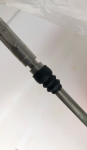
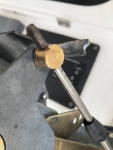
The threaded hole fits on the threaded end of the cable and the little pin fits in the control mechanism, throttle,gear, engine kill. I think these fittings are universal for morse cables and come in various sizes. This device secures the wire that runs down the middle of the cable (the bit that does all the work). The case is secured on our Volvo controllers by a cotter pin shaped a bit lie a Kirby grip (hair grip). It fits through a slot and matches a waist in the stainless steel end fitting on the end of the cable. Its a devil to match the waist in the end fitting with the slot in the controller fitting. If you look at Fisherman's link, previous post (above) the cotter pin fits in the little groove at the lower of the black rubber sleeves. Our cables are identical to those shown in Fisherman's link. The rubber caps hide the threaded portion to which the device in my link fits. Fisherman's cables are identical, as far as I can make out, to Volvo cables.

I did not fit the cotter pin correctly and need to go back to the boat tomorrow - we have had 35 knot winds across Pittwater and it became uncomfortably choppy (I was surfing in the dinghy going home).

It might depend on the yacht but its significantly easier to replace the cable with 2 people.

The engine end of the fitting is secured with a cable end fitting the same as the one above and the cable cover is simply clamped with a plastic fitting and 2 two bolts. The plastic is made for a specific diameter of cable but our cable is bigger by about 2mm but still clamps tight.

I asked about cable life and the suggestion was 10 - 20 years but shorter for long cables and cables exposed to seawater.

I did a Google search for cables - and in Sydney there are a number of sources (so I assume similar in the UK) but there is an infinite variety of sizes. As I mentioned - if you can take the old cable with you and ask for a match. If they don't have a match get the closest - but make sure your end fittings (which you will take with you as you released them when you took out the old cable) and make sure they fit or source new end fittings.

Its a very simple concept - but very fiddly to connect up. The cables have the flexibility of a game fishing rod, the interior of the controller is convoluted and not for big fingers and the fittings are all tiny 3-5mm. At the engine end our throttle is along side the dip stick and frustratingly tight to fit a small 4mm nut. It will take the 2 of us 8 hours to fit our cable (now that we have all the bits and pieces). The cables are long but the components tiny - accept you will drop something - make sure you have something to catch the pieces. Having a decent torch is useful - you lose things in the shadows.

Its a good thing they have a life of 10 - 20 years.

Jonathan
 
Last edited:
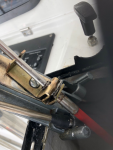
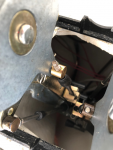
This is part of our controller into which we were installing the new Morse cable.

The controller is supplied by Volvo, it says so on the exterior cover, but I assume actually made by a subcontractor.

The cable is secured in that odd ‘Z’ shaped piece of metal plate. It rotates on the silver metal stud. The cable passes through the ‘z’ shaped part and is secured with a bent pin, cotter pin, but shaped like a hair grip. It is decidedly difficult to insert. The handle top right is the kill switch. It is also a Morse cable but much finer wire.

IMG_2526.jpeg


The hair slide device locks onto the waist, groove, in the rod. You need to get the waist in the right place, but cannot really see it. A torch comes in handy. At the engine end of the cable the cover is also secured but with a simple piece of plastic and 2 small bolts (as I mentioned - ours is up against the dip stick and difficult to get a spanner on the nuts). This is the waist on the cable that secures the cable with the cotter pin
IMG_2523.jpeg

This is the key component and fits with a little rod, hidden, into a plate on the controller. It is threaded to take the end of the cable. The little pin is secured with a simple cotter pin. On the engine the same sort of device is used but it is threaded and secured with a bolt.

IMG_2527.jpeg


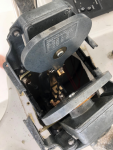
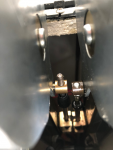
We have 2 engines with 2 controllers. The controllers sit face to face. The upper one (on the picture), has the gear controller on the left centre and the throttle controller at the bottom of the plate

IMG_2529 2.jpeg


There is very little room to work between the 2 controllers. I have used a cotter pin, hair grip type, to hold the brass fitting to the controller plate, gear change cable at the bottom of the picture.
IMG_2530.jpeg


IMG_2532.jpeg


If you are replacing a cable it seems better to connect up at the controller first. You can then set the controller at min revs and attach the engine end of the cable on the lever arm on the engine - at the end stop for min revs. Its easier to make adjustment for length at the engine - where there is more room.

Jonathan
 
Top