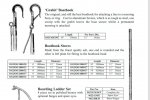
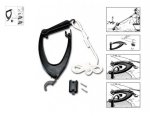
Mooring!

Goodness me, I remember using one of those in the 1960's. It did work well but I have not seen one for decades.
They were available until fairly recently, I think. Simple, reliable technology - I'm surprised that they have been replaced by fiddly plastic things.

I also have a proper Davey Grab-It (twenty quid on eBay) but that's far too good for use afloat so I keep it in my workshop and genuflect in its general direction from time to time.
 
Hoops !! :D
The French love them.
Bit like Moules & Frites
Go well with bouncy finger pontoons.
Ah! Bloody hoops.
I hadn't realised Levington thinks it's in France...

But thanks for the grapnel tip, that'll make life easier at SYH until they finally join the 20th century and fit cleats throughout.
 
Last edited:
Lot of Swedish boats have long poles with auto clips on the end, other end the mooring line ... they use them to make fast stern line to the buoy that holds them off the pontoon. Also used at times to clip to pontoon rings etc. The pole is part of the mooring line. Horrible things IMHO ... but they like them.

I have a bit of kit that people laugh at - but it works .... its the plastic version of the Moorfast ... called the Jolly Hooker. Always makes me think of the book 'Happy Hooker' .... OK - lets leave that one alone !
It may be a bit of plastic - but used properly it works. Mines already many years aold and still good as new. It can be unclipped reverting the boat hook back to normal.
 

Attachments

  • Jolly hooker.jpg
    Jolly hooker.jpg
    47.1 KB · Views: 8
Three booklets of PBO articles by John Goode and Dick Everitt, entitled 'Handling Under Power' , and 'Stress- Free Sailing' by Duncan Wells, will tell you all you need to know.

Also, a day out with a good instructor would help.

I followed your recommendation and bought Stress Free Sailing. It’s utterly brilliant.
 
I’m busy digesting these.

Essentially
make a plan
execute it
if it flounders back out and start again with an amended plan.

Some of the rope suggestions sound useful.

THANKS ALL.
 
Suggestion: I find it very much easier to get alongside a finger which is on the outside of the final turn, to as my preference is port side to I'll try, when possible, to make a turn to starboard into the slot, even if it means going past it, turning round and approaching from the other direction. This particularly helps if the wind is blowing me off the finger.

This is high-bow, long-keeler talk and may not help, but I thought I'd throw it in.
 
known as an open berth. You’re describing exactly what RYA instructors teach, turning a closed berth into an open one by going past and back
Not so easy if, like ours, the berth is almost at the end of the alley. I turn to starboard into the berth and my slight prop walk assists, giving a kick to port ahead and to starboard astern. With most winds this is straightforward but occasionally a northerly will make it hard or impossible to safely tie to the finger. There are only a couple of berths past ours and with saildrive there is certainly no room to turn, leaving no alternative to a robust approach. There is just enough room for me to back off if needed and let the boat turn stern into the wind for an escape and another attempt.
 
with saildrive there is certainly no room to turn

I don’t think that’s a saildrive property - I have a saildrive and can turn on the spot in calm conditions by throwing lumps of water at the rudder and then giving a short burst of reverse to prevent the boat moving forward.

Pete
 
At the outer end of the finger is a horizontal loop of plastic covered steel tube to which you secure your stern line and spring. The steel tube is usually of such a large diameter that the jaws of my Grabit boathook and Moorfast line threader don't open wide enough to pass over it.

Duncan Wells illustrates using a grapnel in his book, but I haven't tried that; PVB's method is so simple


View attachment 119662
Those are the fancy long(er) ones. My favs are the short variety with minimal flotation and that rely on being attached to a vessel to provide sufficient buoyancy to support a single human, never mind one carrying two bags of groceries.
 
We nearly always back in due to having a bowsprit now, but even before that in Holland and Northern Europe, because our bow is also 6' high and my wife doesn't participate in high altitude sports or sky diving.

No jumping is permitted on our boat and at over 8t pushing off is pretty ineffectual as well. To add a bit of spice we also have a long keel. When entering port, especially a new one, we have all fenders out on both sides, as well as all mooring lines, including springs, set and ready and all gates open. Our final line of defense is my wife armed with a roving ball fender.

Fitting midship cleats, as others have suggested, has been a complete game changer for us, even though backing in and then steaming forward into the sternline with the wheel towards the finger generally works for us in France. Backing in also gives you more control over your stern on the last stretch when dealing with the type of boxes & pilings system that are common in Northern Europe.
 
Fenders both sides - ie on pontoon side, and also next yacht side. Ropes preferably to midpoint cleats, and ready both sides if you are not sure which it might be needed on as you ener marina.

Practice moving slowly ahead in clear water without losing steerage then stopping her by going astern. Practice tiller over "blat' turns by sudden rev up when boat stationary, then going astern again before she gathers way

And get ideally paid instruction on the tricks of power handling. Just an afternoon should do it.

Sadly having a tubby long keeler I cant go anywhere accurately astern as Laminar does, so cannot comment on the aid such a reversing might give, but I guess my final bit of advise is "know your own boat"
 
Last edited:
Top