Mooring V-strop versus Single strop

Interesting, but it would be useful to know the failure mode of the strop when a boat goes adrift. How often do we replace the mooring strop? A five year old one will surely fail before a new one that's never even been wet. And what about chafe or failure of the deck fitting? Are there any statistics on this?
 
I'm happy to find that my arrangement, a V, is the strongest. An added advantage is that it reduces the swinging in the breeze that cats are prone to, though reduced swinging on our previous monohull.

As far as wear is concerned, any pennant needs regular examination, and my gut feeling is that, with care not to let the pennants get tangled with the riser - it does happen, rope is likely to last at least as long as an 8mm chain, which is what a good number of boats around me seem to use, because you haven't got the constant grinding between the links.
 
I have a chain and a backup rope which are two independent systems. The Y mooring has a single point of failure in the shackle. I don't think strength is an issue as my cleats would fail before the rope but chafe and shackle failure is more likely. A mooring should have a certain amount of compliance to avoid shock loads. My current harbour authority mooring is a concrete block but it is in a sheltered location, When I laid my own mooring I had a 3/4 inch stud link ground chain that would lift offf the seabed in extreme conditions.
 
Interesting yes but to my mind it ignores the vital question of attachments to the boat. In the case of my boat I have a centrally mounted Sampson post which is more strongly mounted than the two cleats on the foredeck (not that these are flimsy I hasten to add). I would think that as a boat veers about on it's mooring using a v set up the strain would be taken just by one cleat- one side of the v going slack the other tightening. So I would rather have the strain taken by my centrally mounted Sampson post than by alternately loaded foredeck cleats.
Yes all boats have different layouts but ....
 
It depends on......

A mooring is not just the item on the seabed or the items attached to the yacht - its a whole system that should be designed as one compatible unit.

The seabed determines the rate of abrasion and corrosion of any steel items on the seabed. Abrasion on the yacht should be minimal, any wear surfaces on cordage should be protected (there are lots of ways). Average weather events and extremes need to be factored in - there is no one right way.

To pick out one part of the whole for examination seems a bit bizarre without defining the whole. The hefty chain and a slightly lighter one, out of sight, took the snatch loads for our mooring (pictured).

Its a bit like an anchor rode, :) - it has to be considered in total. There should be no weak links, everything should fit, every thing should have a similar tested strength etc. (galvanised components are a waste of time on abrasive seabeds - the galvanising will last weeks, not months) - on mud even less.
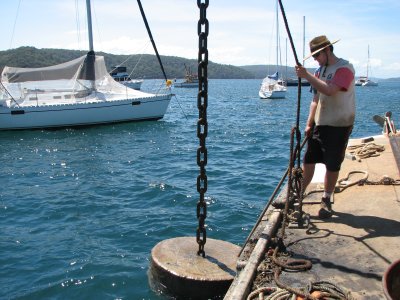
Our moorings in Pittwater, Sydney, had to be serviced annually - with proof of professional servicing.

Often when the concrete block was lifted it would have sand on the top - indicating that over a year the block 'sank' into the seabed.

Failures or wear was from corrosion/abrasion (silica sand). Shackles and swivels lasted about 5 years.


Our mooring was 'designed' by our mooring contractor and was covered by his insurance - any modification by me would negate the insurance. We used a bridle, which was unusual, not many multihulls, but was agreed between me and the contractor. We also had a lightweight pick up strop - easier to handle than the bridle - which was heavy.

Jonathan


40wandeen yachts mooring screen 027.JPG
 
The test confirms the strength of a V bridle or single strop. Even the "weakest" set up (Y bridle) is more than most of us would need for anchoring. If on a permanent mooring, then two separate strops looks like the way to go, although as Neeves and others say the weakest link will doubtless be somewhere else.

I think I will beef up my anchoring V bridle to 16mm 3 strand from 14mm Octoplat.
 
When we had a mooring on Menai Strait our strop was 1/2 inch galvanised chain, replaced every two years. Our contractor would not fit rope strops. The chain ran through the bow roller with a loop on its end that dropped over one of our substantial bow cleats. I would then wind the pick-up line over it on the cleat to keep it all in place.

This is a very testing location for moorings, exposed to the SW/NE with big tides and currents, very windy at times. I have personally witnessed our boat from the shore in force 11 and been aboard in force 10. Despite that, mooring failures were rare
 
I use a single (thick) rope with snubber and chafe protection and if it fails there is a hefty chain riser (swivels included) as backup.

Nothing has ever twisted.
 
We no longer have our old mooring, which was designed and made for a heavy 60ft boat. We're now on a boatyard mooring, which, as far as we are concerned, is an eye on the end of a heavy, and chafe protected rope. As we don't have a substantial mooring point on the centre line, we use two strops of very slightly different lengths (red and green), to take the load to the two bow cleats. This means that the load is always shared equally by the two very substantial cleats.
Edit: I should have pointed out that the eye of the main mooring line is brought up onto the deck, over the bow roller.
 
Last edited:
Obviously, much depends on the deck layout of the boat. This is the most important factor. Chafe is what gets you.

And don't take what I say wrong; I'm glad to see testing.
  • With a y or v you need to expect a lot of single-leg loading during yawing. In other words, both legs need to be as strong as a single line. Also, slack/tight/slack cycling dramatically increases chafe and reduces fatigue life. If the angle of the V is wide enough to eliminate single-line loading, as would be done for a JSD or multihull bridle, the angle increases the force and the rope is still going to be 100% strength. But chafe and tight/slack cycling are reduced.
  • Many of the v bridles are made using a single Brummel. This is only about 50% of the strength of a proper splice and has shown to be a considerable internal chafe point, as the fibers move against each other. I don't know why JG tests did not show this; maybe I am not understanding how the splice was made. A Brummel looks clean, but it is really only about 1/3 strength over time. Numerous high load failures in heavy weather. Better to use two separate lines, seized together to ease handling if you like. By the same token, the Y-splice should have been 96% if properly made. I really wonder if they did not accidentally reverse the results. Or the Y spice was poorly made.
Short term lab testing has value and limitations.
 
Last edited:
Interesting yes but to my mind it ignores the vital question of attachments to the boat. In the case of my boat I have a centrally mounted Sampson post which is more strongly mounted than the two cleats on the foredeck (not that these are flimsy I hasten to add). I would think that as a boat veers about on it's mooring using a v set up the strain would be taken just by one cleat- one side of the v going slack the other tightening. So I would rather have the strain taken by my centrally mounted Sampson post than by alternately loaded foredeck cleats.
Yes all boats have different layouts but ....
I had a similar arrangement on our Snapdragon, with fairleads port and starboard. I took the lines through the fairleads to the Samson post, with a bit of flexible pipe to reduce chafe at the fairleads. If you haven't got fairleads, it's possible you could use the cleats as fairleads.
 
A mooring is not just the item on the seabed or the items attached to the yacht - its a whole system that should be designed as one compatible unit.
Our mooring was 'designed' by our mooring contractor and was covered by his insurance - any modification by me would negate the insurance.


54883087286_9aefd32458.jpg


Seems the fellow is looking rather hard at that well-rusted teensie wee shackle.... As well he might!
 
Last edited:
As far as wear is concerned, any pennant needs regular examination, and my gut feeling is that, with care not to let the pennants get tangled with the riser - it does happen, rope is likely to last at least as long as an 8mm chain, which is what a good number of boats around me seem to use, because you haven't got the constant grinding between the links.
Perhaps our chain is different from yours (we use 10mm), but there's virtually no evidence of grinding of chain links. I'm not sure what its lifetime will be, but it seems like there's very little wear on it except in lively conditions with a boat on it? whereas a rope pennant is sitting slowly rotting/chaffing/becoming a home for sea life 24/7.
 
Perhaps our chain is different from yours (we use 10mm), but there's virtually no evidence of grinding of chain links. I'm not sure what its lifetime will be, but it seems like there's very little wear on it except in lively conditions with a boat on it? whereas a rope pennant is sitting slowly rotting/chaffing/becoming a home for sea life 24/7.
I would put that the other way round.
Chain will rust and wear steadily until it is unsafe. A good quality UV stable length of rope, with suitable chafe protection, will go on and on with almost no signs of damage.
 
Perhaps our chain is different from yours (we use 10mm), but there's virtually no evidence of grinding of chain links. I'm not sure what its lifetime will be, but it seems like there's very little wear on it except in lively conditions with a boat on it? whereas a rope pennant is sitting slowly rotting/chaffing/becoming a home for sea life 24/7.
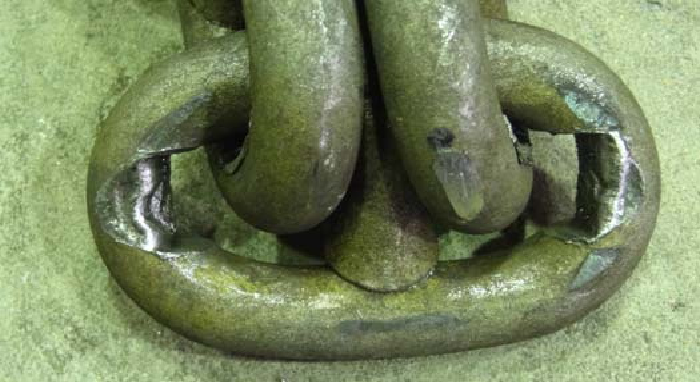
I think I'd describe what happened to this as grinding links.
5-Figure12-1.png

If you want a worse example, there's one at https://kkcl.com.hk/wp-content/uploads/2019/03/Chain_Baddly-Worn.jpg, but for some reason it wouldn't load for me.


I used to reckon that the life of a 10mm chain mooring pennant was a couple of years, three to four if you're lucky, but I kept a close eye on mine after about 18 months.

Yes, I check my rope pennants regularly, but I've yet to see any damage that wasn't self-inflicted. (Pro Tip: driving over a floating mooring line is a bad idea :( I had to cut them off the prop)
 
I think I'd describe what happened to this as grinding links.
5-Figure12-1.png

If you want a worse example, there's one at https://kkcl.com.hk/wp-content/uploads/2019/03/Chain_Baddly-Worn.jpg, but for some reason it wouldn't load for me.


I used to reckon that the life of a 10mm chain mooring pennant was a couple of years, three to four if you're lucky, but I kept a close eye on mine after about 18 months.

Yes, I check my rope pennants regularly, but I've yet to see any damage that wasn't self-inflicted. (Pro Tip: driving over a floating mooring line is a bad idea :( I had to cut them off the prop)
What a most unusual picture! Odd witness marks, even burrs on the link of what appears to be heavy stud-link chain. It's shiny too!
Where is it from?

That exhibited in you other link is my typical of my experiences.
 
Top
