
Mooring Swivel

I can see your argument, but not sure it’s absolutely correct, but it maybe.

When Noelex define his criticism of the Loctite tests done so far, though I am not holding my breath, he can add in an evaluation of thread corrosion.

It is so easy to find fault but ever so difficult to make sensible, realistic recommendations.

Anchor holding capacity testing is constantly criticised - but never has anyone come up with an alternative.

Jonathan
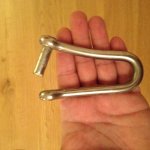
 
We've recently had a boat break free from its mooring where the shackle was still connected but the D had been deformed to such an extent that it came away from the ground chain. The pin was still moused on with monel and tie wraps but the threads had corroded letting the pin pull out

It's surprising how little load is needed to open up a shackle if one end of the pin is able to slide sideways for whatever reason. I once cut off the eye of a 10mm (wire diameter) shackle to let it fit through a narrow anchor roller, not fully appreciating that it was the eye which stopped the end of the pin pulling through. The anchor got slightly jammed on recovery, and the windlass barely broke a sweat bending it open in a split-second:

IMG_0495.jpg

Fortunately I was only testing it while tied alongside a pontoon, and after a rather stressful half hour's fishing was able to recover the expensive new anchor with a Sea Searcher magnet :)

Pete
 
I have tested lots of stainless shackles, 316, and a very common mode of failure is deformation of the eye and thread and the pin pulling out. Those shackle, much loved, with an alan key insert also pull out, the head where the allan key insert is made and the eye both distort. For stainless shackles it is unusual you break the stainless, failure is commonly distortion and pulling the pin out.

The ease with which a stainless shackle distorts is a real issue as once distorted the only way to remove them is to get bolt croppers out. Rated gal shackles should not distort until loaded to slightly less than 2 x WLL - that's part of the spec.

Good galvanised rated shackles commonly show only minimal distortion at failure - the pin simply shears (usually at the thread). But this occurs at or better than their rating.

Side loading is an issue and will reduce WLL and UTS by 50% - I have tested for this and it is correct. It is true of good rated shackles and stainless shackle. So make sure your shackles are free to 'rotate' to allow 'in line' loading.

I have not tested Duplex or High Tensile stainless shackles - they are too expensive and not as common (on yachts, nor chandlers) as gal shackles. If anyone is critical of this omission - send me some shackles (a statistically sound number) and I will test them.

Jonathan
 
Last edited:
Interesting thread.

As I'm from an aviation background I'm familiar and trained with various grades of Loctite - for us it was 221 - undoable in future - or 290 - permanent - and of course wirelocking - mousing in marine parlance.

I use galvanised chain, shackles and swivel ( definitely the weakest link ) throughout as introducing disimilar metals seems asking for trouble - and wirelock / mouse every shackle very thoroughly.

On my half tide mooring the bottom chain and riser go to the underside of a large floating buoy, then through a tube to the top where the largest galvanised swivel I can fit is situated, shackled to the topchain and pickup buoy - which I detach and take home every winter.

I replace the topchain and especially the swivel every 3 years - almost every boat I've known go adrift was due to swivel failure, ranging from just plain wear to the October '87 Hurricane.

I don't bother with Loctite, the way I treble mouse with monel wire is easy to observe and check; I often stay aboard when the boat is dried out on the mooring - something I strongly think other owners on such moorings should do, it's very informative re recent changes in the mud channels too - and check the mooring - I have over-spec topchain, swivel and mooring cleats inc backing pads, but it does help me sleep at night when a gale is bashing against the windows and the boat is 43 miles away.

In the October '87 this approach meant my fathers' boat stayed on this mooring - which we laid as part of a club effort doing several - ( my boat was luckily sheltered in Poole and escaped it ) - would have been spiffing except other boats on less well maintained moorings clobbered my dads' causing serious damage on their way ashore...
 
Last edited:
Here, Pittwater, Sydney, contractors do not use galvanised chain. Its simply a waste of money. It wears off quickly. I can attest to the phenomena as I have taken samples of 'our' anchor chain, 8mm, from a whole range of sources and when leaving it on the seabed to abrade I can remove most of the gal from some chain is 6 weeks. As we are required to service our moorings annually gal protection for 6 weeks is a bit of waste of time.

The key is oversized components from a reliable source. Here swivels and shackles supplied by a service provider will last around 4 years and an annual service gives a safety factor of about 4:1. Sadly some people commonly with small, old, uninsured boats don't service - and we see their boats on the beach - with evidence they have not been serviced as the shackle or swivel has worn - right through - so no failure off a weld, no overly high tension - simple corrosion and abrasion. Both corrosion and abrasion are a function of amount of steel - the more you have the longer it will last.

Jonathan
 
So you use stainless ?

What is the seabed around there, to be so abrasive ?

Sorry about the double ? but I'm intrigued.

The deep mud half tide moorings where my boat is, in fact whole 3 whole harbours inc the Portsmouth naval docks are said to be ' an area of accelerated steel corrosion ' by Portsmouth University Marine Metallurgy Unit.

I have met them and wasn't particularly convinced by some of their theories.

My own - the part of Langstone and Chichester harbours where my club is now, was part of the ' Starfish 16 ' WWII decoy system to lure the Luftwaffe away from the vital Portsmouth docks - a girlfriends' grandfather Robin Milne was a Test Pilot who along with his main job was asked to count the bomb craters in the mud every day to see how the decoys were working.

Even now there are distinct circular spots of even softer mud, making wading around at low tide very dangerous.

So there is a lot of quality Luftwaffe ordnance around involving quantities of magnesium and phosphorus too...

We are also close to very powerful electrical feeds to a large town on one side and a medium size marina - with shore power - as well.

As far as I know the Japanese didn't get as far as Sydney, so that leaves seabed abrasion and any electrical effects going around - how long do anodes - or moorings on boats without them - last ?
 
Not sure where you got the idea we use stainless - simple steel components, straight from the lifting and mining industry. Many of our moorings are deep - our swing mooring is in 10m and our tides are 2m max.

The seabed is silica, quartz, sand. Sydney is built on and was built from sandstone (its now mostly concrete). In deeper water, say beyond 12m, the seabed has more mud (and the contractors are not so keen as the concrete blocks become a devil to extract).

The major factor is abrasion between 2 steel components with the silica as the abrasive medium between them. You can see this from the failed moorings - the inner surfaces are worn, where say a shackle abrades on a swivel but the outer surfaces are polished and clean but suffer only minor wear. So its the combination of the 2 metal surfaces under abrasion and constantly subject to a fresh replenishment of an abrasive medium. Its not a big issue - if the tackle is serviced. A new shackle and swivel cost peanuts.

From memory I think the shackles are peened (is that the correct spelling) as when they replace they cut off with an oxy torch (I'm one of the few who watches our mooring being serviced) and I'm close enough to be able to go and see yachts that have been driven ashore).

The Japanese attacked the harbour from a 2 man midget sub (the wreckage of which they only found recently it is now a war grave). They sank a smallish warship and around 20 men drowned.

Jonathan
 
Jonathan,

I thought ' must be stainless if you don't use galvanised ' - which I'd have thought still worth having.

Peening over bolt ends etc is indeed the term I'm used to.

Interesting re the Jap mini-sub, of course one attacking Pearl Harbour - initiating the first shots of WWII by the U.S. - was discovered recently too.

I have my doubts, but the proximity of the wrecks and any ammo' might be worth a moment's thought re effect on moorings

My 94 yr old father who was a Leading Air Mechanic on Escort Carriers with Seafires and Hellcats in the Med' and Far East* and I still watch documentaries ( usually with cringeworthy mistakes ) and wonder exactly how mad the Japs were; the one photo I've always wanted to see is Hitler's face taking the call from Hirohito - " Great news Adolph, we've taken on America ! "

* My uncle was on another Escort Carrier, at the end of the war they stopped off at New Zealand; he liked it so strolled off the ship - no-one was that bothered, everyone was just glad it was all over - he sorted out the paperwork later and spent the rest of his life there.

The latest news here is that the war grave wrecks of HMS Prince Of Wales and Repulse ( left without air cover by part mechanical failure, largely cockup ) are being scavenged for their propellors and pre-nuclear bomb steel, possibly by Chinese types - the same has already happened here in the relatively shallow North Sea between here and Germany with entire warship wrecks - also war graves - disappearing !

Sorry for the thread drift, but I do have this pet theory that wartime ammunition is not good to have around moorings.

Andy
 
Last edited:
Andy,

To clarify - The Japanese mini sub I think there were 2 and maybe one did not make it into The Harbour - mechanical problems, sank the warship, drowning those 20 on board but also escaped. I think there was a mother sub out in the Tasman and the successful sub was trying to return to the mother ship. Whatever the story it was known she disappeared and was found around half way between The Harbour and Pittwater in the Tasman. It is now marked with a buoy. The 2 Japanese crew were lost with their vessel.

I am sure there is chapter and verse courtesy of Google.

I had read of the looting of the Repulse and Prince of Wales and I have the same views as you. Many of the war graves in the area have been looted - it appears to be a regular industrial scale activity. Given the possible need for pretty hefty bits of kit to make the salvaging successful I find it surprising greater efforts have not been made with satellite imaging to detect such activity.

I too have a very distant family connection, from an earlier time - I have a rather splendid aerial picture of Repulse being fitted out alongside a rather diminutive Canterbury also being fitted out early in 1916 - my Grandfather served on Canterbury, Jutland through to the return from the Allied Intervention (I have a rather splendid silver tray from the Volya, known (I think unofficially) for a short time as HMS Volya), his King's Shilling, medals and the offical collection of photographs, I assume went to all crew.
But this is definite thread drift!

But returning to ammunition and moorings

Pittwater was the site of the RAN's torpedo testing station and is now part of their diving school. HMAS Penguin is at the bottom off our hill and next to where we store our dinghy. But I digress. They used to test the torpedoes by firing them (is that the word?) up Pittwater and then collecting them at the northern end, before they were sent off to submarines (and presumably destroyers etc). They lost 4, would they had been un-armed - but they still lie somewhere on the seabed.

I suspect Hitler's face would have been the 'opposite' of Churchill's.

Enough drift!

Jonathan
 
Back to swivels, shackles etc. I don't use Loctite, indeed I do something which many will consider to be counter intuitive, by smearing all shackle threads with copper grease. Obviously, all mooring and anchor shackles are moused, either with wire or cable ties, or both. Using the copper grease prevents the threads from possible corrosion, and means that the shackles can always be undone when required. My mooring shackles are grotesquely oversize, as my mooring for a 36ft yacht is basically what I previously used for a 60ft MFV. With some shackles, I replace the pin with a (say) 24mm bolt, fit a locknut, then drill the protruding bolt, and fit a splitpin. Belt and braces every time. :encouragement:
 
When we kept our boats on a mooring in Menai Strait all the chain used by contractors was ungalvanised steel, much of it pre-owned by Manchester Ship Canal on lock gates. It seems they had to change it out regularly for licensing reasons. The only galvanised chain we had was the pick up length between buoy and boat. All joints, swivels etc. were welded.
 
Edit If you find fault with the tests conducted, please define in detail - I am always willing to learn and find better ways to investigate.
When Noelex define his criticism of the Loctite tests done so far, though I am not holding my breath, he can add in an evaluation of thread corrosion.

Any testing on marine products, especially anchoring gear, is helpful, interesting and should be encouraged. So I do not feel it is helpful to look for faults, but as you are keen for feedback perhaps I can ask some questions about the study. I am still confused about which specific Locktite product should be used especially on anchor shackles.

Most people seem to use the medium strength Loctite 242 (or the newer version which is 243) when securing anchor shackle pins. User reports are very positive. Vyv Cox has described on many occasions his satifaction when using Locktite 242 to secure his anchoring shackles and swivels. However, your study found even when using two drops of this product, the performance was poor:

“With two drops of adhesive, the Volvo product developed some strength but not enough to inspire confidence in a critical item, like a propeller or anchor shackle pin.”

Have you any thoughts why this discrepancy occurred between the user reports and the test results?

Rather than genuine Loctite 242 you used a Vovo product, which was a re-branded Loctite 242 according to your article. Do you think the genuine 242 would have performed better?

The next product tested was Loctite 609. I had to look this one up as it was a Loctite I have not used. It appears it was designed not for threaded components, but for smooth close fitting metal surfaces such as rotors in electric motors. Yet his medium strength Loctite performed better. Did Loctite recommend this product for shackle pins? Should we be using 609 instead of the more suitable (on paper) 242 or newer 243?

The final Loctite tested was 263, which is what the article indicated you use on your own shackle pins. As this needs a blowtorch to remove it, this would seem less convenient than mousing (although mousing is not possible in some cases). You have frequently advocated choosing the anchor so it ideally suits the substrate in any particular anchorage. How do you make this work with 263? I cannot imagine using a blowtorch routinely on the foredeck when you change anchors, so you must have a different solution.
 
I tested Loctite commonly available in hardware stores in Australia, specifically one we all knew or know - Bunnings. Frankly I don't see any reason why one should need to search high and low for a specific variant (nor do I think it relevant). I am not au fait with what is commonly available in the UK and it would not be relevant as it was for an Australian and US magazine (and the results never published in the UK). I did not check availability in the US either - these were standard stock here, in fact Bunning had no other and the Volvo product is standard in Volvo dealers - whether they tweak the formulation (or have it tweaked) I do not know - its simply a standard product. Whether the, ostensibly equivalent Loctite would perform better, or worse - how on earth would I know (and I certainly would not guess). I assume Volvo provide their product because it fits a cross action of their applications. If it is good enough for Volvo it was worth including and I simply did not bother making a special order for 242 or 243. It is available here from any Volvo dealer - it ease of sourcing made it an obvious choice.

I have a very small blow torch, even smaller than one we use in the kitchen/galley which is part of my 'anchor kit' along with a shackle key, Loctite, different size of shackles (2 of our anchors need 1/2" shackles and 2 need 3/8th" shackles) different snubber 'hooks' (or retaining devices). I have become quite adept at changing anchor - it is not that difficult (if your anchors are lightweight :) ). I have a largish adjustable spanner, along with 2 x knives, 2 screwdriver, common alan keys - within hands reach of the helm - and inside the cabin (does not everyone have the same?). You make changing anchor sound so difficult - its easy.

As an aside - each of our spare anchors always has the appropriate shackle already attached. Our anchor kit contains spare shackles because on a cold wet rough night it is too easy to drop a shackle, or pin, and having the spares handy in a box is convenient. (I know - because I dropped a Crosby pin, and have never got over it!)

The reality is - if we are planning on making a series of changes of anchor I will not use Loctite at all. Simple cable ties will suffice for a days work. If we are making an annual cruise of 2,000nm then I will not be planning to test a series of anchors, nor will we carry them. We will have our standard inventory (Excel, Spade, FX16 and FX37 - all alloy) and one anchor will be a primary and we would expect it to be there for the whole period. The other anchors, as they are all alloy - would be deployed by hand (that's why we have a spare rode). So - 263 for the primary, cable ties for anything short term - simple really. We don't use 242 except when we service our props - and a bottle is kept with the 'prop kit' which needs a rather large socket (unused for anything else).

On a larger yacht with bigger anchors the sensible option is twin bow rollers - it would be part of my standard inventory with bigger anchors. Then the original anchor could be lashed in place and the chain simply swapped to the new anchor (assuming only one windlass). Obviously if you had not planned then taking a large anchor off one bow roller would be a herculean task - so how one, say, deploy a big Fortress would be something to ponder.

I think my and Vyv's results suggest that the specific application area that are defined for each of the product is not so critical but if you can source any of the formulations mentioned - those are the results you might expect.


Your originally criticised statistical significance - this was obviously a red herring No mention of quality and formulation then. No mention of availability or application. You also seem more concerned at how we change anchors.

Feel free to ask more - I am sure there are many more unanswered questions.

Jonathan
 
Last edited:
Back to swivels, shackles etc. I don't use Loctite, indeed I do something which many will consider to be counter intuitive, by smearing all shackle threads with copper grease. Obviously, all mooring and anchor shackles are moused, either with wire or cable ties, or both. Using the copper grease prevents the threads from possible corrosion, and means that the shackles can always be undone when required. My mooring shackles are grotesquely oversize, as my mooring for a 36ft yacht is basically what I previously used for a 60ft MFV. With some shackles, I replace the pin with a (say) 24mm bolt, fit a locknut, then drill the protruding bolt, and fit a splitpin. Belt and braces every time. :encouragement:

Norman,

Trying to be more positive and not nit picking

I hope you are using Grade, or is it Class, 8 or 10 bolts.

Note my comment that shackle pins for good shackles fail by shearing at the thread of the pin where the thread is exposed 'inside' the shackle bow. This might not be unexpected as the thread thins the pin.

An alternative might be to source Van Beest Green Pin Super Shackles. These are Grade B shackles which, certainly for the small sizes 3/8th" or thereabouts, can be around twice the strength of Grade A shackles. The Super Shackles are the same quality as Crosby's G209a shackles (which are better than their G209). To avoid excitement and more nit picking - Van Beest do NOT make a 3/8th" Grade B, I quote that only as an example. If you want a small Grade B, 3/8th", you need source from Crosby (Tecni and others) or Campbell. Van Beest make, very much, larger sizes in their Super Shackles range and they offer this quality with a clevis pin with external nut with a hole through the end of the pin to accept a cotter pin. You can thus use Loctite, red, and a cotter pin.

Van Beest are European based with at least 2 manufacturing sites and as far as I am aware their range of product is freely available in the UK, though possibly not in NW Scotland.

I have used their Omega links from their Excel range (made in France) and their quality has been excellent. They also sell HT chain but my understanding is they merchant that - and I don't know who their supplier might be.

http://www.vanbeest.com/getattachment/aa492c75-5752-4fe6-84fc-b506b6fe93ab/Chapter01-Shackles.aspx

You will need to scroll down to find the Super Shackles and read the small print to find those that meet Grade B specifications. Most rated shackles are Grade A, again sometimes defined in the small print.

Grade B shackles are the best you can source for a galvanised shackle. There are differences in specification sometimes due to differences in safety factor. I've never tested Van Beest shackles, only their Omega Links (both G80 and G100). I have tested Crosby and Campbell 3/8th" Grade B shackles and they both achieve their specified UTS. I have also tested CMP Black Pin and Peerless Blue Pin shackles, both marketed as Grade B shackles. Both failed their own UTS and CMP downgraded their specification accordingly. CMPs Black Pin shackles are better than a Grade A but do not meet the Grade B specification and are not as good as Crosby's nor Campbell's Grade B products.

Jonathan
 
Last edited:
When I destructively tested shackles they failed in every conceivable way, with no obvious pattern. Included were threads pulled away, pin sheared, eye broke off or unrolled itself, the wire of the D broke in the middle and maybe some others. Probably influenced by the manufacturing method.
 
Jonathan, I'm sure all of that makes perfect sense, BUT my wee boat is never going to shear a 24mm bolt.:D

Exactly.
If we are talking about moorings, everything is sized with a generous allowance for corrosion.
Proof testing, certification and QA are out of the window once the hardware has been in the harbour a month.
 
When I destructively tested shackles they failed in every conceivable way, with no obvious pattern. Included were threads pulled away, pin sheared, eye broke off or unrolled itself, the wire of the D broke in the middle and maybe some others. Probably influenced by the manufacturing method.

I agree - most Grade A shackles failed every which way, and Grade A shackles are the common shackle in Europe and Australia. I don't recommend Grade A shackles, nor Grade B wannabes. I recommend taking the trouble to source Grade B shackles, Crosby or Campbell. They are undoubtedly more expensive, they are more difficult to source - but they are a critical link in your rode. The, Grade B, 3/8th" shackle cost stg 10 ?? How much is your yacht worth?

I have images of failed shackle (from others) - failed every which way. I do not, yet, had a failed Grade B shackle, nor heard of one.

Stg10 - too much?

Jonathan
 
Exactly.
If we are talking about moorings, everything is sized with a generous allowance for corrosion.
Proof testing, certification and QA are out of the window once the hardware has been in the harbour a month.


As I have jut said - shackles cost peanuts - the choice is yours

A cheap shackle, a decent bolt - I wonder how that stacks up against a decent shackle - its your decision, not mine.

Good shackles, Grade B, are made from high tensile steel, there is direct correlation between hardness, tensile strength and abrasion resistance. A high tensile shackle, of HT steel, will last longer than a less high tensile strength steel.

Google 'abrasion resistant steel' - look at the hardness, check the tensile strength, compare with milder steels

I'm just a supplier of information, I don't make it up, it is not a guess.

The decisions are not mine.

Jonathan

Edit

Once the hardware has been in the sea for a month, or 6, the high tensile shackle is still made from high tensile steel, but will have abraded less. The less high tensile steel shackle will be relatively 'more' weaker - it was weaker to start with it will have abrade more.

I cannot quite agree with your thoughts.

close edit
 
Last edited:
Top