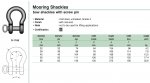
Mooring Swivel

Jonathan, I'm sure all of that makes perfect sense, BUT my wee boat is never going to shear a 24mm bolt.:D

Norman,

I know you know what you are doing. I am sure you have sussed out the issues. You are one whose experiences I respect - you've been there, done that - and no bull.

But someone will read this thread - I'd rather they bought a Van Beest Super Shackle than made a guess and made it wrong. Too many guess - and have no idea.

Jonathan

Edit,

And Norman - your yacht is not wee, and yes (for others) I do know what 'wee' means!, its a decent size and one to be proud of. And you take her to some pretty demanding places - all credit to you.

close edit
 
Last edited:
As I have jut said - shackles cost peanuts - the choice is yours

Good shackles, Grade B, are made from high tensile steel, there is direct correlation between hardness, tensile strength and abrasion resistance. A high tensile shackle, of HT steel, will last longer than a less high tensile strength steel.

Decent shackles don't cost peanuts, mine (BS28 x 32 bow)for instance are £25 each but are drilled and pinned.

Both mooring tackle suppliers I use say specifically to stay away from high tensile steel, the hardness should match the chain. Whilst an HT steel shackle may last longer, the chain will wear more quickly - in the opinion of the experts, not mine.
 
I don't know how much your yacht is worth but are you seriously complaining that the shackle costs too much -

I suppose all off us using HT shackles on our anchors should throw the a shackles away as the chain is wearing faster than the shackle. You might be correct, I'd like to see some evidence - as wearing 10% faster is slightly different to wearing twice as fast. The size of the chain, if its a ground chain, is limited by the size of the opening - a chain that size - if abrasion is an issue - would simply not be relevant. Oddly I recall a number of members here in the past have mentioned that their mooring contractors use Green Pin shackles which are still HT shackles, not as high a strength as the Super Shackle but still, I think, a G60 vs a G30 for the chain. In fact most rated shackles would be a G60 so you would be hard pushed to find a shackle made from mild steel. Crosby's G209a are a G80 (as will be Van Beests Super Shackle.
 
Is it possible that we are talking at cross purposes on this thread? Neeves has made reference to 3/8" shackles and anchor attachment. Not directly relevant for a permanent mooring. My understanding was always that on a permanent mooring you throw as much steel into the sea as you can afford, and when it comes to ground chain etc there is little point spending extra on galvanised (especially if means fewer kg in total), let alone special grades of steel.
 
I don't know how much your yacht is worth but are you seriously complaining that the shackle costs too much -

I suppose all off us using HT shackles on our anchors should throw the a shackles away as the chain is wearing faster than the shackle.

What I consider cheap are the poor quality Chinese shackles on the market, decent ones cost quite a bit more.

You mention anchors whereas the topic is about moorings
 
Is it possible that we are talking at cross purposes on this thread? Neeves has made reference to 3/8" shackles and anchor attachment. Not directly relevant for a permanent mooring. My understanding was always that on a permanent mooring you throw as much steel into the sea as you can afford, and when it comes to ground chain etc there is little point spending extra on galvanised (especially if means fewer kg in total), let alone special grades of steel.

I did mention that my testing is on 3/8th" shackles and that Grade B 3/8th" shackles are twice the strength, in terms of WLL, of 3/8th" Grade A shackles. I was simply using that size as that's what I haver experience of. It may be that 3/8th" shackles do not reflect the same numerical comparison with say 1" shackles - Sorry if it was not clear. But I only report on what I test - I (and you) may or may not scale up and extrapolate tests on small shackles and consider big ones will be as good - that is a decision you make. But I try not to guess, I try not to pluck ideas out off ether as fact and make unsubstantiated claims.

As I said, if I confused - I apologise

Jonathan
 
What I consider cheap are the poor quality Chinese shackles on the market, decent ones cost quite a bit more.

You mention anchors whereas the topic is about moorings

You were suggesting HT shackles would wear the links of 'mild' steel chain (without too much corroboration). I think quantifying this you were suggesting that say a Crosby G209A shackles would wear a G30 chain, quickly. This might be correct (in fact I am sure it i), but it needs some checking to define how big are the differences and it is certainly an interesting comment.

The combination of G30 and 209A is a common combination in the anchor rode, and used by many who anchor frequently - comment is made that the link attached to the shackle corrodes more quickly - I have never heard mention that the link thins at the crown - it may do, but it is not sufficiently noticeable. An anchor rode is but a smaller version of a mooring - or maybe you believe they are so different they do not bear comparison.

A with Norman's mooring, there is one here laid for Superyachts based on 3 Danforth and John Knox' mooring was also based on 3 danforths

I think the comment valid - you use the biggest kit you can on a mooring - it will last longer, or have a higher safety factor. Weight may be a restriction, depends how the mooring is arranged - and weight is a reason we don't have beefy components on our rodes. But the original thread was actually about reliance on a questionable component and it is very possible a weld failed. Size did not come into it. The thread has developed into moorings in general - and nothing wrong with that :)

Some cheap Chinese shackles are reasonable quality, CMPs (all made in China) Yellow Pin and Black Pin Shackles (there are better shackles but if push comes to shove??) being examples, West Marine's shackles, also made in China, are an example of your fears - the trouble is - by looking at them you cannot tell the difference. Many brand name shackles, rated, are made in China - but again you cannot tell the difference between them, simply by looking, than ones made in 'the west'.

A rated shackle is not a panacea of quality. Proof Testing is conducted voluntarily for some specifications or at the customer's request - so some, like West Marine's shackles, would fail a Proof Test but do meet some specifications. Some shackles do not seem to be tested for UTS with sufficient rigour nor sufficiently frequently. Some, from China, are tested by the Chinese manufacturer - but not by the importer.

Your only certainty is to buy from a reputable suppliers whose product has been tested independently. Van Beests Green Pin shackles have a good reputation, Shackles (or some of them) supplied by Knox Anchor have been independently tested, CMP's, Campbell's and Crosby's shackles have been independently tested. I'd trust Gunnebo's shackles, though bit big for many of our applications (fine for moorings). Columbus MacKinnon, probably good - those from your local hardware store, might be good - but I would only use for them for a dog or maybe a tender its simply not worth saving the money - too many horror stories (the link in the opening post simply being one example), too many horror test results.

Jonathan
 
Last edited:
Is it possible that we are talking at cross purposes on this thread? Neeves has made reference to 3/8" shackles and anchor attachment. Not directly relevant for a permanent mooring. My understanding was always that on a permanent mooring you throw as much steel into the sea as you can afford, and when it comes to ground chain etc there is little point spending extra on galvanised (especially if means fewer kg in total), let alone special grades of steel.

Was mulling this one over

I'm not sure what is 'meant' by special grades of steel?

But most reliable shackles are made to match a G60 specification (Crosby's G209 and Van Beest's Green Pin shackles, the latter commonly used in moorings in the UK) and 'better' ones made to match a G80 specification (Crosby's G209A and Van Beest's Super Shackles) - noting that most of our chains are G30. I'm not aware you can source 'reliable' G30 shackles, they are certainly not used in the lifting industry - which is the major market for such devices (apart from securing dogs and dinghies).

So - quite how you source reliable, sufficient to satisfy an insurance company, non HT shackles ( so made from clog iron :) ) that match either Kelpie's or Graham's ideas I'm not entirely sure. I suppose you could buy one, cheaply, branded 'China' but then you possibly expose yourself to the exact issues of poor production and quality control illustrated on the link to the CF thread.

Frankly I'd rather pay 50% more and have a shackle or swivel from a reputable source - and suffer the consequences of higher abrasion, as I think having something with some form of believable specification is worth a few extra stg.

G30 chain will abrade more than a G80 shackle because it is less hard and as a consequence is less abrasion resistant. Certainly if you have 2 components off the same 'size' of 'wire', so the wire off the chain is the same diameter as the clevis pin - then the wire will wear though more quickly - and you would notice. Whether it, the chain, would wear less rapidly if connected to a G30 clevis pin - it would be interesting to see some data but I question the idea.

However I admit I am guessing and possibly there are G30 shackles with tight specifications from reputable sources - and I'd like to know.

Jonathan
 
Last edited:
"A mooring is a larger version of an anchor"
Well in some ways, but there are differences. Principally saving weight is usually of no concern (and in fact extra weight is generally good), and secondly inspection/replacement of components is far more difficult.
I have no trouble mixing stainless and galv in my anchor rode, as any accelerated corrosion can be spotted and dealt with, but I would never do it with my mooring.
So I would be wary of mixing different harnesses of steel in case it accelerated wear. In a decent mooring the actual tested strength of a component is of little concern, as it will be grossly oversized anyway to maximise lifespan.
 
Van Beest (green pin) make shackles specifically designed for mooring. These “mooring shackles” are G30 or mild steel for reasons that have been mentioned.

Some of my favourite marine stores are the ones that supply the fishing industry and commercial ships. They often have enormous shackles on the shelf that make our anchoring gear look like toys. I am no expert on moorings, but equipment like this is what would seem sensible for a mooring. There is no need to think about weight savings or hi-tech steels.
 

Attachments

  • AD7CC8F8-B498-4F4E-B834-490B6FCE98E3.jpeg
    AD7CC8F8-B498-4F4E-B834-490B6FCE98E3.jpeg
    288.7 KB · Views: 0
Last edited:
Van Beest (green pin) make shackles specifically designed for mooring. These “mooring shackles” are G30 or mild steel for reasons that have been mentioned.

Some of my favourite marine stores are the ones that supply the fishing industry and commercial ships. They often have enormous shackles on the shelf that make our anchoring gear look like toys. I am no expert on moorings, but equipment like this is what would seem sensible for a mooring. There is no need to think about weight savings or hi-tech steels.

Thank you Noelex you are sometimes so reliable.

I note that the smallest shackle is 32mm (I wonder how much it costs) and a 32mm clevis pin will only fit a pretty enormous chain (I wonder how much that costs?) and concerns have already been expressed as to costs. It would be interesting to compare costs (though difficult to compare as, unusually, these shackles have no strength specification).

Obviously if you own a very large yacht these might be appropriate but I have this nasty suspicion any mooring contractor using these on the average yacht on this forum might go out of business very quickly.

Jonathan
 
Van Beest make mild steel G30 shackles down to 13mm if you want to use something smaller, or G40 shackles in an even larger range from 5mm although for a mooring “big is better” is not a bad philosophy.

This is just from one company. So there is plenty of choice of well made shackles from reputable suppliers that are produced in lower grades of steel.
 
Last edited:
....

Obviously if you own a very large yacht these might be appropriate but I have this nasty suspicion any mooring contractor using these on the average yacht on this forum might go out of business very quickly.

Jonathan
I suspect many UK mooring contractors are using such kit, but they buy it used with no certification.

The ground chain on my mooring is bigger than 32mm, it's shackled to a ring well over an inch thick cast into a ton or more of concrete.
I think the certification of shackles would be invalidated by weld the pin in anyway?


I have watched the mooring boys lift/attempt to lift seriously neglected moorings. The sinkers stick in the mud, a one ton 'clump' can take 5 tons or more on the crane to shift it.
Sometimes they come up with chain and shackles corroded to a few mm thick. Sometimes they break. You look at those which come up and realise that another few months in the water and the chain might just rust to nothing.

Unless your mooring is very lightly designed to use minimal parts, all talk of grades of steel and fancy QA for the shackles is cloud cuckoo land.
The things that matter are not coming undone, and strength at 'end of service'. Which is achieved by having plenty of steel to rust away and an adequate inspection/replacement regime.
 
Van Beest make mild steel G30 shackles down to 13mm if you want to use something smaller, or G40 shackles in an even larger range from 5mm although for a mooring “big is better” is not a bad philosophy.

This is just from one company. So there is plenty of choice of well made shackles from reputable suppliers that are produced in lower grades of steel.


I note the G3/G30 shackle have no WLL/MBS/UTS - I wonder why. I could not commend them, unless so grossly oversized they cost more that sensibly sized rated shackles.

I have said before - its your yacht, your choice.

Jonathan
 
I note the G3/G30 shackle have no WLL/MBS/UTS - I wonder why. I could not commend them, unless so grossly oversized they cost more that sensibly sized rated shackles.

I have said before - its your yacht, your choice.

Jonathan

You don't seem to understand that the rating of a 'rated' shackle will be null and void once it's been on a mooring for a while.
It's probably void if you weld the pin.
 
You don't seem to understand that the rating of a 'rated' shackle will be null and void once it's been on a mooring for a while.
It's probably void if you weld the pin.

Quite likely, a larger unrated shackle is stronger than a smaller rated one and has more thickness to wear away before failure. All mooring shackle failures I have seen have been due to threads rusting away and the pin has come out due to insufficient or lack of mousing.
 
A rated shackle will deteriorate with time, it will corrode, it will abrade. In 1 years time it may be 10% less than it was when new. An unrated shackle will also deteriorate, if it were the same composition, by 10% - except you have no idea, at all what its base line was. A lower MPa shackle will have a lower hardness and will abrade more quickly - it is thus likely to deteriorate more than the 10% of the HT shackle.

You can of course use a bigger shackle - except that the bigger shackle (recently proposed) has no performance rating - so you don't know how big - and as you err on the side of caution - you might end up paying more. In fact you might pay more and still not have the abrasion resistance of the shackle made from a higher Mpa steel. Unless you quantify the difference - you have no idea, at all.

Much research has been conducted by steel companies defining the relationship between MPa, hardness and abrasion resistance - its not rocket science - but it is critical as many HT steels are sold into abrasive environments and it is critical to the end user that the abrasive characteristic are known and - importantly - specified

During production of HT steels, some of which are abrasive grades (widely used in the mining and construction industries where abrasion resistance is critical), one of the automatic QC techniques is a standard hardness test - because hardness is a quick and simple proxy for abrasion resistance (and strength). The test takes seconds, the result recorded automatically. The relationship is well known and defined. Later other tests, for example tensile tests are conducted - which verify, or not, the production hardness testing).

I've lost touch with who does what in the UK steel industry but both Corus (in the UK) and SSAB (in Scandinavia) were big in this area.

You are arguing from a position of not knowing, at all, what the abrasion resistance characteristics are of the steels you propose so I find your argument specious.

You may be correct, welding the pin negates any certification - but that does not negate its inherent strength nor negate its ability to withstand, or not, abrasion. I also suspect that welding the pin is an accepted method of seizing the pin and as the weld is only on the outside of the eye it will not impact strength - especially as G80 pins fail at the thread. I have about 10 x G80 shackles showing this mode of failure when tested, without exception. Other unrated shackles failed by fracture of the bow, fracture in the middle of the clevis pin and the clevis pin pulling out of the eye, thread failure. I have never heard of a G80 shackle fail in service (though I'm sure they do) - I have a nice collection of 'un-rated' shackle failure - in service.

You do not need to weld, peening has been practiced for a few years now and though heat need be applied carefully to certain steels - I am not aware that peening has any issues. There are also a number of shackles with higher clevis pin security, cotter pinned nuts (possibly prompted by the oil industry) etc

Moorings fail for a number of reasons but an unserviced well laid mooring often fails as a result of abrasion.

I simply repeat, its your yacht, your choice.

Jonathan
 
Top