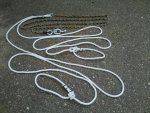
Mooring Buoy Set Up???

Jaguar 25

Well-Known Member
Joined
14 Nov 2012
Messages
466
Location
Liverpool
Visit site
Advice please.

We are about to set up a mooring in Langtone Harbour having been allocated a position by Tudor Sailing club. As a minimum the mooring includes a sinker but nothing else. So, we need a mooring buoy, 3/4 inch chain plus 3/4 inch shackles to make the connection between the sinker and the mooring buoy lower swivel. So here are my queries:

1. What is the best way to make the connection between the sinker and the mooring buoy lower swivel, can you walk out to the mooring at low water and fit everything or is it better to use a dinghy and time it for when there is about a couple of feet of water at the mooring and reach down to the sinker to make the connection?

2. We have normally been limited to connecting to club/marina mooring buoys at the top of the buoy. However, some advice indicates that we should connect the mooring strop and chain to the lower mooring buoy swivel by means of a shackle then a separate swivel and this shackled to the chain and strop.

3. Is a 450mm dia mooring buoy OK for supporting 12 foot of 3/4 inch chain?

I know there are many ways of doing the above but what is the perceived wisdom of the forum?
 
Advice please.

We are about to set up a mooring in Langtone Harbour having been allocated a position by Tudor Sailing club. As a minimum the mooring includes a sinker but nothing else. So, we need a mooring buoy, 3/4 inch chain plus 3/4 inch shackles to make the connection between the sinker and the mooring buoy lower swivel. So here are my queries:

1. What is the best way to make the connection between the sinker and the mooring buoy lower swivel, can you walk out to the mooring at low water and fit everything or is it better to use a dinghy and time it for when there is about a couple of feet of water at the mooring and reach down to the sinker to make the connection?

2. We have normally been limited to connecting to club/marina mooring buoys at the top of the buoy. However, some advice indicates that we should connect the mooring strop and chain to the lower mooring buoy swivel by means of a shackle then a separate swivel and this shackled to the chain and strop.

3. Is a 450mm dia mooring buoy OK for supporting 12 foot of 3/4 inch chain?

I know there are many ways of doing the above but what is the perceived wisdom of the forum?


3/4 " chain seems OTT for a 25 ft boat. OTOH 12 ft saounds very short unless your mooring is in very shallow water ( 8ft at HW springs )
My drying yard mooring, which conforms to the Chichester Harbour requirements for category 3 ( boats up to 9m) has a concrete sinker with , IIRC, 12 ft of cast in in 1" chain and a riser of 3/8" chain.

There are a couple of publications on the Chichester harbour website that might provide some useful info

http://www.conservancy.co.uk/assets/assets/guide to layings a drying mooring 2013.pdf

http://www.conservancy.co.uk/assets/assets/mooring leaflet_2011.pdf

The rod through the centre of some buoys is not suitable for mooring to. The chain/ strops have to be connected to the riser below the buoy. How you connect depends on the type of buoy. The chain can be passed through the centre of some.

Can you actually walk to your mooring at low tide or is it in deep sticky mud that will trap you until you drown?

You can look up the weigh of chain (not correcting for its buoyancy will allow a safety margin) and calculate the weight a buoy will support from its dimensions. Volume of a sphere = 4/3 x Pi x r cubed


But surely your mooring will have to comply with the requirements of the Langstone Harbour Board.
Either your sailing club or the Harbour boar should be able to provide you with guidance / similar info to that above
 
Last edited:
3/4 " chain seems OTT for a 25 ft boat. OTOH 12 ft saounds very short unless your mooring is in very shallow water ( 8ft at HW springs )
My drying yard mooring, which conforms to the Chichester Harbour requirements for category 3 ( boats up to 9m) has a concrete sinker with , IIRC, 12 ft of cast in in 1" chain and a riser of 3/8" chain.

There are a couple of publications on the Chichester harbour website that might provide some useful info

http://www.conservancy.co.uk/assets/assets/guide to layings a drying mooring 2013.pdf

http://www.conservancy.co.uk/assets/assets/mooring leaflet_2011.pdf

The rod through the centre of some buoys is not suitable for mooring to. The chain/ strops have to be connected to the riser below the buoy. How you connect depends on the type of buoy. The chain can be passed through the centre of some.

Can you actually walk to your mooring at low tide or is it in deep sticky mud that will trap you until you drown?

You can look up the weigh of chain (not correcting for its buoyancy will allow a safety margin) and calculate the weight a buoy will support from its dimensions. Volume of a sphere = 4/3 x Pi x r cubed


But surely your mooring will have to comply with the requirements of the Langstone Harbour Board.
Either your sailing club or the Harbour boar should be able to provide you with guidance / similar info to that above

Thanks for that.

WE do have to comply with Langstone regulations and this has been interpretted by Tudor Sailing club into a mooring specification. However, reading the Tudor Sailing club spec again, the 3/4 inch chain is for the ground chain. Spec'd as follows:
For Boats up to 26 foot: Ground chain to be 12 foot of 3⁄4 inch diameter
chain, bridle chain to be 12 foot of 3/8 inch diameter chain.

Excuse my ignorance, does this mean that from the sinker there is 12 foot of ground chain to which you attach 12 foot of bridle chain , which is then attached to the mooring buoy?

In terms of walking out to the drying mooring, the worry is that we don't know how deep the mud is and, although the bosun has said that it has been done, it is not official policy. I know that someone has drowned in Chichester harbour doing this. This means that we will need to lean out from the dinghy to make the attachments to the sinker.
 
I now see that the Chi Harbour recommendations for laying a mooring show the use of 3/4 inch chain from the sinker to the mooring buoy, with the chain passing through to the top of the mooring buoy. This, presumably is the arrangement we had last year in Chichester, whereby we attached the mooring strops to the top of the buoy.

The mooring buoys that are commonly available are the rod type where you connect the riser chain to the lower swivel on the bottom of the mooring buoy.
 
you might find the website of Diving Belle (on the Tamar) of use. Highly skilled mooring contractors, and delightful people as well; they have evolved a mooring standard used many clubs and mooring associations in Plymouth

http://www.divingbelle.co.uk/

Lots of sound technical advice.
 
I personally find no problem mooring to the eye on the top of the buoy, WTF else is it for other than scratching your topsides?
Obviously you need a decent buoy with hardware you can trust, and it needs to be properly assembled and regularly checked.
There are some about with very light rods and lower swivels I'd not trust. I think they are intended for some fishing application not yacht moorings.
Try to get a decent make like Norfloat.

The heavy ground chain is important, it provides some damping to the mooring. It also takes a lot of wear as mud can be remarkably abrasive and the lower bit of chain stirs around in it a lot of the time.
The crucial thing is ensuring shackles do not come undone, simple mousing with wire seems to fail now and then, people have different cures, mine involve lock nuts, lock washers and loctite, the pro's weld their shackles. Some people drill and pin nuts or shackles.
The constant motion of a mooring has an unbelievable ability to undo things.
Langstone mud is treacherous in places, I'd suggest working from a boat if unsure.
 
I suspect if you ask the club they'll have a diagram of how the mooring should be assembled, but from what you've said, they require both a 3/4 ground chain and a 3/6 riser (to the buoy). A few years back when we were still allowed to work on our own moorings in Southampton, the preferred method was to chose a very low tide and go out in the dinghy just before low water, so that we dried out on the mooring to do the work. Although when we had a member who was a professional welder, the chains were assembled ashore and welded, otherwise they were shackled on using shackles selected for having a couple of threads protruding. Once secured (using Loctite on the thread) the end of the pin was upset so that it "couldn't" come undone and then a mousing was put in place - sort of belt, braces and safety pin. As mentioned above, if you have the chance to shop around for shackles that will take a bolt and lock nut, then all the better. Usually by the time all the fasteners were secured, the dinghy would be afloat again and we were away home.

Incidentally, I have always preferred a chain strop (attached to the riser below the mooring buoy) with an equal length rope strop to the pick-up buoy. This arrangement has the advantage that the chain strop will, of course, sink alongside the riser pulling the pick-up buoy close in to the mooring buoy. By attaching below the mooring buoy, you don't depend on the condition of the rod through it.

Rob.
 
I suspect if you ask the club they'll have a diagram of how the mooring should be assembled, but from what you've said, they require both a 3/4 ground chain and a 3/6 riser (to the buoy).
Rob.

We have asked the club and they have supplied a specification without a diagram. My problem is that the club is near Portsmouth and I am in Liverpool trying meet a Thursday deadline for getting the boat onto the mooring. A bit too much of a rush perhaps to install the mooring kit and move the boat around from the top end of Chichester harbour in a single day!

Anyway, it seems to me if we have a 12 foot ground chain and then a 12 foot riser, this will produce near to a 50 foot turning radius at the boat stern. 100 foot diameter turning circle seems a lot more than I remember we had last year in Chichester but looking at Google Maps, it seems similar to other boats on the mooring.

Also looking at Google Maps, few boats on the mooring appear to have a mooring ball. A bit strange i'd have thought. Not sure if it applies but there is a mooring system that allows use of only a pick up buoy with a strop down to the riser chain but I am not in favour of that.
 
Tomorrow( Sunday)I will be making up half a dozen moorings at least
Sinker - pass chain through loop & double it back up on itself for 400mm. fasten with 2 No 19*22 galv shackles , stockholm tar or grease on threads, Tighten really tight with 30 inch wrenches.( that is important) Chain is 8 or 7 M long ( depends on depth) 19 * 97. Then we have a 5metres length of 25mm multiplat with nylon eyes each end. Fix to chain with 19*22 galv shackle ( note shackles are CE marked) at top of multiplat connect to 16*100 chain with 19*22 shackle. This chain is 1.5M long, Fix to a RB 60 or RB 70 Dan buoy ( bigger buoy used further out in stronger current) with 16 * 19 shackle ( buoy centre will not take bigger shackle) Buoy has a twin central bar with swivel eye at top. Each boat has 2 painters - usually rope some use chain, One painter is slack other takes the load.Fixed to buoy individually in case shackle comes undone which happens if owner does not mouse or tighten enough
length overall is 14M which allows for 5 M depth plus 5.5 M tide plus 1 M storm surge
This has worked for us for years. Chain gets changed every 3-4 years. The moorings checked annually. Sometimes have to change nylon thimbles which can be done on the workboat with a couple of tyre levers
All shackles are moused with HD cable ties 7 M chain in shallower water
We would not allow mooring holders to use smaller risers. The multiplats last years at least 10-15 provided eyes changed every couple of years & helps take load off buoy. Weed can be a problem as it sometimes collects around chains for a while & I would prefer the larger buoys but solid RB 70's are £ 200-00 plus
 
Last edited:
I personally find no problem mooring to the eye on the top of the buoy, WTF else is it for other than scratching your topsides?

So perhaps yours is suitable for mooring to the top ring ......... Some are not. The eye on the top is only intended to make coming alongside and picking up easy. With these types the riser and the main mooring pennant should be attached to a strong ( usually swivelling ) eye on the bottom Some have the top ring vinyl coated

http://www.compassmarine.co.uk/PBCPPlayer.asp?PW=1&ID=1091553
 
Just one comment to add or really reiterate. Shackles should be tightened really tight before being moused to stop the pin unscrewing. There can be a huge an relentless force of friction of the chain trying to rotate the pin. It can unscrew hence the mousing. But even a little movement of the pin cleans the contact surfaces of the thread inviting rust which quickly wears away so that the thread can be eroded. Mention of 3/8 chain for riser. In my experience this will last one maybe 2 seasons before becoming worn to the point of suspect. The heavier chain will last much longer having more meat for the rust/wear to work on.
Just remember your beloved boat has nothing else to do all day than try to escape. good luck olewill
 
W......
Also looking at Google Maps, few boats on the mooring appear to have a mooring ball. A bit strange i'd have thought. Not sure if it applies but there is a mooring system that allows use of only a pick up buoy with a strop down to the riser chain but I am not in favour of that.

If the water is not so deep that the riser chain is heavy to lift, it's a fairly good solution to just have a pickup buoy. it makes the mooring simpler with less to go wrong.
Also there are no issues with the buoy rubbing the bow.
You probably still need a swivel.
It normally implies bringing rusty chain on deck.
 
I'm a bit puzzled over the reference to ground chain in this situation. I am under the impression that a ground chain runs along the ground between two or more anchors or sinkers. Where you have a single sinker like the OP the is no ground chain but a few links of heavy chain cast in to the sinker.
I have a 5/8" ground chain between two galv anchors, my 3/8" riser terminates in a swivel which is shackled to my large mooring buoy. A chain strop is also shackled to the riser and terminates in a shackled loop which goes over my cleat. (This does make a bit of rusty marks on the deck but isn't going to chafe and part as rope can).
 
This is the spec the professional installer recommended for my mooring, Scottish sea loch, 10- 12tone boat, all year round use, twice yearly inspections: (to maintain their 3rd party insurance)
· 5m by 12 mm galv pick up chain ie from buoy to deck.
· 12” inflatable pick up buoy
· 60” mooring buoy
· Rope riser 32mm , 8 part ( set to depth )
· 22 mm surge chain 6m
· 36 mm ground chain
· 2T concrete block
So there is a ground chain and a surge chain, then the rope riser. I was a bit surprised by the riser being rope but as its 20-24m deep I assume chain riser would have required a massive buoy.

I have a second pickup buoy with a rod through but never use it for mooring to - its lifted on deck to stopped it bumping the hull.
I may start using it this year but I will be attaching a loop of the pickup chain from the bottom swivel to the rod eye in case the rod or eye fail.
 
For a drying mooring you don't need a large buoy. The pick-up buoy with a short fibre rope will support plenty of 3/8 inch chain. You might also not need a swivel, so if allowed by the regs, keep it simple - sinker, short piece of heavy chain, lighter chain coming onto your deck and a pickup buoy with the mooring number written on it. I can wade out to my mooring in Chi harbour but I do like to have the dinghy there in case I need something to grab onto - it's also useful to carry the tools.
 
For a drying mooring you don't need a large buoy. The pick-up buoy with a short fibre rope will support plenty of 3/8 inch chain. You might also not need a swivel, so if allowed by the regs, keep it simple - sinker, short piece of heavy chain, lighter chain coming onto your deck and a pickup buoy with the mooring number written on it. I can wade out to my mooring in Chi harbour but I do like to have the dinghy there in case I need something to grab onto - it's also useful to carry the tools.

However, the Tudor Sailing club spec for moorings states

Chain Sizes:
For Boats up to 21 foot: Ground chain to be 12 foot of 5/8 inch diameter chain, bridle chain to be 12 foot of 5/16 inch diameter chain.

For Boats up to 26 foot: Ground chain to be 12 foot of 3⁄4 inch diameter chain, bridle chain to be 12 foot of 3/8 inch diameter chain.

I assume that this means for our Jaguar 25 (2 tonne displacement) that I need to shackle a 12 foot length of heavy 3/4 in chain to the sinker (I am assuming there is a sinker present!) with a further 12 foot of 3/8 in chain shackled to the end of the 3/4 in chain acting as the riser to buoy. This would appear to produce quite a large turning circle.
 
Top