Monel Rivets

davidmh

Well-Known Member
Joined
30 Jan 2015
Messages
477
Visit site
I need to fit a small fitting on the boat mast, the fitting is 2mm thick stainless steel and will carried no real load. If I use aluminium rivets how best to stop the electroysis between the rivet and fitting. If I use a monel rivet how big a rivet can i set with a simple riveter with 9ins arms. I do not have a lazy tongs riveter. The Riveter I have has collet/rivet sizes up to 5mm dia. I will have to use a barrier paste between mast and fitting.
Thank you
 
I struggled to set 4mm Monel rivets with a bog standard 9” arm rivet gun. I extended gun arms with two lengths of pipe and that helped a lot, though obviously puts a lot of strain on the gun mechanism. Duralac is the stuff to use as ‘barrier’ between dissimilar metals.
 
Aluminium rivets are widely used for this application. Duralac inhibits galvanic corrosion partially by chemical action, partly by isolation, Tefgel only by isolation. On a mast the risk is normally low anyway, as water does not lie and dries off fairly quickly.
 
The corrosion you need to prevent is between the mast and the fitting. You don't want the aluminium mast corroding behind the stainless fitting. That's expensive. Despite what Vyv says, it happens and can lead to the end of life of the mast.


If the rivets corrode they are cheap. So Duralac on the back of the fitting as well as the rivets.

Don't forget to get it spread around and dripped all over the mast, deck, your hands, the riveter, your lunch, the dog, the dog's lunch and everywhere else it's not meant to go. That's the usual application method. 😀

I know chromates are unpleasant chemicals with health risks and we really should take more care!
 
Last edited:
If rivets go through an aluminium mast, then that's what to use for rivet material, because that's where corrosion shall be invisible until the fitting falls off.
 
If rivets go through an aluminium mast, then that's what to use for rivet material, because that's where corrosion shall be invisible until the fitting falls off.
Fine for low load applications but not high load because they are not sufficiently strong. Then monel rivets are used which do cause galvanic corrosion in aluminium but not much and controlled with Duralac.
 
If the fitting does not carry much load 3.2mm monel rivets could be used. They are stronger than aluminium. As said above, coat the back of the fitting with Duralac or similar. If you need to use bigger rivets because the fitting was made with bigger holes you need to ask around your marina or yacht club for someone to lend you a bigger riveter.
 
The corrosion you need to prevent is between the mast and the fitting. You don't want the aluminium mast corroding behind the stainless fitting. That's expensive. Despite what Vyv says, it happens and can lead to the end of life of the mast.
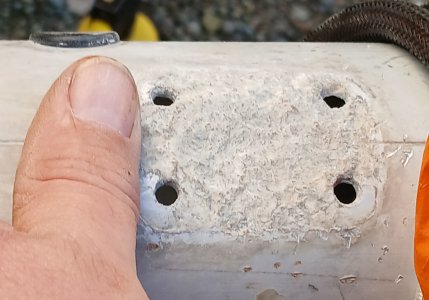
It goes without saying, from me at least, that attaching a fitting to anything without bedding it on sealant is guaranteed to result in corrosion, as your pic shows.

Aluminium is similar to stainless steel in that it relies on a passive oxide film to provide corrosion resistance. If water accumulates in the joint its oxygen levels will be depleted, the oxide film cannot be restored on the aluminium and corrosion will result.
 
I've used plastic from milk bottles between the fitting and mast. Another option is a few layers of duct tape and then always duralac on the rivets.
I used to race Hobie 16s. There are thousands of them around the world, many in the tropics. After a few years the riveted chain plates on the aluminium trampoline bars would pull out due to exactly the kind of corrosion Angus' photo shows, except the whole rectangle would come off with the stainless fittings

Hobie needed a cheap solution for the production line, not involving any sealant or glue. Their solution was perfect: a little rectangle of sticky-back plastic. Problem solved.
 
Thanks for alll the replies. I will isiolate the fitting from the mast with a piece of damp course material ("rubber? sheet") coated both sides with CT1 or similar, and use aluminium rivets coated with duralac/Tefgel.

Thanks
David MH
 
The corrosion you need to prevent is between the mast and the fitting. You don't want the aluminium mast corroding behind the stainless fitting. That's expensive. Despite what Vyv says, it happens and can lead to the end of life of the mast.


If the rivets corrode they are cheap. So Duralac on the back of the fitting as well as the rivets.

Don't forget to get it spread around and dripped all over the mast, deck, your hands, the riveter, your lunch, the dog, the dog's lunch and everywhere else it's not meant to go. That's the usual application method. 😀

I know chromates are unpleasant chemicals with health risks and we really should take more care!
I didn’t know of health risks.

I know Duralac has stained my best sailing trousers and outer shell jacket - it has not washed out after many years; and I was helping a friend upon their mast !

A tube or tube of Duralac lasts a long time in my experience.
 
I didn’t know of health risks.

I know Duralac has stained my best sailing trousers and outer shell jacket - it has not washed out after many years; and I was helping a friend upon their mast !

A tube or tube of Duralac lasts a long time in my experience.
Chromates are known carcinogens if in dry powder form and inhaled.
 
If I remember correctly, Duralac used to be zinc chromate based, which was nasty stuff, but is now barium chromate, which is less nasty. VicS will know
You may be right but for as long as I have known anything about it it has been barium chromate.

Duralac Green is a chromate free alternative.
 
Thanks for alll the replies. I will isiolate the fitting from the mast with a piece of damp course material ("rubber? sheet") coated both sides with CT1 or similar, and use aluminium rivets coated with duralac/Tefgel.

Thanks
David MH
Lots of rubbers are loaded with carbon black, which is electrolytically active and can corrode aluminium. Wouldn't be a problem with a damp course but it might be in this application.

Polythene (see above milk bottle suggestion) is probably a safer alternative. UV stability probably isnt an issue here because it is covered.
 
Top