Modify flybridge helm seating ...?

Yep - it DOES take me a long time.
I'm retired and I have space at home so I can set it all up - do a bit - leave it - do a bit - leave it etc.
But in answer to your question - a couple of weeks of evenings.
The hardest bit is getting the size correct - the boat is 1000 miles from home - no "popping down" to check the sizes.
Old covers can't really be used as a template - they will have shrunk.
It is amazing how much the old covers shrink.
Old covers are useful to get the overall shape though.

There are other methods of getting the templates right.
For some jobs, I use plastic template material to make panels to get the shapes.
The panels are stuck together on-site using double sided sticky tape (special tape that the industry uses - called Venture Tape)
Like this
View attachment 193011

To get something like this - flybridge console cover
View attachment 193010

That technique works quite well - detailed on the Sailrite website.

These ones are made from the same material but a different colour.
I adapted them from the original Princess covers - mine have zipped sections so that we can get to the flybridge coolbox for drinks etc.
IView attachment 193012
Can you obtain a paper template from the OEM manufacturer and pattern it out with the aid of chalk and pins?
 
@Hurricane very impressive as ever 👍🏼. Would you be so kind as to give the name, supplier or a link to the white pvc cover material that you’re buying please?

My boat has similar on the OEM covers and I need to do a bit of diy. I also have a sailrite as you know but it doesn’t have as skilled or active a driver as yours 😀. By the way did the new motor help? Was it an upgrade or just a service replacement? I never found the old motor lacking.
The PVC supplier is Lows of Dundee.
Lows of Dundee Ltd | Industrial Textiles | Coated Fabrics | UK Wide Distribution | Sidecurtains
I think the part number is C7456 - they do white, grey and an awful shade of blue.
The white rolls are 2180mm wide and 25m long so quite heavy to ship.
Other colours are different sizes.
Lows handle the shipping though.
The fabric has a nice linen feel on one side - the back side is smooth.
Lasts 5 to 8 years in the Med sun - longer than standard Sunbrella.

The old Sailrite motor has never been a problem.
I just thought an upgrade to a machine that works for me would be a good thing.
When I bought my Sailrite, I opted for the full package which included the heavy metal Monster Flywheel rather than the standard plastic one.
The new motor is powerful to not require the Monster Flywheel but it can be fitted as well as the new motor.
To do that, you simply use the old belts.
However that introduces a gear reduction and the whole machine sews slower (but even more powerful).
The new motor comes with a new plastic flywheel but I fitted my old Monster Flywheel.
I'm not sure yet if that is the best option because the machine runs very slowly.
That said, my sewing is MUCH better if I am forced to run the machine slower.
I don't have a plan to remove the Monster Flywheel at the moment but I may do sometime in the future.
In all, it is a very nice upgrade.
They only supply a 110v option though so I bought a 110v to 240v transformer for mine.

Here's a Sailrite video on the new Worker B upgrade kit.
I think you will see from that video that you get much greater control.

EDIT
If you are going to do some DIY with this PVC material, treat yourself to some Venture (double sided) tape.
Then, before joining two pieces, stick them together and then sew.
That makes the whole process much easier.
The Sailrite is powerful enough to sew through anything so a bit of extra thickness isn't a problem and it helps to water proof the seams.
I have lots of tips if you are interested.

EDIT 2
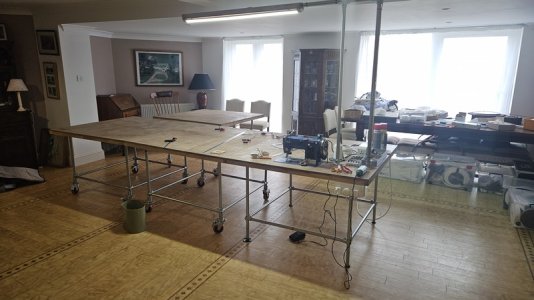
Part of my recent upgrade was to build some dedicated sewing tables - one with the sewing machine fitted.
Here's a pic of my workshop aka the dining room!!
20241206_111135.resized.jpg
 
Last edited:
Hi Hurricane
Many thanks for all that.
Loving your industrial strength workshop there - hope Mary approves :):)
I like that worker B motor - I didn't know about it. Basically its a much better controlled motor than the original. I'll order one - looks an easy upgrade.
Best wishes/respect!
 
Hi Hurricane
Many thanks for all that.
Loving your industrial strength workshop there - hope Mary approves :):)
I like that worker B motor - I didn't know about it. Basically its a much better controlled motor than the original. I'll order one - looks an easy upgrade.
Best wishes/respect!
Yes that's correct. I bought the internal led lamp at the same time. It integrates into the new motor control and lights up the working area from a light above the needle. That was a good addition as well.
I've only done a couple of jobs with the new motor.
It feels like it is sewing too slowly but that isn't a bad thing because it is easier to keep the stitching straight. It seems a shame not to use the heavy duty Monster Flywheel - that's why my machine is slow. If you don't have that heavy Monster Flywheel, don't worry - I'm sure that the plastic Flywheel that comes with the new motor will be sufficient. I may well end up using that combination in the end.
The upgrade was easy and, as usual, Sailrite have a video on how to do it.
 
Thanks for this info @Hurricane my wife is looking for an upgrade to her sewing machine to make some covers for our boat, her ancient Husqvarna is struggling to even do curtains now.
The Sailrite is definitely the tool for most sewing jobs on the boat.
However, it can be difficult doing the thinner fabric jobs like curtains etc.
So, don't give up on the domestic sewing machine.
We use both.
SWMBO has a nice Pfaff machine that we use for light stuff.
But that machine definitely doesn't cope with the heavier fabrics used in covers etc.
Thats where the Sailrite machine comes in.
Both our machines have a "walking foot" but the Sailrite is much more accurate with the heavier fabrics.

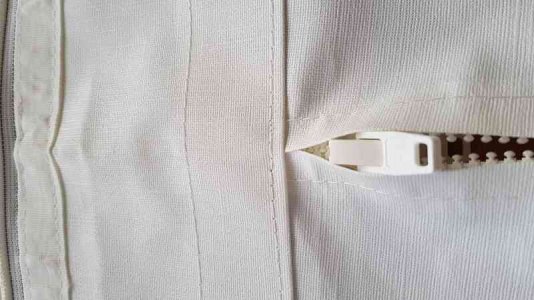
Example - this pic shows how uniform the stitches can be when using a Sailrite - even through several layers of material and even through a zip.
20201121_123801().resized.jpg

A domestic machine would have trouble with that but for lighter fabrics, the Sailrite can be too aggressive.
You really need both.
 
Having been inspired by Hurricanes posts on DIY upholstery and canopies with the Sailright machine, and somewhat shocked at the prices for some replacement garden furniture cushions, I have decided to have a go as well.

My project is considerably simpler and being well basically "tight" I thought I would get a heavy duty domestic sewing machine to learn the basics of machine sewing and see how I get on. Then worse case it goes on Ebay or in a cupboard for domestic repairs etc. So I bought a Singer 4411 heavy duty machine.
It is better than I expected. It can happily sew up to 300gsm canvas up to 3 layers using a V69 thread and a jeans needle. On light 250 - 270 gsm weight canvas of various materials it is very happy sewing 8+ layers. So making cushions and light duty/weight covers it works pretty well.

With a piping foot it is really easy to make piping/welting and not too hard to make box style piped cushions. To a point. It can do it on 250 ish gsm material, but on 300 gsm material it has a problem in that the foot will not go high enough using a relatively small 3mm pipe/cord and is short of torque at low speeds which you need for tight corners. The base machine does not have a "walking foot" but there is one as an accessory. ( the upper pressure foot also helps pull the fabric through) So far I haven't felt the need for it.

One draw back is that it is tricky keep at slow speeds. This needs practice and stiff soled shoes. My simple solution is to just turn the wheel by hand on very tight turns. As machine to experiment and learn with it's very useful to learn the techniques and give it a go. I will do the internal and external cushions with it and reupholster the single fly helm seat (well I will try).
But for serious external covers I think it will need a sailrite. If the lighter weight cushions don't last well, I could then get a Sailrite and do a stronger job, knowing what to do/expect and hopefully the learning curve will be a lot shorter and the end results better.
 
Last edited:
Top