Micro 12v Generator Project

UPDATE - Slight change of plan...maybe?!

I have been busy trying to finish it off over the weekend but found myself at a fork in the road....

The original Honda GX25 micro genny is 95% complete, as per my original spec, near enough, the engine speed is held by a servo control, the alternator regulator is managed also by the PIC microcontroller and is fully adjustable and programmable, anything you like really, the water cooling system is done, it bolts onto the engine, so no drilling needed, and makes a huge difference to the running temps when put in a box with zero ventilation.....so there i was just getting ready to tidy it all up and make it all a bit more permanent...but i have just aquired a Yanmar L35, 3hp electric start diesel, for a cheap price....so i think i will wait till it arrives then seriously consider migrate the electronics and alternator onto the diesel and finish it off from there, making another water cooled manifold system or maybe i should finish this 100% first, tricky one...diesel off the main tank is so much more appealing although it will be a fair bit bigger and heavier, i will of course be able to get a load more amps too at 3hp.

As for the performance, it is about what i expected, it will happily do 25-30amps, but that is getting towards the upper noise levels on the engine, it is quiter at 20amps downwards, the pics show it running at fast idle where it produces just 3.4amps

vids of it running to follow on youtube
 
Last edited:
just my opinion but it would be nice to see a fully working microgen before you nick the peices from it for a bigger project.

yes, i will take some decent vids before (if) i take it apart, it is fully working, just not in a box and elec start not fitted.
 
why not finish the present one , and offer it for sale as a prototype, to see how the various add-ons stand up to service.

Then put the cash from the sale towards new kit for the Mk2 version.
 
How does the cooling work? You have said much about water cooling the exhaust, and I see bits of copper pipe round the head. But I don't see much physical contact between the pipes and the head. I would have thought physical contact would be essential to carry the heat away from the head once you box it and air cooling is innefective.
 
For what it is worth I would love to see a 100% finished product (if only to demonstrate to the non-believers). Something that looks neat and tidy with well organised connections, pipework etc is worth striving for. Electric start - not sure. The simplicity of hand start is appealing (and vital in an emergency when batteries are dead).

Any project with a bigger engine is probably starting to stray into commercial teritory.

Yoda
 
How does the cooling work? You have said much about water cooling the exhaust, and I see bits of copper pipe round the head. But I don't see much physical contact between the pipes and the head. I would have thought physical contact would be essential to carry the heat away from the head once you box it and air cooling is innefective.

There is physical contact, on the pieces of flat copper bar only, the picture are not great, in the picture you can see, the flat copper bar is screwed down to the rocker cover, which has been machined flat so the whole thing is in contact, it then has copper pipe soldered on, there is 5 key points with copper plates bolted on to the engine and cold water going through them, i had to be carefull to make sure i was not cooling the engine unevenly, side to side, so decided to take the heat out of places like the top of rocker cover and oil resevoir (on the side below head in picture)

It completely retains the original air cooled system too, with fins, ducting, fan, cowling etc, this is just additional cooling, it is very surprising how much heat is coming away in the water (most of it must come out the exhaust?)

The amount of heat coming off the engine from the air cooling, is massively reduced, i have run it inside a makeshift box, but not for long periods (yet)

It will also retain some air cooling to the box, it will have to have an air supply for the engine ro run, i will probably go for a couple of computer type fans on the box to keep the air moving around.
 
The waste heat to be disposed of will be around 2.85kw. Most of the heat will pass out through the water cooled exhaust. Roughly 0.25kw will probably come from the alternator, and 1kw. from a bit of radiation and the engine.

Removing that 1.25kw from the box could be achieved with an air to water heat exchanger of some type. It would need to have corrosion resistance to seawater and fouling would potentially take place.

!BpsBD1wCGk~$(KGrHqQOKkIEu,beM5MJBLsfFJZOK!~~_35.JPG
A little pump like this one on ebay http://cgi.ebay.co.uk/ws/eBayISAPI.dll?ViewItem&item=320569500663&ssPageName=STRK:MEWAX:IT
which gives a flow of 2 litres/min. and is described as being suitable for PC cooling so is presumably silent would be adequate as the temperature rise resulting would be such that the case temperature would not be excessive.

The heat exchanger could be a coil of plastic pipe as the air side surface area would be the limiting factor rather than the conductivity of the tube wall.

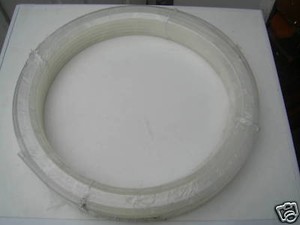
ebay again.http://cgi.ebay.co.uk/Air-Nylon-Pne...30-Metres-/110576258392?pt=LH_DefaultDomain_3
!Bc7HIqQ!Wk~$(KGrHqUH-C8Equpwt5zNBK2rsiHSv!~~_35.JPG


How much 12mm od 10mm bore nylon pipe could be spirally coiled (so that it was self draining for frost) inside the box? 20 meters?
 
12v loads

Car headlamps ( 50/55w and drive both high and low beam simultaneously for about 9,5 amps ) or 12v 50w halogen dichroic lamps ( low voltage interior lighting about 4.5 amps ). The dichroics can be had from ikea for around £1 a pop.

Lamps are pretty resilient to abuse so probably a good way to go.
 
12v loads

Car headlamps ( 50/55w and drive both high and low beam simultaneously for about 9,5 amps ) or 12v 50w halogen dichroic lamps ( low voltage interior lighting about 4.5 amps ). The dichroics can be had from ikea for around £1 a pop.

Lamps are pretty resilient to abuse so probably a good way to go.

Just got some, thanks. Will take some vids for youtube later today, work load allowing.
 
in a word, no.

havent had much spare time recently, plus, not been using the boat, so not been getting wound up with a power (or lack of) problem.
 
Not the only ones

We're not the only ones interested in this. From the AYRS discussions....

john37363 wrote:

Most small stand alone petrol generators, or diesel for that matter, are designed to output 240 or 110volt AC power, with or without a secondary relatively low power 12 volt DC output that can be used for battery charging. On most small yachts the main electrical power requirement is for charging a 12volt battery bank ... The alternative of charging with solar cells and/or windmills incurs high capital costs and considering the small annual usage of most yachts this will take decades to recover in fuel saving.
...

Yet which system is most economical is heavily dependant on the rate and type of use and the conditions. Of course owning almost any boat is uneconomical anyway.
...

Surely it would make more sense to have a generator designed to utilise the full power of the generator engine to generate only at 12Volts DC (or 24/48volts DC if preferred). If there is an occasional light duty requirement for AC mains power on board this could then be met by a small inverter, these are now readily available from camping shops etc. The kind of application I have in mind is a cruising multihull that uses an outboard motor for auxiliary propulsion, in which case petrol will be available on board but charging capacity from the propulsion engine will be very limited so a light weight petrol generator makes sense.

More sense in my opinion would be to use an electric outboard and charge the battery with a combination of solar, wind and water generators. I would use a combustion generator only if heating is also required or if the amount of actual use is very small. In the latter two cases a human-powered generator might also suffice as Tom wrote in a later mail: you can generate a bit of power and keep yourself warm at the same time. However good human powered generators are probably commercially unavailable and you would have to build this yourself.

What is needed is a small petrol engine, e.g. lawnmower engine, direct coupled to a heavy duty ex. lorry alternator that could probably be obtained from a scrap yard. The electrics could be relatively simple since no conversion from AC to DC is needed. Obviously any such DIY solution will cost very little money and much time. If you buy new stuff, it is costly. I have a 4-stroke Honda engine with integrated 2:1 gear box but nothing else which costed more than the genrator set with the very same engine. This would run a Lynch-type generator (high efficiency permanent magnet DC motor) idealy. Such a Lynch-type motor is also ideal as an electric drive. Not quite cheap, though.

This link describes a device that would appear to be suitable. http://www.fridge-and-solar.net/genset.htm
However, this link http://www.xor.org.uk/silkroute/equipment/generator.htm gives the experience of a user and he does not seem to be a happy user. From what he says, it is not as well designed as it could be.

Nothing made in small quantities can be both affordable and as well designed as it could be. I have looked for better designs but haven't found one. http://www.fischerpanda.de/products/eng/1 for example make good generators but it appears for larger yachts using diesel and 230/400 V AC....

Don't forget fuel cells, stirling engines and micro turbines! Maybe even steam engines. All the latter only if you can use the heat.
Cheers, Theo Schmidt
 
We're not the only ones interested in this. From the AYRS discussions....
john37363 wrote:
[......]
What is needed is a small petrol engine, e.g. lawnmower engine, direct coupled to a heavy duty ex. lorry alternator that could probably be obtained from a scrap yard. The electrics could be relatively simple since no conversion from AC to DC is needed.
Did not someone propose precisely that idea earlier in this thread ? And was not that idea promptly dismissed ?
Simple, easy to make, cheap (around £25) if you hunt around, could be quiet if you led the exhaust underwater - and involves re-cycling which would appeal to those so motivated.
(PS - a small car alternator is all that's required for battery charging)
 
I was following the 'micro' thread with interest,to the stage of obtaining a brand new Honda engine(£100),gathering various alternaters from previous projects,ammeter,voltmeter etc,including a wiring diagram from a link provided by Skipper Stu.However,in the meantime I was given a Honda ED250 4 stroke petrol powered battery charger that was in bits,and was not working before disassembly.I've got that running and it now charges at 14.4 volts @ 10 amps.It can charge at 6,12 or 24 volt.It is light enough to lift over my head,literally.Runs on a sniff of petrol,and is reasonably quiet,certainly quieter than the other 240v gen sets that I tried,but discarded due to the weight.The only disadvantage to it is that it will not tick over for a long time on the 50-1 petrol that I carry for the Johnson O/B,without fouling the plug.I'll get a 'sig' bottle to sort that.'When did this wonder of modern science become available to us?'I hear you ask.In good old 1965.And as for spending £650 for the Aussie one?forget it.

Cheers
 
thought i was about time i posted an update for those that are still interested....

as you may or may not know, the original plan was to make a micro genny in a box, with water cooling, automatic stop/start however, it took a bit or change in direction when i got hold of a small electric start diesel generator, which is in the process of being installed in the rear locker to solve all my power needs (240v, 2.5kw)

anyway, the Micro Genny is now being finished, in a more simple form...

It will now just be an alternator connected to the engine, althought i have completed the water cooling system, i am going to put it back to the standard exhaust for simplicity reasons, i am also binning the servo control on the throttle (as it no longer needs to be auto start) to make it more simple.

It will now just be the alternator and my PIC controlled alternator regulator that i made, this increases the load/charge voltage and hence load on the engine until it senses a drop in the RPM, and adjusts/maintains accordingly, so you start engine and set the throttle you want (manually) and it manages the alternator charge rate for you, to match the engine power curve.

It will be up for sale when complete, as i have no need for it, i have proved the concept, should be good for say 7-30amps depending on how loud you want it to run.

The alternator regulator design may also be handy for others who want a regulator that boosts the charge output without stalling the engine!
 
when i got hold of a small electric start diesel generator, which is in the process of being installed in the rear locker to solve all my power needs (240v, 2.5kw)

as i have interrest in a diesel generator, what did you found?

my idea is having electric engine to power my boat when not sailing with a diesel generator to keep the batteries topped up.
 
Top