Merlin Rocket restoration

Doran

New Member
Joined
27 Feb 2022
Messages
3
Visit site
Hi all, I am new to this but hopefully you could give some advice.
I have a 1952 mahogany clinker MR
Has been stored under cover for 25 years, hull has 15% moisture content max.
I have stripped all back so now can finish and replace decking etc.
My question please:
Should I epoxy the hull which is quite sound to encase it which will prevent it from taking up when in water.
she will only be used in water occasionally
( I still have original Egyptian cotton main Jib and spinnaker )

I would prefer to just varnish the inside but would a mixture of coverings cause any problems.

should I epoxy both in and out or Varnish both in and out.

I am really torn as want a beautiful finish but also an easy to maintain boat.

if I varnish will the boat leak until it takes up.
If I Epoxy is there a risk of damaging the finish and allowing water under the epoxy.

it will be very difficult to completely seal the whole hull inside and out.

I need help, my instinct is stay traditional but….
 
Hi Doran, and welcome. You're well aware of the issues, and have come to one of the 'good' places to glean the correct info. CVRDA will certainly have Merlin Rocket/Nat 12/Firefly owners from that era, who'll have 'precise' info to help. I only mention CVRDA as it's the only one that I've heard of.
Some of your 'dilemma' might be due to a time constraint, so I'd just urge you to carry on searching for info in the manner that you are; it shouldn't take long to get the best advice.
Pics are always good to see here!
 
Basically never use epoxy to cover a wooden hull that has been in the water. You run the risk of locking wet and thus rot in. Varnish is the way to go, I’m afraid.
 
I have only sailed a merlin rocket once on the Thames but if you are near Surbiton you might drop in to the Thames sailing club bar and ask in the clubhouse about the MR as I believe quite a few were there along with the Thames raters.
 
if you can dry her out under cover, then epoxy. But that will need 4 coats of good varnish .

I'm only slightly jealous. A Merlin was the first boat I put over. But that was about 1965. It was my first sailing course.

Enjoy, a beauty boat
 
Hi all, I am new to this but hopefully you could give some advice.
I have a 1952 mahogany clinker MR
Has been stored under cover for 25 years, hull has 15% moisture content max.
I have stripped all back so now can finish and replace decking etc.
My question please:
Should I epoxy the hull which is quite sound to encase it which will prevent it from taking up when in water.
she will only be used in water occasionally
( I still have original Egyptian cotton main Jib and spinnaker )

I would prefer to just varnish the inside but would a mixture of coverings cause any problems.

should I epoxy both in and out or Varnish both in and out.

I am really torn as want a beautiful finish but also an easy to maintain boat.

if I varnish will the boat leak until it takes up.
If I Epoxy is there a risk of damaging the finish and allowing water under the epoxy.

it will be very difficult to completely seal the whole hull inside and out.

I need help, my instinct is stay traditional but….

I would be doubtful about epoxy on a hull which could be flexible.

Suggest you look for the Facebook Group ‘ Merlin Rocket Revival Fleet’. They have super advice and will take a great interest in a boat of that age. What is the name and number?
 
Last edited:
Do not use epoxy unless as a glue. Varnish will be fine. I wouldn't waste time trying to prevent leaks until she is launched, this will prevent you from spending your life patching up the wrong bits.

After she has taken up a bit assess the situation. If you think you have a leak tape it up with Gorilla tape. If this works you have found the leak, if not, you are barking up the wrong tree. I have been known to leave the tape there for a couple of seasons but then I am lazy.

I take it that she is ribbed clinker rather than glued clinker? If so you may find tired fastenings have 'wasted' where they go through the planks and are letting water in. Again. do nothing apart from varnishing until the boat is in the water. Solution is obvious and tiresome, particularly below the foredeck.

I sail a clinker dinghy that lives in the dinghy park and is exposed to hot sun. Worst possible scenario. Inevitably she leaks, I have got used to it.
 
Using epoxy is a terrible idea. It only works as a wood coating if you can 'encapsulate' or seal all the various faces. The wood stays dry as it is effectively sealed in a 'bag' of epoxy. With a traditional clinker boat you could never completely coat the landings of each plank or between the ribs and the planks. Water would then find its way around the epoxy, into the wood and before long the whole thing would be a mess that would be a nightmare to correct.

A conventional varnish system is the only way to go. With the boat having been dry for so long, the wood might appreciate some form of 'penetrating' oil feed. People use various home made alchemy concoctions, but I have had success with Owatrol Deks Olje D1 until it won't accept any more, followed by Deks Olje D2 until you get a surface, followed by a decent tung oil rich varnish. (Hempel Classic is good). I would apply it all with a spray gun with a clinker boat (and before you put the new decks on). It's possible for the interior planking in the low wear areas, to stop after the Deks Olje D2 and only add the varnish for the high wear areas like the thwarts and gunnels, etc.

Have fun.
 
I've recently finished restoring my old Merlin. Just strip back and varnish. Use something like Eppifanes, and thin the first coat about 30%, and then thin the next few coats about 10% (helps the varnish get into the wood). You can also get a sealer from International, which puts a tough coat on the wood before you start varnishing (but I didn't bother). The planks are glued together, so you won't get seepage through the hull. Just get it all nice and dry before you start varnishing.

What hull number is it?
 
Hi and many thanks for the useful replies, looking like I will use an oil based varnish both inside and out. She is under cover but will wait for more warmth before starting. Till then lots more prep to do.
For those who kindly asked, she was built and designed by Jack Holt hull no 418, originally at the Upper Thames SC. I am her second owner although I understand she has been stored in a warehouse for over 25 years.
Will try to post some photos.
I have taken a lot from your posts so thanks again
 
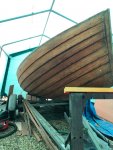
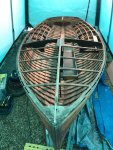
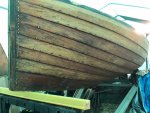
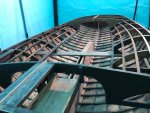
Here are some photos of Allouette
Think mahogany planking is set by roves and not glued
 

Attachments

  • PHOTO-2022-02-28-17-25-14.jpg
    PHOTO-2022-02-28-17-25-14.jpg
    108.4 KB · Views: 47
  • PHOTO-2022-02-28-17-25-14 4.jpg
    PHOTO-2022-02-28-17-25-14 4.jpg
    145.4 KB · Views: 46
  • PHOTO-2022-02-28-17-25-14 2.jpg
    PHOTO-2022-02-28-17-25-14 2.jpg
    116 KB · Views: 42
  • PHOTO-2022-02-28-17-25-14 5.jpg
    PHOTO-2022-02-28-17-25-14 5.jpg
    118.9 KB · Views: 42
Yes those planks are all rivetted. No glue of any description would have been used with the possible exception of the garboard planks having some kind of bedding compound into the hog/keel; and where the planks land on the stem and transom. Once you have cleaned, sanded and revarnished the planks will take up water, swell and stop any leaks. Two or three of those planks on the starboard side look like they “might” need some repair. Difficult to be sure from the photos.
 
Firstly I would echo skysail's advice re the merlin rocket revival group in Facebook as they will have accurate and pertinent advice including the whole process Inc fitting out.
Secondly I would think about what you want from the boat, if you want a time capsule to preserve and look good , then traditional varnish and if necessary a bilge pump. (It won't take up if it lives in the garage except for 3 trips a year).
On the other hand if you want a usable competitive racing dinghy then a sealant epoxy coating and then thicker epoxy to glue up between the planks. If you are worried about water getting into the wood and not getting out then don't epoxy the inside. If the rivets have become tired and loose then epoxy is the only practical way to go
 
We’ve just retightened a gig, approx 2000 rivets. It took 2 of us a day. To remove them and epoxy join the planks would have taken significantly longer.
 
Get a carving diskfor a 4 inch angle grinder. Run it along the face of the planks such that you do not cut the plank but you form a 6mm * 6mm groove into the land. You will get the idea of depth because you will feel the cutter touch some rivets. Do not cut the rivets. With the hull upturned you then fill the groove with west resin & filler ( the brown one I forget the No). Smooth it off as you go. You can put a slight round on it but to maintain the look of the boat you may be better leaving it flush.
This will glue the boat together & make up for loose rivets.
When I did my Stella I filleted the lands because I wanted to sheath the whole hull in 300grm mat. Obviously you will not do this.
On my Stella I coated the inside with a very liquid resin ( a bit like creosote for consistency). This was supplied by Wessex resins. It dried to a crystaline finish & soaked right into the wood. It acted like an antifreeze in a car because it seeks out all the holes & went through any pin holes etc. It totally sealed the wood & if the boat has not been in the water for years it should be dry enough.
Borrow a moisture meter if you are not sure. Wessex have reps who will come & see you and will always advise if you buy from them & discuss on the phone rather than just lobbing emails at them
You can then coat the outside in epoxy once you have found further leaks & dealt with them.
I believe that UV resistent epoxy is available, but I suggest a discussion with Wessex would answer that & update how to finish with varnish etc
One has to remember that all these finishes add weight so you have to consider the protection with the weight that you are adding
 
Top