Whippersnapper
Well-Known Member
This behaviour is the same seen with conspiracy theorists. They make assertions and provide no evidence. Their claims are refuted with evidence so they ignore that and make a different assertion or provide “evidence” that is not relevant to the question.
Bottomline. I have provided evidence that a modern 600hp diesel will burn ~120lph at full power. The Mercury v8 300 burns around 145lph at full power so the 600hp v12 will be >250lph.
Bottomline. I have provided evidence that a modern 600hp diesel will burn ~120lph at full power. The Mercury v8 300 burns around 145lph at full power so the 600hp v12 will be >250lph.
Worked perfectly for my 260hp turbo diesel. 54lph at full powerSpot on.
QBhoy, you don't need to convince anyone that modern outboards are good. They wouldn't sell as hot cakes if they weren't.
It's when you jumped in the conclusion that petrol engines are "more fuel efficient" than diesel engines, that you dug the hole in which you are now.
And from where, as the old saying goes, you'd better stop digging.
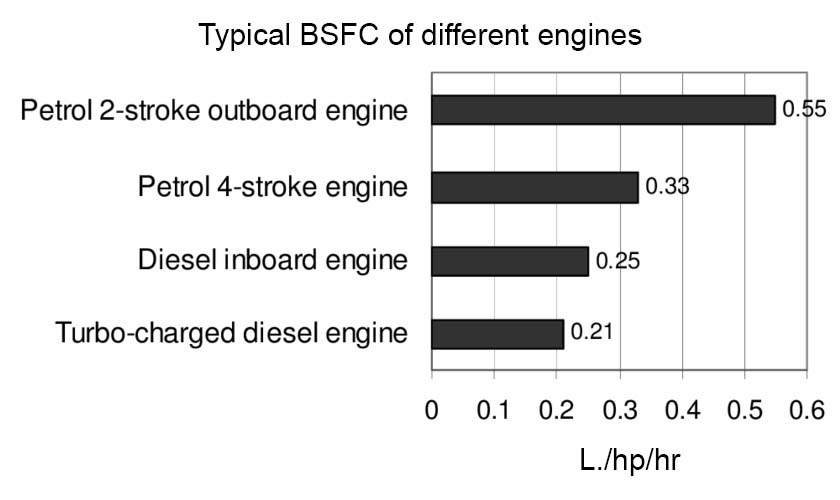
See, the point is that there's only one commonly accepted definition of fuel efficiency of internal combustion engines, and it's the Brake-Specific Fuel Consumption, aka "BSFC".
There are actually slight variations on that, because some engine manufacturers use the weight rather the volume of fuel, and you can either use kW or hp to measure power, but this is just hair splitting.
Essentially, it's meant to measure the amount of fuel that one engine burns for each unit of power produced.
And the crux of the matter is that there are physical reasons why even the worst diesel engines are, and will always be, more fuel efficient than the latest and greatest petrol engines.
Of course MPI, direct injection, and many other tricks all contributed to improve the fuel efficiency of petrol engines over the years - as well as others factors did with diesels, anyway.
But none of these factors, neither alone nor all together, can circumvent physics.
For this reason, if you take the following table, which is obviously generic and based on averages, and you compare it with the specs of ANY engine, you will be surprised to see how valid the approximation is.
Don't take my word for it, give it a try.