MD7A temperature issues

Clyde Coastin'

New Member
Joined
12 Feb 2022
Messages
16
Visit site
Hi Folks,

I'm having an issue (I think!) with my MD7A. It does, and always has, started no problem and ran well but never pumped a massive amount of water out the exhaust. The amount is does pump looks acceptable and there is never any clouds of steam (just the usual old Volvo puff).

On a recent trip we found ourselves becalmed and running the engine to make our way home, we had been running for maybe an hour when out of boredom/ curiosity I got the laser thermometer out and began zapping the engine (our boat never had a temp gauge hence the hand-held thermometer), to my horror the head was sitting around 80C and the top of the block at the head gasket was closer to 90C. We turned the engine off to cool for another 45 mins before running it around 1100 RPM to limp towards our destination, in doing so we saw more acceptable temps for the raw water cooled engine of around 70C head and block.

The following weekend I went down to the boat and removed the exhaust manifold and elbow and gave the waterways a good clean out, cleaned the visible ports / waterways in the head and re-fitted with a new gasket. The thermostat looked a touch iffy so as an interim fix I cleaned the housing and punched the centre out the thermostat before refitting. When I fired the engine up she wasn't pumping any water and I had to prime the system by filling the strainer basket with water and blowing down the inlet side tube ( I was expecting the system to self prime, the impeller is 4-5 months old). When she started to pump out there was a good bit more flow than before, I expected this due to the thermostat removal.

This is where is gets more interesting/complicated... After our recent Wednesday evening race we had to motor around the bay waiting to enter the marina and by the time we tied off we had probably had 45 mins running so I thought I'd do a temp check. I got 60-70 at the head but could find hot spots on the block near the head (both front and rear of 85-90C I assume this to be abnormal especially given the lack of thermostat?! To be honest I was expecting low temps across the whole engine due to constant flow.

Does anyone know if the water circulates through both the head AND block of these engines? If this is the case could the water galleries in the block be restricted/ blocked? The difficulty priming the system also worries me as there could be air in the system or some other contributing factor.

I am really not wanting to remove the cylinder head unless its 100% required and my next step is to order some eco-friendly Rydlyme and loop-flush the system and double check all the hoses for air leaks. Has anyone had similar issues before or is there something else I can do/check to help? (I have ordered a VDO gauge and replacement sensor for peace of mind as the boat had no gauge and the temp alarm / light setup evidently doesn't work)

Any and all help appreciated!
 
You could just stop using the thermometer! I think on some engines the thermometer can control how much water goes where, no idea on yours. A good flush with Rydlyme isn't a bad idea, can't do any harm. If it has been running hot maybe some localised salt deposits have occurred?
 
Cooling water circulates in the block , particularly around the cylinders. Just look at a head gasket & you will see the holes where coolant flows. I cleaned an MD7A head/block in preparation for fresh water cooling when it started overheating after around 1500 hours and the block water passages were quite badly crusted. I cleared it with dilute brick cleaner and needed several goes to clear it out. As suggested above a loop system is the best way ahead.
 
This was my fix - run brick cleaner through on a loop to clear the channels.
Taking the heat exchanger off showed severely coked up little holes. No surprise it was getting hot and was much better after.
Hi Stu,

I've actually watched your video before, it was really handy and it helped me get this far. Can I ask a (probably silly) question, at 4:38 in the video you say that you think that opening up the bypass made it run hot. In your case I assume at this point the bypass was open, giving water flow but the old thermostat was damaged and staying shut hence no flow through the block?

I plan on running some RydLyme through the system on sunday to hopefully help clear the passageways and I will also need to take a look at getting the pump to prime as well.

I shall report back with my results, thanks for all the advice!
 
Hi Stu,

I've actually watched your video before, it was really handy and it helped me get this far. Can I ask a (probably silly) question, at 4:38 in the video you say that you think that opening up the bypass made it run hot. In your case I assume at this point the bypass was open, giving water flow but the old thermostat was damaged and staying shut hence no flow through the block?

I plan on running some RydLyme through the system on sunday to hopefully help clear the passageways and I will also need to take a look at getting the pump to prime as well.

I shall report back with my results, thanks for all the advice!

Hi... the thermostat had basically dissolved. Once I cleared the passages it allowed the coolant to take the short cut only intended to warm the engine up. Actually... that seems counter intuitive doesn't it. The hot/open stat allows the coolant to access the full loop..? It was a good few years ago now. Fitting a new stat definitely fixed the issue though. It was easy enough to find a replacement. Getting the bolts out without snapping a head took a bit of patience. Also the push fit pipes need the rubber washers to be in just the right place. But it is definitely do'able.
 
My new beta fitted 3 year ago has a temp gauge. From new it ran at 90 degrees. When a calorifier was fitted it ran at 88 degrees. My diesel car runs at 90 degrees. I don't see it as a problem. When it goes over 100 then it might be. I think coolant will boil at about 110 due to coolant system pressure
 
My new beta fitted 3 year ago has a temp gauge. From new it ran at 90 degrees. When a calorifier was fitted it ran at 88 degrees. My diesel car runs at 90 degrees. I don't see it as a problem. When it goes over 100 then it might be. I think coolant will boil at about 110 due to coolant system pressure

Hi Neil,

I totally agree that 90c is OK for a diesel engine, the issue for me is that in this case it is cooled by sea water and at above ~75-80C it will leave deposits in the cooling system which in turn clogs the system and causes more overheating. I believe this is why raw water cooled thermostats operate at a lower temp than those using an indirect / heat exchanger setup. Is your beta raw water cooled?

My plan is to try and de-scale the block with Rydlyme or similar, I'd imagine the block waterways will be just as bad as the ones in the head that I cleaned manually!
 
I cannot be specific for your engine but in many raw water cooled engines the thermostat has a dual function, opening the flow into the block and closing off the bypass. If yours is like this removing the thermostat will have the opposite effect of what is intended, allowing most of the flow from the pump to bypass the engine. These dual purpose thermostats have a flat disc at the top that closes off the bypass flow into the housing.

Your thermostat should have the temperature at which it starts to open stamped on it, possibly 65 C for your engine.
 
I cannot be specific for your engine but in many raw water cooled engines the thermostat has a dual function, opening the flow into the block and closing off the bypass. If yours is like this removing the thermostat will have the opposite effect of what is intended, allowing most of the flow from the pump to bypass the engine. These dual purpose thermostats have a flat disc at the top that closes off the bypass flow into the housing.

Your thermostat should have the temperature at which it starts to open stamped on it, possibly 65 C for your engine.

Hi vyv,

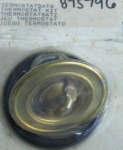
I appreciate what you are saying about the lack of a thermostat having the reverse of the intended effect. Looking at the part I removed and this photo of a genuine spare, I don't *think* that it has the disc you were referring to that closes out the bypass. I'm not sure though, please feel free to look at the image and give your thoughts.

therm.png
 
Hi vyv,

I appreciate what you are saying about the lack of a thermostat having the reverse of the intended effect. Looking at the part I removed and this photo of a genuine spare, I don't *think* that it has the disc you were referring to that closes out the bypass. I'm not sure though, please feel free to look at the image and give your thoughts.
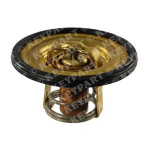
You are right. There is no flap that closes the bypass. Many are like Vyv describes though
This is the Image on Keypart's website

1656429385693.png
 
You are right. There is no flap that closes the bypass. Many are like Vyv describes though
This is the Image on Keypart's website

View attachment 137649

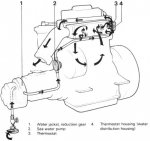
That makes sense. I have found an image of the cooling circuit in the old manual but it is a tad confusing. I have read several people saying that the thermostat controls the bypass but I cant see how that works. I think the bypass is always open thus constantly cooling the exhaust, meanwhile the water is pumped into the head and block at two points *that I can see* where is is then warmed as the engine operates before eventually opening the thermostat and allowing the water to flow into the bypass chamber where it joins the bypass flow and is pumped out the exhaust. This would mean that the system *should* operate without the thermostat, just at a lower temp as there is constant flow around the head/block??
Volvo Penta MD7A Water flow diagram.jpg
 
That makes sense. I have found an image of the cooling circuit in the old manual but it is a tad confusing. I have read several people saying that the thermostat controls the bypass but I cant see how that works. I think the bypass is always open thus constantly cooling the exhaust, meanwhile the water is pumped into the head and block at two points *that I can see* where is is then warmed as the engine operates before eventually opening the thermostat and allowing the water to flow into the bypass chamber where it joins the bypass flow and is pumped out the exhaust. This would mean that the system *should* operate without the thermostat, just at a lower temp as there is constant flow around the head/block??
The diagram is confusing.
When the thermostat is closed water flows from the pump along the hose under the manifold to the bottom of the thermostat housing, through the bypass leaving from the top of the thermostat housing and flowing to the exhaust outlet elbow, via the antisyphon loop if fitted.

When the thermostat opens water can also flow via the tee piece under the manifold, to passages in the manifold, around the cylinder head and block leaving via other passages in the manifold and the thermostat, mixing with the water flowing through the bypass.
 
Last edited:
The diagram is confusing.
When the thermostat is closed water flows from the pump along the hose under the manifold to the bottom of the thermostat housing, through the bypass leaving from the top of the thermostat housing and flowing to the exhaust outlet elbow, via the antisyphon loop if fitted.

When the thermostat opens water can also flow via the tee piece under the manifold, to passages in the manifold, around the cylinder head and block leaving via other passages in the manifold and the thermostat, mixing with the water flowing through the bypass.


The bypass is purely to ensure sufficient flow of water to cool the exhaust and it is not a big hole, If enlarged it reduces the flow through the head and block and promotes the chance of overheating. I have found that the wax element on the thermostat on these engines is in a dead spot and there is a delay in that water heating up due to zero flow. I have always drilled a small hole in the thermostat to reduce the chance of this dead pocket of cooler water forming. This gives the thermostat a chance of responding more promptly . small means less than 2 mm. I have seen new thermostats both with the hole and without..
 
Top