Masthead floats at sea: obvious benefit, or deadly mistake?

Greenheart

Well-Known Member
Joined
29 Dec 2010
Messages
10,384
Visit site
I was thinking of what Seajet said months ago, about attaching an emptied 'two-pint milk carton' to the masthead of a dinghy, to prevent the inconvenience of inversion...

...and at the time I commented that two pints wouldn't be enough. But looking on the web today, I read that even 20 litres of buoyancy can be insufficient to stop inversion, in cases of sudden capsize.

Investigating further, I found on another forum, a discussion of whether in fact a masthead float is a good idea at all...

...and the fact that Bethwaite deliberately designed his boats to invert, rather than blow away at sea leaving the crew adrift.

Worth a quick look:

http://www.yachtsandyachting.com/fo...643&KW=crewsaver&PN=1&title=masthead-bouyancy

I wonder whether (aesthetics aside) there might be any value in buoyancy at the spreaders, or even lower, enabling enough of the mast to go under to prevent the boat drifting rapidly away, but also preventing complete inversion, and leaving most of the righting-work done?
 
Righting a dinghy from an inversion is not significantly more problematic than that of a normal 90' capsize. It's not really an issue.
 
More problematic is where the depth is limited and the mast strikes the river or sea bed and breaks.

The small buoyancy aid stops the mast head getting to a position where the damage may occur.
 
In my Laser 4000, inverting & righting isn't so much of an issue, unless of course it gets stuck in the mud (7.5m mast).

Already forked out £1000 for a new mast, don't fancy another one...

Definatly going to look into some sort of masthead float.
 
I think Wayfarers are problematic when inverted

Not really, even as a lightweight boy of 13 I could right one from fully inverted with the help of the crew. The technique is to grab the jib sheet, climb onto the opposite quarter and lean back and out, bouncing up and down a bit. As the quarter sinks keep tension on the job sheet and try and work towards the centre board. Then right as normal when its back up. Now I may be getting mixed up with the 420, which I also sailed a lot. The stern on Wayfarer has the large buoyancy compartment, so I have a vague recollection of righting from inverted on the bow, instead of the quarter. Either way, its very rightable if patience and technique are used. Some Wayfarers had knotted righting lines tied to the thwart which were long enough to go over the opposite gunwale and back to the quarter.

Are masthead floats required, I am not so sure, I think its wise to be able deal with an inversion
 
One thing you should cosider is that any buoyancy device you add to the top of your mast is additional weight just where you don't want it. Even a small weight at the top of the mast will exert a significant capsize force to the boat as soon as it heels. Not to mention the extra windage.
 
Interesting points, thank you. Here's the germ of an alternative solution, which may solve issues of problematic inversion after it occurs, whilst avoiding the blow-away boat terror, and obviating weird wind-resisting masthead shapes, with their additional weight aloft:

How about having an empty ten or fifteen-litre water-can (or better still, a small fender) stored but not tightly secured near the mast foot, held by a halyard that can haul it to the masthead? The halyard's other end is attached to a free spot ahead of the shrouds, where the swimming crew can find it...

...they do so, and haul the buoyancy down to the masthead, then proceed with normal righting procedure, aided by perhaps 150N of buoyancy at the masthead...

...after which it can be lowered, rather than flop around like a spare prick at a wedding? :)
 
Last edited:
The blow away only occurs if you've got a high buoyancy boat on its side and there is a strong wind.

You can put a 6pint milk container at the top of the mast and I bet you wouldn't notice any performance issue - it may not stop an invert, but it would slow it down - gives you time to get on the bottom and stop a total inversion.
I've not sailed a monohull that I've not been able to right from invert save for when the mast was stuck in the mud ... and I've only had to chase after 1 boat that capsized - that was my 420. I've never worried about masthead buoyancy because I'm usually racing ... That's from 30 years sailing all sorts ...
 
Surprised nobody's invented something resembling an automatic lifejacket which would be packed tightly at the top of the mast [no windage, minimal weight]. If inversion occurs, automatic inflation occurs after a short interval.
Is this a market opportunity, after all, most sailors are gullible enough to buy any new piece of kit?
Almost as bad as golfers.:)
 
Surprised nobody's invented something resembling an automatic lifejacket which would be packed tightly at the top of the mast [no windage, minimal weight]. If inversion occurs, automatic inflation occurs after a short interval.
Is this a market opportunity, after all, most sailors are gullible enough to buy any new piece of kit?
Almost as bad as golfers.:)

Readily available: http://www.tridentuk.com/sailing/Wayfarer_Anti_Capsize_Cushions_And_Mast_Floats.html
 
Surprised nobody's invented something resembling an automatic lifejacket which would be packed tightly at the top of the mast [no windage, minimal weight]. If inversion occurs, automatic inflation occurs after a short interval.
Is this a market opportunity, after all, most sailors are gullible enough to buy any new piece of kit?
We could slide the "mastjacket" down inside the mast ready to explode into life if the sensor got wet. The sensor needs to run down the mast for 1/2 its lenght and needs to be totally wet before setting off the mastjacket. We may have technical problems in the British summer!
 
I taught briefly at one sailing school where they fitted substantial foam triangles into pockets sewn in the tops of mainsails, and they did work 99% to prevent inversion. Personally I preferred to have students deal with inversions as a perfectly normal part of dinghy sailing: that way when they got their own boat they could cope with an inversion as well as a normal capsize.

The worst boats for righting after inversions I have ever met were Lasers IIs, for some reason they seemed to always turtle in a capsize, and be very hard (though do-able) to right. Wayfarers, Enterprises etc very easy to right in comparison.
 
The worst boats for righting after inversions I have ever met were Lasers IIs, for some reason they seemed to always turtle in a capsize, and be very hard (though do-able) to right. Wayfarers, Enterprises etc very easy to right in comparison.

How interesting that you should say so...I was reading today about Laser 2 training boats in the US, requiring more than 20kg of masthead buoyancy to prevent inversion. I wonder why...there's not much to them.
 
Surprised nobody's invented something resembling an automatic lifejacket which would be packed tightly at the top of the mast [no windage, minimal weight]. If inversion occurs, automatic inflation occurs after a short interval.
Is this a market opportunity, after all, most sailors are gullible enough to buy any new piece of kit?
Almost as bad as golfers.:)

Donald Crowhurst had something almost exactly like that, gas cylinders and a pipe to a deflated balloon in the top of the mast. The whole contraption was supposed to be computer controlled for incipient inversion, but the computer didn't make it onboard. He thought it was revolutionary, at least.
 
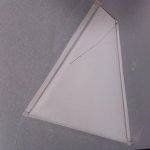
Wanderer dinghies often have inflatable masthead floats stuffed into a velcro pocket at the top of the mainsail. Not much larger in volume than a couple of big plastic milk bottles but an awful lot neater.

My newer mainsail just has a foam pad with eyelets at the top of the mainsail to tie it on to, the same size and shape as the inflatable pocket on older sails.

I put it in if I'm racing on a windy day to prevent inversion, which I have often experienced if capsizing without the pad, and I can vouch for it's effectiveness. I've never come close to inverting the boat with the pad in.

http://www.hartleyboatschandlery.co...943&itemtitle=Wanderer Buoyant Head Pad&shop=

Head patch.jpg
 
Last edited:
Top