
Mast step-Ankle

Sable

New Member
Joined
10 Feb 2020
Messages
9
Location
Tyne and wear
Visit site
Hi All,
I'm having the standing replaced on Sable.
While inspecting the mast the ankle(I think that's the correct term-sits inside the mast allowing it to pivot) was found to be severely corroded.
Just wondering if anyone knows where I might get one from or have one fabricated.

Many Thanks,

Paul -Sable
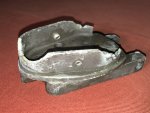
 
I'm not sure if I have the right terminology but I believe the ankle sits inside the bottom of mast and attaches to the foot via a pin which allows the mast be lowered/raised by pivoting.
The boats a Saddler Seawych 19
 

Attachments

  • Sablemast.jpg
    Sablemast.jpg
    222.6 KB · Views: 33
I'm not sure if I have the right terminology but I believe the ankle sits inside the bottom of mast and attaches to the foot via a pin which allows the mast be lowered/raised by pivoting.
The boats a Saddler Seawych 19
Ah, I see the connection. I think that part would normally be called the "foot", or seeing that it's designed for raising and lowering the mast, maybe "heel". The mast sits on the "mast step".
Is there any sort of a maker's label on the mast? If you can find out which company made the mast, they could help you. The other possibility would be if there is an owner's association.
If that part is so eaten away, what's the mast like where the two connect?
 
Thanks for prompt reply Norman-the inside of the mast is sound.
There is an owners association and I've also posted there.
I'll look into the mast manufacture.
Cheers,
Paul
 
I might suggest from the photo that you just refit it with lots of duralac. When sailing all the load is down ward. With very small strength required to stop the mast base skidding sideways. however the base will need it's integrity to the mast when the mast is being lowered. ie a large force pushing the mast and base forward. Yes it might let go but then not a great disaster and quite unlikely. Or if it really worries you get is weld repaired. ie built up on the walls to gain greater grip on mast. Or try to find a new on.
Just deviating a little. This type of base is very susceptible to having the lugs snap off either in this part or the base it sits in. This happens because the mast swings sideways when being lowered. (especially if on water) Make sure you have a person standing on cabin top holding mast on centre line. Or for better fix ensure cap shrouds remain tight through out the traverse of the mast from vertical to horizontal. This is done by extending the chain plate up (rigind pipe or bar) to a point exactly in line with the mast pivot bolt so cap shroud pivots at that point. (assuming this is a rig with cap shroud chain plates abeam the mast base. (search mast lowering) ol'will
 
The style of the foot looks like a kemp (now selden) fitting. To get a new one cast requires a mould or it maybe get one machined from a lump of alloy ?
SS Spars I think you will find assuming its the original mast on Sable.
 
I might suggest from the photo that you just refit it with lots of duralac. When sailing all the load is down ward. With very small strength required to stop the mast base skidding sideways. however the base will need it's integrity to the mast when the mast is being lowered. ie a large force pushing the mast and base forward. Yes it might let go but then not a great disaster and quite unlikely. Or if it really worries you get is weld repaired. ie built up on the walls to gain greater grip on mast. Or try to find a new on.
Just deviating a little. This type of base is very susceptible to having the lugs snap off either in this part or the base it sits in. This happens because the mast swings sideways when being lowered. (especially if on water) Make sure you have a person standing on cabin top holding mast on centre line. Or for better fix ensure cap shrouds remain tight through out the traverse of the mast from vertical to horizontal. This is done by extending the chain plate up (rigind pipe or bar) to a point exactly in line with the mast pivot bolt so cap shroud pivots at that point. (assuming this is a rig with cap shroud chain plates abeam the mast base. (search mast lowering) ol'will
Assuming the rig is original, (and the mast heel pictured in #3 certainly looks like the original ) the boat has aft swept spreaders.

The lowers are in line with the mast though and I have often thought about moving them from the deck U bolts to extended chain plates on the cabin sides. Partly to steady the mast when raising and partly to make passage along the side decks easier. It would only be a small inboard movement.
Some owners square off the spreaders , move the lowers aft and fit additional forward lowers.
 
Just cogitating on this question of damaged mast base plug. If OP goes with my suggestion to leave as is then there will be times when he needs to be careful as loads on the base will not be just downward. No problem when mast is up and sailing. however when raising the mast presumably using a tackle on the forestay there will be a force pushing base of mast forward which could cause the base to unseat due to loss of metal. This load is at max when mast is near horizontal and particularly when raising the mast. To alleviate this load lift the mast as far as possible from cockpit, Not so difficult being a small mast. He might even set up a pole with crutch on top to allow the mast to be lifted even more. After 45 degrees when going up things get easier but must have tackle on fore stay.
The other time for concern is when the mast is down resting in a crutch at the transom but base is still attached at the pivot. You can get an upward force on mast base due to mast c of g is aft of crutch support. Of particular concern if you lower the mast on water to traverse under bridges. This can be alleviated by fixing transom crutch as far aft as possible even leaning out backwards a bit. I once went with an acquaintance to help him in first traverse under our Fremantle bridges on 20fter. As the mast lowered in to the crutch at the stern the brass screws that were used to bolt the base in place on deck fell to bits with corrosion and the mast base went skyward. (put an end to that adventure)
If as Vic says cap shrouds chain plates are aft of abeam the mast then they will go slack as soon as mast goes backwards. So can't use them to stabilise the mast sideways as it goes down. As he suggests you could use intermediate shrouds whose chain plates are abeam the mast by extending the chain plate fixed part up so shroud pivots in line with mast pivot. Or as I said rtisk it and use a man to guide the mast up and down standing on cabin top. (as I do) Just be careful. ol'will
 
Thank you all so much for the advise and support.
The rig does seem to be original (aft swept spreaders)-
Sable is moored in a marina so the only issue would be stepping or unstepping which wouldn't happen that often-
I'm going to try and take a cast of the existing foot and try to get someone to fabricate a new one (think this would be best long term solution especially for any new owners in the future)
I think as a short term fix I might ask my local garage to try and weld some ali plate to the existing foot .
I never cease to be amazed by the support when posting on this forum. I will post some images when the jobs complete.
Thanks so much and happy sailing.
Paul
 
When sailing all the load is down ward. With very small strength required to stop the mast base skidding sideways.

That's incorrect, I believe.

When not sailing all the load is downward.

When sailing, the boat is being dragged through the water (forward and sideways) by the stays, the mainsheet, and the mast foot/step.
 
That's incorrect, I believe.

When not sailing all the load is downward.

When sailing, the boat is being dragged through the water (forward and sideways) by the stays, the mainsheet, and the mast foot/step.

The load on mast step is minimal actually ... the majority of forces making the boat move are through the stays and shrouds ..... the mainsheets in fact - load is windage ...

Here's my weekender that has a tall mast with large sail area ....

nQlTKMBm.jpg


FXpOydrm.jpg


The mast step - original design is a folded alloy plate that mast foot just drops over. Basically no mount or extra .. just drops over and the vertical plates stop mast foot from moving about. I have canted that boat over using the mast on dry land - so I can service each lifting keel - she has two .. one either side of central keelson.

JpxoqxZl.jpg


D25y5Gyl.jpg


If the mast step took any real force - I am sure that thin alloy mount would soon complain !!
 
So, imagine that by some magic your shrouds and fore and aft stays could hold the top of the mast in position - laterally and fore and aft - without imposing any downward force on the mast, and the flat bottom of the mast was just sitting on the flat deck with no fitting or friction. Now apply your boot to one side, or the back, of the mast at gooseneck height. What do you think will happen next? (Hint - duck!)

The force that the front of your mainsail applies to the mast (including that transferred along the boom at the gooseneck) will, and can only, be taken both at its top (via the stays) and at its bottom (via the mast step and friction). Remove either one of those and the mast and sail will immediately be over the side of the boat.

I suspect that you and Ol' Will are overlooking the role of the very substantial download on the foot of the mast (from the tension of the stays and the weight of the mast) in creating huge friction where the bottom of the mast meets the boat (cabin top or keel). It is by friction that most of the lateral & fore and aft force is transferred from the mast to the boat, and which limits the amount of additional obvious lateral fitting support required.
 
When sailing all the load is down ward. With very small strength required to stop the mast base skidding sideways.

The load on mast step is minimal actually ...

If the mast step took any real force - I am sure that thin alloy mount would soon complain !!

Try this experiment next time you have the mast off your boat.

1) Lay the mast on the ground
2) Attach boom and mainsail.
3) Lift the top of the mast onto a trestle, stool or whatever.
4) Put the 'aft' end of the boom on a similar support of the same height.
5) Is the foot of the mast now just hanging in the air at the same height of its own accord? [ No? What a surprise! ]
6) Place the foot of the the mast on a similar support of similar height to the others.
7) Put a significant weight in the middle of (or, preferably, all over) the sail (water, stacks of newspapers, your only begotten son, or w.h.y.).

PART DEUX
7) Place a bathroom scale between the mast foot and its support.
8) Check whether there is negligible weight at the mast foot.
9) Take out the bathroom scale and put it under the top of the mast.
10) Check whether it is now reading very many times the weight recorded for the bottom of the mast.
11) For completeness, move the scales under the outer end of the boom, and compare the relative reading with the other two.

PART TROIS
12) Report back here on your findings.
 
Try this experiment next time you have the mast off your boat.

1) Lay the mast on the ground
2) Attach boom and mainsail.
3) Lift the top of the mast onto a trestle, stool or whatever.
4) Put the 'aft' end of the boom on a similar support of the same height.
5) Is the foot of the mast now just hanging in the air at the same height of its own accord? [ No? What a surprise! ]
6) Place the foot of the the mast on a similar support of similar height to the others.
7) Put a significant weight in the middle of (or, preferably, all over) the sail (water, stacks of newspapers, your only begotten son, or w.h.y.).

PART DEUX
7) Place a bathroom scale between the mast foot and its support.
8) Check whether there is negligible weight at the mast foot.
9) Take out the bathroom scale and put it under the top of the mast.
10) Check whether it is now reading very many times the weight recorded for the bottom of the mast.
11) For completeness, move the scales under the outer end of the boom, and compare the relative reading with the other two.

PART TROIS
12) Report back here on your findings.


Very funny ... I'm laughing my head off at the pseudo science ...... pity that gravity plays such an essential part in your playground experiment.

You have completely re-written the rules of forces and gravity with that ridiculous post !!
 
So, imagine that by some magic your shrouds and fore and aft stays could hold the top of the mast in position - laterally and fore and aft - without imposing any downward force on the mast, and the flat bottom of the mast was just sitting on the flat deck with no fitting or friction. Now apply your boot to one side, or the back, of the mast at gooseneck height. What do you think will happen next? (Hint - duck!)

The force that the front of your mainsail applies to the mast (including that transferred along the boom at the gooseneck) will, and can only, be taken both at its top (via the stays) and at its bottom (via the mast step and friction). Remove either one of those and the mast and sail will immediately be over the side of the boat.

I suspect that you and Ol' Will are overlooking the role of the very substantial download on the foot of the mast (from the tension of the stays and the weight of the mast) in creating huge friction where the bottom of the mast meets the boat (cabin top or keel). It is by friction that most of the lateral & fore and aft force is transferred from the mast to the boat, and which limits the amount of additional obvious lateral fitting support required.


In fact NO-ONE is ignoring the large amount of FRICTION between mast foot and deck mount imposed by stays / shrouds ....

Its your post saying that :
When sailing, the boat is being dragged through the water (forward and sideways) by the stays, the mainsheet, and the mast foot/step

You have completely mis-read and applied your own 'logic' missing the real situation of a Mast step. The mast step in fact is a locating device .. if it was such a device as you try to to show - then why do mast manufacturers supply such flimsy mounts ??

I am not interested in pseudo science created by misunderstanding the forces involved ... I shall leave you to your dreamworld ....
 
To echo VicS - it’s called the heel of the mast.
Hopefully you will have more success finding one if you call it by its correct name.

Not wishing to get involved in Refueler’s discussion with LittleSister, the heel you show has a pin through the aft face. The purpose of this is to allow you to raise and lower the mast. The forces while doing this aren’t just downward, so you do need to make sure the heel is securely fastened into the mast. William has provided a good outline of what is happening.
 
To echo VicS - it’s called the heel of the mast.
Hopefully you will have more success finding one if you call it by its correct name.

Not wishing to get involved in Refueler’s discussion with LittleSister, the heel you show has a pin through the aft face. The purpose of this is to allow you to raise and lower the mast. The forces while doing this aren’t just downward, so you do need to make sure the heel is securely fastened into the mast. William has provided a good outline of what is happening.

There are actually a number of these mount bases on eBay let alone other sales sites. The trick is of course to get the right size to suit the mast.

Those forces while raising / lowering against that pin can be significant ... its why I advocate a proper A frame and NOT to trust a Gin Pole ...
 
Top