Making chartlets - well it's either talking about yachtsmen's gardens

tillergirl

Well-Known Member
Joined
5 Nov 2002
Messages
8,794
Location
West Mersea
Visit site
Those who are interested on the CTTE surveys - SW Sunk swatch, Spitway, Little Sunk, Ray Sand, - will know that I had always hand drawn the chartlets within an accurate lat/long grid. Many years ago I was given the gift of some software called 'Surfer' which will draw maps - or reversed will draw charts. To my shame I cannot remember the name of the kind forumite who provided the software to me - he was based on the Orwell I recall but it was very good of him as it was not cheap. I always used the software to initiate the chartlet as reference (which was important for accuracy) but could not use it as a publication because in those days it could only use Decimal Degrees. But I had discovered the more recent versions of the software could now use Degree, Minutes and seconds or Degree and Decimal minutes (like most (or all?) chart plotters). So I paid for the upgrade, not the cheapest, but nevertheless very powerful. A measure of the development of software is illustrated by the manual: the manual I had originally had 60 pages, total now it has over 1800 pages! So there is a lot to learn.

So I have had a play inbetween the gardening! Here is the current state of the Surfer chartlet v the home drawn chartlet last year. It is using the same data of 2019 which some of you might recall that was collected courtesy of Plum allowing me to attach some kit to his boat.
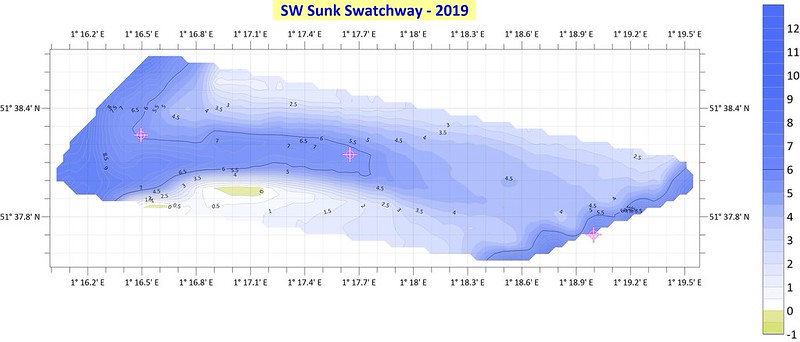
Surfer Image SW Sunk 2020 V2 by Roger Gaspar, on Flickr
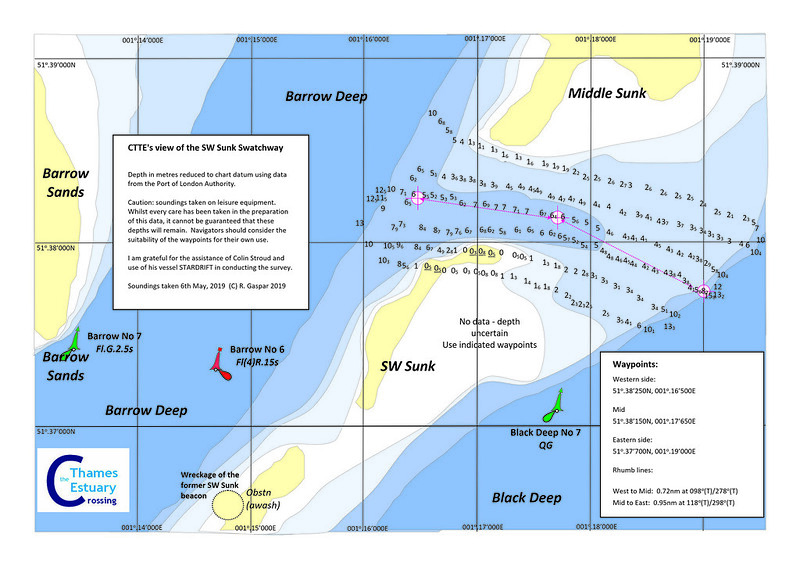
SW Sunk 2019 V1a by Roger Gaspar, on Flickr

Obviously the Surfer image is not yet top and tailed, indeed not QC'ed yet. And there are so many choices about the appearance of the image that there is much to learn. For example, a simple change of the opacity can bring the colour up or down. In this it is at 77% opacity and can in a moment be made more vivid. I think one of the skills to be developed is to balance colour, contrast and deetail to aid the reader. The colours of the contours are my first stab at a custom palette and so each colour can be changed within each contour. Actually there are many standard palettes within Surfer but all but one are intended for land and thus maps, while the one Sea palette isn't really that good - well for the Estuary waters at least. The number of contours can be varied, soundings can be included but I haven't mastered that yet. The image is limited to the data but it can be widened to extrapolate outside of the data range i.e. it makes judgements about the depths outside of the area surveyed. Frankly that isn't the best so the extraplaton remains turned off.

Now you can comment please. Such as 'context'. I drew the chartlet wider than the surveyed area so as to give a context besides just lat and long. I think some context needs to be provided; the Spitway of course provides the 'context' with the two Safe Water Buoys but the SW Sunk has nothing. So if the Surfer chartlet is used in the future should I provide the Surfer chartlet in a wider area context. Does it need soundings when it has contours every 0.5 metres? I can add contours every 0.1 metre of depth but it becomes a little busy - mind you at the Spitway that works better there at 0.1 contours. Colour palette? Ugh or OK or good?
Why do the values on the Axes chose those instead of .0 and .5? Don't know , haven't got command of that yet.

The advantage for me is speed. It takes me a good two days to select soundings and draw contours and colour contours etc, etc to draw a chartlet. Once the reduction to Chart Datum has been completed, it would take me about 5 minutes to use Surfer! This is based on 6508 soundings courtesy of Plum's boat. So it is worth the cost of the upgrade as far as I am concerned.

Who knows when I will be possible to do the 2020 survey at the SW Sunk and elsewhere. 'tis frustrating but there it is, particularly since I have set up the boat to run three separate systems that will hoover up data at the same time and I haven't even turned them on for real yet. But once afloat she is ready to go.

Sorry to drone on but I have had a pleasant afternoon avoiding gardening.
 
Most interesting. If the software helps you in your sterling efforts to help us, what's not to like?

I think it's excellent, and very usable just as it is. Amazing for a 'first stab'.

I prefer the darker 'Surfer Image SW Sunk 2020 V1', but there's not much in it.

I wonder whether it would be even clearer, and perhaps less likely to give the impression of a spurious degree of reliability (given the likelihood of some change, etc.) if the contour gradation were done at 1m intervals.

For most of us, once it gets to a few metres another metre doesn't make much difference, so I wonder of there's a way, either with the contour colouring or (if it's possible) moving the dark line currently on the 6m contour to a shallower one, to focus on the lesser depths.

But these are just mild preferences and vague thoughts: it's great just as it is.

Well done, and I hope the garden's not suffering too much! (y)
 
Last edited:
It's quite fun to play. The alternative today is to build a compost heap courtesy of the Council stopping recycling! Hey ho.

Yes V1 is more vivid. That is using 100% opacity:

Surfer Image SW Sunk 2020 V1 by Roger Gaspar, on Flickr

The 6m dark line is the software function of the mid line of the contours. I am sure there is a way of changing the emphasis and I have been thinking a sort of principle of the 'controlling' depth. The PLA talk about the controlling depth of channels; for example in Fisherman's Gat it talks about the controlling depth of 8 metres or so), i.e. the 'guaranteed' depth in the channel. For Yachtsmen and women, the 'guaranteed' depth (I know, not the right expression) in swatches might be say 2m. At our Club, many of the racers have 2+m keels and I know they are conscious of the Spitway where the 'controlled' depth is well less than 2m (see below). Perhaps the emphasised contour for us ought to be the 2m contour?

This is the Spitway:

Spitway 2020 V1 by Roger Gaspar, on Flickr

In that chartlet I have deliberately 'max'ed' the contours. As you can see I have tried with the background of the contour labels and I improved the export of the image to increase the Pixel rate. The buoys are imported from my drawing programme and now needs to be adjusted so as to avoid see-thru. Note there is no emphasis on the contour line. At the moment I have no idea where that has gone to! So much to learn.... but better than building a compost heap.

Oh, new navigation danger - Bl**dy fox poo. They need to be charted!
 
Those who are interested on the CTTE surveys - SW Sunk swatch, Spitway, Little Sunk, Ray Sand, - will know that I had always hand drawn the chartlets within an accurate lat/long grid. Many years ago I was given the gift of some software called 'Surfer' which will draw maps - or reversed will draw charts. To my shame I cannot remember the name of the kind forumite who provided the software to me - he was based on the Orwell I recall but it was very good of him as it was not cheap. I always used the software to initiate the chartlet as reference (which was important for accuracy) but could not use it as a publication because in those days it could only use Decimal Degrees. But I had discovered the more recent versions of the software could now use Degree, Minutes and seconds or Degree and Decimal minutes (like most (or all?) chart plotters). So I paid for the upgrade, not the cheapest, but nevertheless very powerful. A measure of the development of software is illustrated by the manual: the manual I had originally had 60 pages, total now it has over 1800 pages! So there is a lot to learn.

So I have had a play inbetween the gardening! Here is the current state of the Surfer chartlet v the home drawn chartlet last year. It is using the same data of 2019 which some of you might recall that was collected courtesy of Plum allowing me to attach some kit to his boat.

Surfer Image SW Sunk 2020 V2 by Roger Gaspar, on Flickr

SW Sunk 2019 V1a by Roger Gaspar, on Flickr

Obviously the Surfer image is not yet top and tailed, indeed not QC'ed yet. And there are so many choices about the appearance of the image that there is much to learn. For example, a simple change of the opacity can bring the colour up or down. In this it is at 77% opacity and can in a moment be made more vivid. I think one of the skills to be developed is to balance colour, contrast and deetail to aid the reader. The colours of the contours are my first stab at a custom palette and so each colour can be changed within each contour. Actually there are many standard palettes within Surfer but all but one are intended for land and thus maps, while the one Sea palette isn't really that good - well for the Estuary waters at least. The number of contours can be varied, soundings can be included but I haven't mastered that yet. The image is limited to the data but it can be widened to extrapolate outside of the data range i.e. it makes judgements about the depths outside of the area surveyed. Frankly that isn't the best so the extraplaton remains turned off.

Now you can comment please. Such as 'context'. I drew the chartlet wider than the surveyed area so as to give a context besides just lat and long. I think some context needs to be provided; the Spitway of course provides the 'context' with the two Safe Water Buoys but the SW Sunk has nothing. So if the Surfer chartlet is used in the future should I provide the Surfer chartlet in a wider area context. Does it need soundings when it has contours every 0.5 metres? I can add contours every 0.1 metre of depth but it becomes a little busy - mind you at the Spitway that works better there at 0.1 contours. Colour palette? Ugh or OK or good?
Why do the values on the Axes chose those instead of .0 and .5? Don't know , haven't got command of that yet.

The advantage for me is speed. It takes me a good two days to select soundings and draw contours and colour contours etc, etc to draw a chartlet. Once the reduction to Chart Datum has been completed, it would take me about 5 minutes to use Surfer! This is based on 6508 soundings courtesy of Plum's boat. So it is worth the cost of the upgrade as far as I am concerned.

Who knows when I will be possible to do the 2020 survey at the SW Sunk and elsewhere. 'tis frustrating but there it is, particularly since I have set up the boat to run three separate systems that will hoover up data at the same time and I haven't even turned them on for real yet. But once afloat she is ready to go.

Sorry to drone on but I have had a pleasant afternoon avoiding gardening.
I think I've mentioned it before, but I used to do this sort of thing for a living for about 30 years. I would not advise using Surfer for this application - it is really designed for analyzing the results of seismic surveys. I'd be very happy to help - GIS software such as QGIS will offer many alternative ways of producing the results you need, and it should be possible to avoid the artefacts that Surfer has introduced. I can't guarantee this, though, as data gathered along tracks is notoriously difficult to handle.

If you're interested in following this up, please drop me a PM.
 
What is the problem with Surfer? I don't really want to learn new software if I can avoid it.
Not a problem - Surfer is excellent for the applications it's meant for. But it isn't meant for deriving topographic surfaces like sea beds, where you can make helpful assumptions safely. Just to put it into context, there are at least 4 or 5 main classes of algorithms to do this task, each class having numerous subclasses, and all of them having advantages and disadvantages. I'd be inclined to start with methods derived from something called ANUDEM, which is widely implemented in GIS packages. It has the advantage of assuming that the surface is smooth, and providing you disable some of the things it assumes by default, it generally does a very good job. Otherwise, Kriging can give good results, with the advantage that it derives a figure of merit so you can see how reliable the results are.

If you like, I could run your data through a few possibilities.
 
Those who are interested on the CTTE surveys - SW Sunk swatch, Spitway, Little Sunk, Ray Sand, - will know that I had always hand drawn the chartlets within an accurate lat/long grid. Many years ago I was given the gift of some software called 'Surfer' which will draw maps - or reversed will draw charts. To my shame I cannot remember the name of the kind forumite who provided the software to me - he was based on the Orwell I recall but it was very good of him as it was not cheap. I always used the software to initiate the chartlet as reference (which was important for accuracy) but could not use it as a publication because in those days it could only use Decimal Degrees. But I had discovered the more recent versions of the software could now use Degree, Minutes and seconds or Degree and Decimal minutes (like most (or all?) chart plotters). So I paid for the upgrade, not the cheapest, but nevertheless very powerful. A measure of the development of software is illustrated by the manual: the manual I had originally had 60 pages, total now it has over 1800 pages! So there is a lot to learn.

So I have had a play inbetween the gardening! Here is the current state of the Surfer chartlet v the home drawn chartlet last year. It is using the same data of 2019 which some of you might recall that was collected courtesy of Plum allowing me to attach some kit to his boat.

Surfer Image SW Sunk 2020 V2 by Roger Gaspar, on Flickr

SW Sunk 2019 V1a by Roger Gaspar, on Flickr

Obviously the Surfer image is not yet top and tailed, indeed not QC'ed yet. And there are so many choices about the appearance of the image that there is much to learn. For example, a simple change of the opacity can bring the colour up or down. In this it is at 77% opacity and can in a moment be made more vivid. I think one of the skills to be developed is to balance colour, contrast and deetail to aid the reader. The colours of the contours are my first stab at a custom palette and so each colour can be changed within each contour. Actually there are many standard palettes within Surfer but all but one are intended for land and thus maps, while the one Sea palette isn't really that good - well for the Estuary waters at least. The number of contours can be varied, soundings can be included but I haven't mastered that yet. The image is limited to the data but it can be widened to extrapolate outside of the data range i.e. it makes judgements about the depths outside of the area surveyed. Frankly that isn't the best so the extraplaton remains turned off.

Now you can comment please. Such as 'context'. I drew the chartlet wider than the surveyed area so as to give a context besides just lat and long. I think some context needs to be provided; the Spitway of course provides the 'context' with the two Safe Water Buoys but the SW Sunk has nothing. So if the Surfer chartlet is used in the future should I provide the Surfer chartlet in a wider area context. Does it need soundings when it has contours every 0.5 metres? I can add contours every 0.1 metre of depth but it becomes a little busy - mind you at the Spitway that works better there at 0.1 contours. Colour palette? Ugh or OK or good?
Why do the values on the Axes chose those instead of .0 and .5? Don't know , haven't got command of that yet.

The advantage for me is speed. It takes me a good two days to select soundings and draw contours and colour contours etc, etc to draw a chartlet. Once the reduction to Chart Datum has been completed, it would take me about 5 minutes to use Surfer! This is based on 6508 soundings courtesy of Plum's boat. So it is worth the cost of the upgrade as far as I am concerned.

Who knows when I will be possible to do the 2020 survey at the SW Sunk and elsewhere. 'tis frustrating but there it is, particularly since I have set up the boat to run three separate systems that will hoover up data at the same time and I haven't even turned them on for real yet. But once afloat she is ready to go.

Sorry to drone on but I have had a pleasant afternoon avoiding gardening.
Thanks for the mention. that is a huge time saving! I think context is very important as not everyone will be so familiar with the area. Something like :-SW Sunk context-1.jpg
www.solocoastalsailing.co.uk
 
Thanks both. Let me deal with Plum's point first. Yes, I like that or that sort of thing. It certainly is important as not everybody as you says knows the area. I have permission to use Imray's charts so better that than the UKHO. My UKHO licence is only to cover NtM. I can set up a 'context' inset and that would not need to be altered very often.

On AP's comments. First I will download the QGIS and explore. I thought you would have commented on the biggest oddity but I'll leave that aside. Surfer does have a choice of gridding methods - for those who don't yet know, Gridding controls the interpolation between known values. Surfer includes Kriging and I have been using that and it is using the above. The manual and web site has a lot of relevant information about the alternatives which I had read up way back when I first started using Surfer with the old version. Agreed Surfer is intended or perhaps designed for land mapping. But ANUDEM is designed for land, albeit lakes as well. Thanks AP for that, I am going to read up the background of ANUDEM. It seems to me though, that no gridding method is specifically designed for sea beds. I bet such a gridding method would have a challenge for different seabeds such 'our' Estuary compared to say off the coast of New Zealand (earthquakes, volcano stuff and all that)! Surfer has 13 choices for the gridding method and as I said I opted for that. I could compare some; indeed I might play later.

But, I am might with some justification be verbally beaten-up for claiming that I have deliberately attempted to reduce the need for interpolation as much as possible. My primary depth system gives me one ping a second, so I have a sounding every second. Keeping boat speed is therefore critical: one ping at 8 kts is 4.12metres (if my sums are right), at 4 kts is 2.05m and at 2 kts 1.03m. So I intend to keep boat speed to 4 kts. Plum will remember well that we had a bit of trouble on the reverse runs with the speed. To our surprise pretty much close to HW a lot of tide was still running through the swatch - Plum had to throttle back dramatically I recall; perhaps his memory is better than mine, but I thought there was in excess of 3 kts help occasionally! And it was the intention to get very straight runs so at least along the sounding run needs very little interpolation. But on that day the conditions for surveying were marginal (in contrast with Larry doing the Ray Sand, conditions were ideal and he achieved straight lines not worst than 0 .02 degrees - pretty good. In fairness to Plum conditions were marginal). So what about interpolating between the straight runs: generally I include a series of cross runs at 90 degrees. That is intended to reduce interpolation and, by doing the cross runs at the end of the survey, it gives me a check on the chart reduction process (i.e. am I getting the same chart reduction values in the same place say two hours later). And finally I now use three independent data sources. Primary gets one ping a second, Secondary gets 8 pings in 6 seconds and the third is one ping approx every 1.5 second. So there is a web of soundings.

For an amateur this is anorak stuff. I am going to explore QGIS - at least while there is no way I can finish the fitting-out.
 
Top