mainsheet on the coachroof - pros and cons

Looking around at 31' boats, ATM . I like a transom mounted traveller (modified with lines led forward) and thoroughly dislike cockpit ones. I notice the Moody S31, which AIUI, is supposed to sail quite well, has it on the coachroof, as does the Parker 31, which is noted for it's performance AIUI.
What are the pros and cons of this arrangement? Thanks
I have a Parker 31 - I changed the cabin top traveller to one mounted behind companionway and definitely wouldn’t change back. It’s very reassuring when wind is up and gusty to sit with one hand on tiller and one hand on mainsheet, especially in a light and very responsive boat such as mine.
 
OK, so Apart from the Figaro, how many such boats have the track on the transom?
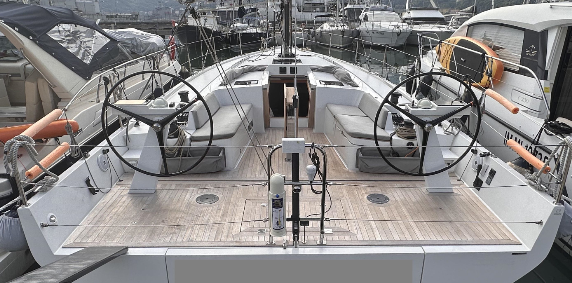
Say 10-15% Loa from the transom: a lot of upper market cruiser racers like Solaris, Vismara, Italia Yachts, Grand soleil, recent Baltic, etc etc, more or less constant beam in the aft third/half boat, same maximum possible track length wherever it is located.

Screenshot_20250223-142641_copy_572x283.png
 
Say 10-15% Loa from the transom: a lot of upper market cruiser racers like Solaris, Vismara, Italia Yachts, Grand soleil, recent Baltic, etc etc, more or less constant beam in the aft third/half boat, same maximum possible track length wherever it is located.

View attachment 189955
In front of the helm----NOT on the transom thankyou🫣 🤣
You can see how much further out the boom can go in that position before it gets out from over the traveller.
An excellent picture to demonstrate my point.
 
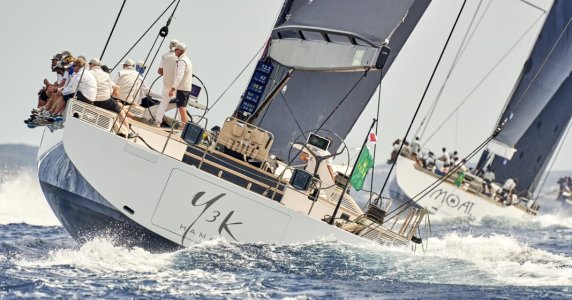
Interesting to note that sadly a crew man died in last Sydney to Hobart race when he was hit by the main sheet in a gybe and thrown in to a winch head first. So yes a safety feature in that way for cabin top traveler. But other wise I do no like them. Limited traveler width and as said a huge load on the sheet and middle of the boom. The load on the boom being almost entirely at the clew. But end of boom sheeting requires a lot of rope to allow boom to go right out on a run.
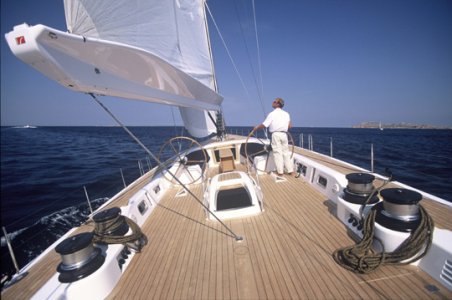
My traveler is at the bridge deck at entry hatch. Yes it can get in the way. Yes it does provide a lot of pressure to near centre of boom but amount of rope is manageable. Yes it can be reached from helm. The traveler track full width of cockpit but not of hull which would be even better.
I think most really big boats use traveler on transom with "german" type sheeting.
I would say to OP if he likes the boat don't be put off by main sheet arrangement. It can be changed. ol'will
 
I think there's sometimes an assumption that every boat designer can simply choose what sort of mainsheet system that they want, without it impacting the rest of the boat.

My boat is designed to have a large working cockpit, if the mainsheet had been specified as a coachroof mounted one in front of the hatch, it would attach to the boom at approx 1/3 of the distance from the goosneck to the clew. Clearly impractical.

Size, and shape, of the boat is also a factor. Other poster have mentioned using the "German" mainsheet system as being a good way of managing to have the sheet brought back to within reach of the helm whilst still having the track on the coachroof. Which is true. However, this is not especially practical on a boat with narrow aft ends, as the lead becomes complicated, and the room for extra winches even more so. And on boats below about 35 feet, that system simply introduces friction and complication without any advantages.

Whether or not you tolerate the mainsheet, and track, in the cockpit is a matter of your sailing plans and your level of risk tolerance. To my mind a planned gybe by a competent crew in high winds is arguably safer with a cockpit mounted mainsheet, as the level of control is higher. It's uncontrolled, unplanned, gybes that cause the issues. Which is why, when cruising, I would rig preventers as a matter of course.
 
Say 10-15% Loa from the transom: a lot of upper market cruiser racers like Solaris, Vismara, Italia Yachts, Grand soleil, recent Baltic, etc etc, more or less constant beam in the aft third/half boat, same maximum possible track length wherever it is located.

View attachment 189955
My track is of similar proportions.

To be honest we very rarely use the bottom 1/3 of it. Going upwind you're blading the main out well before you've dropped the trav that much, and on a reach you are adding twist and using the kicker to control leach tension.
 
The centre of pressure on a boom is probably somewhere well forward of the end of the boom. My coachroof mounted track is probably not far off the optimal position in terms of the stiffness required of the boom.

But that is really a red herring, fine tuning will be easier for the racers if the traveller is at the back, safety will be enhanced for the cruisers if it is out of the cockpit. Personally I have seen quite a few incidents with cockpit sweeping mainsheets so definitely prefer not having one.

As for the loads imparted by kicking straps...
 
I can only assume that designers who put the mainsheet on the coachroof have never actually sailed. I can't imagine anything worse than being alone at the helm, perhaps even behind a wheel, when conditions change and I need to play the sheet quickly, perhaps when sailing through moorings and hit by a gust, and finding that I am ten feet away from the sheet which first has to be de-clutched.
I was taught to always leave loaded main & jib sheets on a winch and never to close the associated clutch so a quick release was always possible.

Some modern boats I've sailed have a single main sheet that has ends either side of the cockpit with a single winch each side.

It does mean when tacking that the main has to be locked off with the clutch, taken off the winch then loaded up on the other side when that winch becomes lazy after the jib is tacked. I've seen people get lazy and not bother managing the main on a winch but it makes trimming, easing and any fast release very difficult.
 
I was taught to always leave loaded main & jib sheets on a winch and never to close the associated clutch so a quick release was always possible.

Some modern boats I've sailed have a single main sheet that has ends either side of the cockpit with a single winch each side.

It does mean when tacking that the main has to be locked off with the clutch, taken off the winch then loaded up on the other side when that winch becomes lazy after the jib is tacked. I've seen people get lazy and not bother managing the main on a winch but it makes trimming, easing and any fast release very difficult.
That is an especially silly setup, I would agree.
 
For cruising non-single-handed cruising I would not have a boat with the mainsheet in the cockpit, full stop.

In terms of sheet load vs. take-off position on the boom, it's a non-issue. If you move the mainsheet from the aft end of the boom to halfway along then double the purchase in the system - the load will be the same (ignoring the extra friction from more blocks) and the amount of rope you have to move will be the same.
 
For cruising non-single-handed cruising I would not have a boat with the mainsheet in the cockpit, full stop.
That's your opinion, and it's a valid one. It is not however a universal one.
In terms of sheet load vs. take-off position on the boom, it's a non-issue. If you move the mainsheet from the aft end of the boom to halfway along then double the purchase in the system - the load will be the same (ignoring the extra friction from more blocks) and the amount of rope you have to move will be the same.
Non issue on a cruising boat with a roller furling main, sure.

However it very much isn't a non issue if you're trying to get a proper leech tension for upwind work on a performance boat. Plus of course your boom now needs to be considerably stronger to take the loads, your sheet/boom attachment needs beefing up as you've doubled the load at the attachment. And the vertical load on the traveller car has just doubled too, so we'll need to upspec that to make sure it moves under load.
All doable, and if getting the mainsheet out of the cockpit at all costs is your goal, then sure. But don't lose sight of the compromises that you've made by describing them as a "non-issue"

My own boat goes the other way. The boom is a fair amount longer than the foot of the main, and the track is aft of the helm. From a racing point of view this is great, and from a cruising with family point of view it's also ok. There's a big area of cockpit that is well outside of the danger zone, and the helm has every control right at hand.
 
For cruising non-single-handed cruising I would not have a boat with the mainsheet in the cockpit, full stop.

In terms of sheet load vs. take-off position on the boom, it's a non-issue. If you move the mainsheet from the aft end of the boom to halfway along then double the purchase in the system - the load will be the same (ignoring the extra friction from more blocks) and the amount of rope you have to move will be the same.
We have the thing you seem to dread, big style. The traveller runs across the cockpit at seat height, coaming to coaming. Not the smallest problem unless your crew is 2 years old. More of an issue safely wise when racing, you’d generally have more people on board. The up side is control. It's right there, both sheet and traveller. We have a short boom so it comes off the end, pretty much. The helm sits aft of the traveller, we have actual helm seats either side. There’scample room for 2 crew each side without crowding people into the alleged danger zone. There may well be boats with layouts entiely unsuited to a cockpit mounted traveller, but no need to be dogmatic about it.
 
Bet anyone would be hard pushed these days to find a charter or school yacht, in their thousands? with sheets anywhere else but on the cockpit roof.

I've sailed lots of yachts with the mainsheet in many places. Coachroof is gazillion times better and safer for students and inexperienced charter crews.

In my opinion....
 
Bet anyone would be hard pushed these days to find a charter or school yacht, in their thousands? with sheets anywhere else but on the cockpit roof.

I've sailed lots of yachts with the mainsheet in many places. Coachroof is gazillion times better and safer for students and inexperienced charter crews.

In my opinion....
For a school boat, or a charter, what you have is a relatively large, inexperienced crew. They fall over themselves, each other and the boat. It would be my opinion too in those circumstances.
 
For cruising, coachroof mount is fine. For more 'sporty' owners, perhaps not.

Bottom line is, if we wanted to go fast, we most certainly would not choose a sailing boat!

IMHO, of course.
This is partly what I don't understand - The S31 was meant to have a bit more sparkle than the staid previous Moodys and the Parker 31 is considered something of a flyer AIUI. To me that indicates these are boats that would appeal to someone more interested in performance than the average "fit & forget" cruiser and ergo the controls would be ...controllable, but if having an awkward traveller arrangement is not very controllable that's what I'm trying to reconcile.

Fast is relative AFAIC. And speed, especially VMG = a wider exploration area for us: Littlehampton to the Dolphin takes us IDK 8 hours, whereas a Super Seal 26 can do it in 4. If you swap the focus on speed for distance, that could get us to Hurst on day 1 - that's what interests me :)
 
Top