
Mainsheet ajustment

Daydream believer

Well-Known Member
Joined
6 Oct 2012
Messages
23,576
Location
Southminster, essex
Visit site
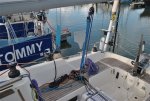
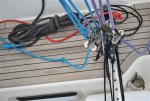
My current mainsheet is 4:1 with another 4:1 tackle on the tail. This allows me to fine tune the mainsail when going upwind. So as well as letting the traveller off I can ease the main & get it back in quick without hurting my aged hands. It is much easier than before. Has less friction than 6:1. Does not involve an expensive easymatic block ( so do not suggest one please) But it is a bit cluttered This is the first experiment & I do intend to use smaller lines & blocks but this is what I had aboard at the time. It would have been better to take the second tackle down to the cockpit floor, but the liferaft stops me doing that- See pics
DSC_0036 (600 x 402).jpg
DSC_0037 (600 x 402).jpg


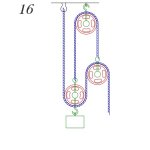
So I found this drawing of a spanish baton
barton (525 x 525).jpg
Here is a link of the animation Animation
I was wondering if one were to substitute the boom for the top line & the traveller for the weight the system could be used on my boat. The left hand fall cound be made as 4:1. rather than fixed as shown in the animation. Thus pulling the boom in first.
So my question is whether the baton ( for want of a better description) would stay extended until I actually got to the point where I wanted to trim the main upwind. then would it give me any power advantage. I have watched an animation but have still not worked out the ratios or whether it is just one of those non effective things that give no mechanical advantage at all. However, I found it on a watch makers thread.
 
Last edited:
I think that there are 2 problems with this arrangement. Firstly as miming says the right hand pulley can only go as far as the top pulley severely limiting the range.
Secondly the whole thing makes no mechanical sense and can only be using "spanish" in the old pejorative sense as with spanish practices and spanish pox
 
Your current system is a bit busy :)

Ours was almost exactly the same as yours with the fine tune 6mm and the coarse 8 or 10mm. My memory is poor, like your hands - our system was 25 years ago.

We found that to allow it work effectively you constantly had to release the coarse tune and re-tighten using the fine tune. This allowed the upper block on the fine tune to sit, roughly, half way between the boom and traveller. It then worked well - but it was constant work with a lot of string in the cockpit (which needed to be constantly tidied up). I was racing with a crew of 5 or 6, so one was operating the mainsheet

Sorry I'm not much help - but it does work if you address it with religious fervour.

Jonathan
 
We had a system similar to yours (albeit more pulleys, at 6:1 + 6:1 fine tune) on our previous boat. Worked very well.
However, the fine tune used much thinner dyneema cored rope, and small but high quality pulley blocks and jammer (Harken, I think).

Fine tune system is great, but needs the right rope and fittings.
 
I had a coarse/fine (6:1, 4:1) on my Stiletto 27. But I found I played the traveler more as a coarse/fine than the main sheet, because it was physically easier. This depends, of course, on having a good traveller set-up, and it was one of the best I have used. So I remove the fine and went to 8:1.

On my PDQ it came 3:1 with a 2-speed winch, but I changed that to 4:1 so that more trimming could be done in light winds without the winch handle in. A sort of coarse/fine/very fine.

I've though about coarse fine for my F-24, but at length went from 5:1 stock to 7:1. That was enough. If I raced I'd go 8:1. The nice thing about the Stiletto coarse/fine is that the the fine was along the boom and came out at the mast base, so the sheets were not next to each other. I'd do that again on the F-24, but the boom is roller furling.
 
Your current system is a bit busy :)

Ours was almost exactly the same as yours with the fine tune 6mm and the coarse 8 or 10mm. My memory is poor, like your hands - our system was 25 years ago.

We found that to allow it work effectively you constantly had to release the coarse tune and re-tighten using the fine tune. This allowed the upper block on the fine tune to sit, roughly, half way between the boom and traveller. It then worked well - but it was constant work with a lot of string in the cockpit (which needed to be constantly tidied up). I was racing with a crew of 5 or 6, so one was operating the mainsheet

Sorry I'm not much help - but it does work if you address it with religious fervour.

Jonathan
I do not find any problem with my current system that could not be even better with better blocks & different line diameters. I certainly intend to do that now I have tried it, adjustment is very easy. But the option I have seen may be much easier.So worth thinking about
 
I had a coarse/fine (6:1, 4:1) on my Stiletto 27. But I found I played the traveler more as a coarse/fine than the main sheet, because it was physically easier. This depends, of course, on having a good traveller set-up, and it was one of the best I have used. So I remove the fine and went to 8:1.

On my PDQ it came 3:1 with a 2-speed winch, but I changed that to 4:1 so that more trimming could be done in light winds without the winch handle in. A sort of coarse/fine/very fine.

I've though about coarse fine for my F-24, but at length went from 5:1 stock to 7:1. That was enough. If I raced I'd go 8:1. The nice thing about the Stiletto coarse/fine is that the the fine was along the boom and came out at the mast base, so the sheets were not next to each other. I'd do that again on the F-24, but the boom is roller furling.
The traveller is Ok but only 4:1 so takes a bit of pulling. Plus I sometimes want to just let the leech off in really strong gusts, which I can do with the fine tune.
 
I might be missing something here but would there be a problem with having enough sheet to let out downwind? Would the shorter piece of line stop the boom going out very far?
"
AHH !!! you are correct. "Wondered when you would spot that one Wilson".
Thanks. Never occurred to me. Oh well keep thinking but next time engage brain first perhaps :(
 
The traveller is Ok but only 4:1 so takes a bit of pulling. Plus I sometimes want to just let the leech off in really strong gusts, which I can do with the fine tune.
Yup.

BTW, the Stiletto 27 is an overpowered, somewhat capsize-prone catamaran (only 1300 pounds at 27 feet), so I understand the need for fine gust control. Flying a hull requires precise control. Your other tool is feathering.
 
Another thing to consider is cleat rotation. One of the most common complaints is that "I can't release under high load." Hard to see from the photo, so this could be way off base. Apologies in that case, but maybe someone else will benefit.

a. You need to be able to pull hard enough to move the rope toward you to unload the cams. This is true of the coarse even with fine/coarse systems, because the fine could be run-out.
b. The cams need to be rotated high enough, out of the way, so that just pulling towards you, not down, releases the line. Cleating can require a potentially awkward lift, but release must be a straight pull from any seating location. Many a dinghy or beach cat racer has capsized because of this mistake.
 
Yup.

BTW, the Stiletto 27 is an overpowered, somewhat capsize-prone catamaran (only 1300 pounds at 27 feet), so I understand the need for fine gust control. Flying a hull requires precise control. Your other tool is feathering.
In racing circles, feathering has been found to be slower than easing the main. Certainly in dinghies. But I concentrate on cruisers now, having finally & regretfully, sold my Phantom last year.
As for how to uncleat a sheet- I started sailing dinghies at 11 years of age.So I think I have mastered that art. However, I have managed to capsize quite a few (a lot actually) times .
 
Last edited:
In racing circles, feathering has been found to be slower than easing the main. Certainly in dinghies. But I concentrate on cruisers now, having finally & regretfully, sold my Phantom last year.
As for how to uncleat a sheet- I started sailing dinghies at 11 years of age.So I think I have mastered that art. However, I have managed to capsize quite a few (a lot actually) times .

Yeah! :ROFLMAO: I remember several trips forward of the bow on my beach cat! I recall another boat coming over to us 40 years ago, asking if we were all right. They mistook our histerical laughter for drowning and injuries! We had been goofing around on the trap at way-to-fast.

I did not mean to imply that you feather instead of easing. It is just one many tools. There is also the old saw about pinching on a header and footing on a lift. There is math behind it, to the point where AC teams used their first computer "Wally" to figure it out.

For the cruiser, constant trimming is exhausting. Feathering is fingertip. If I have to ease more than a few times, it is time to flatten, travel down, and perhaps reef. The standard drill.
 
Daydream,

A query, please excuse my ignorance.

You seem well endowed with winches, 2 on the coach roof (for head sail sheets) two at the transom, (runners? - on a cruising yacht?) and 2 in the middle of the cockpit (which I would have assumed were for the mainsheet, but you don't need them with your mainsheet system - travelor). Basically you seem to have redundant winches - which, considering you are cruising and have delicate hands - seems a bit of a waste.

Jonathan
 
Daydream,
A query, please excuse my ignorance.
You seem well endowed with winches, 2 on the coach roof (for head sail sheets) two at the transom, (runners? - on a cruising yacht?) and 2 in the middle of the cockpit (which I would have assumed were for the mainsheet, but you don't need them with your mainsheet system - travelor). Basically you seem to have redundant winches - which, considering you are cruising and have delicate hands - seems a bit of a waste.
Jonathan
The 2 on the cabin are for the 3 halyards & 3 single line reefing, Cunningham, Topping lift ,Adjustable chute tack, mainsail clew outhaul, Vang, MOB hoist & pole hoist
The 2 on the side ( which I can reach whilst helming) are for the genoa, or more often the furling line one side & the self tacking jib the other .Sometimes the barber haulers. They are not really barber haulers in the true sense as they pull the leech down , not in.
The aft 2 take the barber haulers for the ST jib when off the wind. They run through blocks on the deck forward & outboard of the normal sheeting car position to bring the leech down as an ST sail is not adjustable
One of the aft 2 can take the furling line if using the genny although I have never used the genny furled but it keeps it ready.
They also take the sheets for the cruising chute because I would be at the helm & it makes it easy to reach in a broach. Due to the traveller I find it difficult moving forward from the tiller position with the boat heeled. With the sheet here I can turn the sheet up to windward & either use the windward winch or sheet by hand.
Sitting here I can adjust the Aeries or the autopilot quickly, as the controls & chart plotter, AIS are behind me, as you can just see in the picture. Plus , of course the mainsheet & its fine trim & the traveller car.
The backstay (next to the dan buoy) is 32:1 & can be reached from the helm. I made it that ratio so it could be adjusted more easily quickly. As supplied it was only 4:1 and was insufficient to put a decent bend in the mast.

Finally the aft 2 winches make great mooring bollards when berthing single handed. My 6 metre long stern line is 25mm poly propylene & floats (less likely to go in the prop if I do not see it fall in the water) it has loops both end & I just need to drop one loop over the winch instead of winding round a cleat as I moor up. Just saves a couple of seconds when single handed. Very quick to release as well. Loop on this one, round the cleat on the pontoon back to a clove hitch on the genoa winch. Sort out properly once hooked up
 
Last edited:
Thanks Daydream for putting in the effort.

I did wonder if you could use the centre winches to trim the main, coarse trim or traveller, as they seemed near enough to the helm for you to operate. I assumed you would have a tiller pilot of some sort.

Many of the functions of the forward winches are not normally used, you only raise halyards occasionally :) and I did wonder if you could consider cross sheeting freeing up winch availability. I too, we all need at sometime, to sail single handed and I often cross sheet simply to get all the controls I need in one location (saves crossing a big cockpit). But I do it for specific manoeuvres for which I plan in advance - not something to do quickly. I also have a 'barber' haul strop with a carabiner at one end and a snatch block at the other to allow me to quickly re-route a control line to another winch (in addition to 'fixed' barber hauls.

Keep exploring and airing the options - you will get the answer :) or so de Bono said

Jonathan
 
We used to have a 4:1 with a 3:1 for fine tuning on our catamaran Frankly, it was a bit of a pain. We now have a 4:1, with the 2 tails leading forward through the boom to the gooseneck, and then back to the roof-top winches. This makes it easy to sheet in with a substancial force, and also easy to let go in a hurry. However, in a squawl, I normally let go the traveller.

TonyMS
 
Top