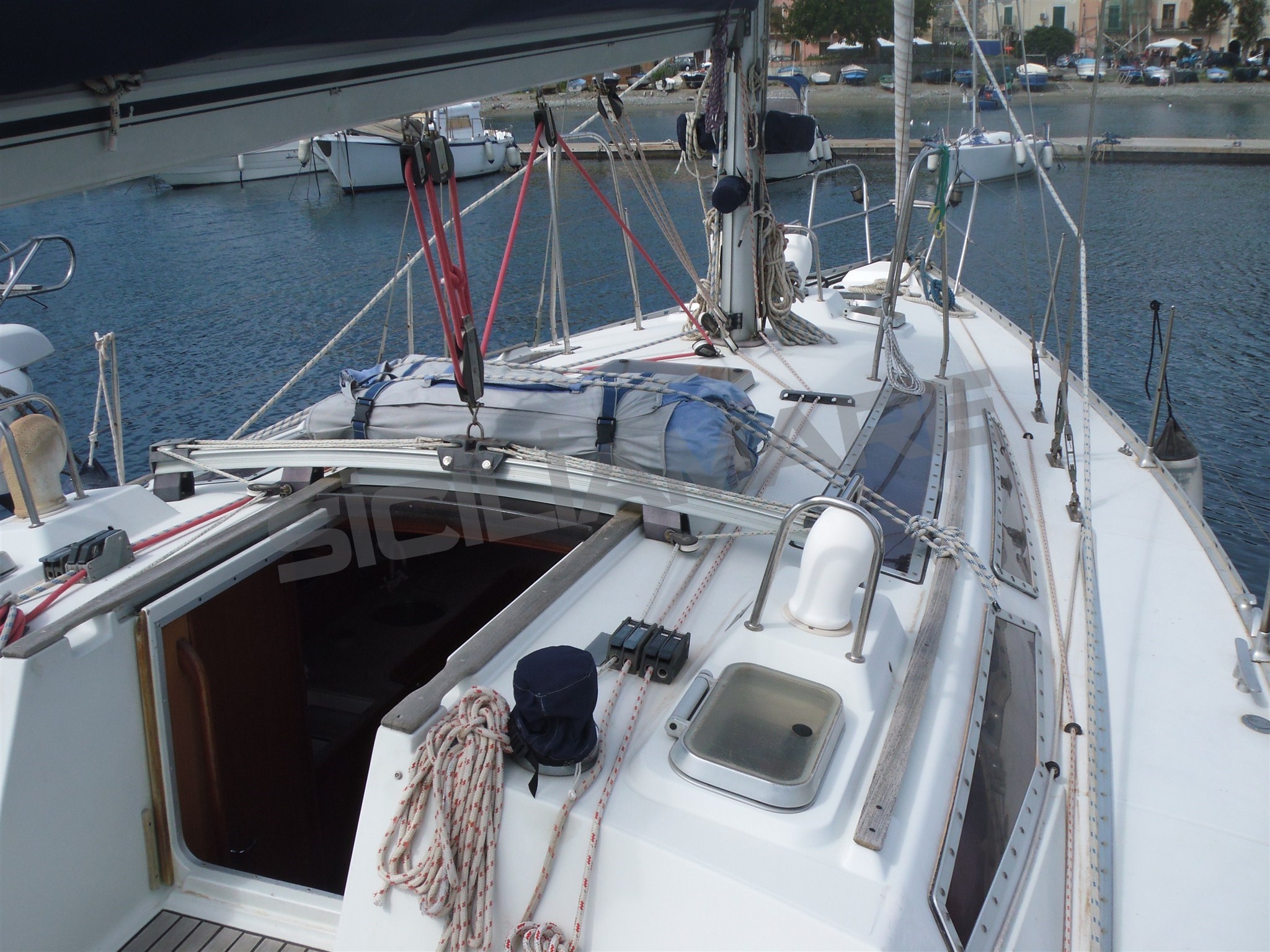
Mainsheet advice needed please!

I agree with the majority view that ball bearing blocks will reduce friction loads, but be sure you're sitting down when you look at the price of BB blocks that size, never mind triple sheave ones! The sheet does look ready for replacement. The forward turning block might be usefully moved onto the shackle/eye on the mast foot, it will give a better lead. Does not having a kicking strap/vang not cause problems when furling the main? The one time I sailed with a mast furler it was very fussy about the angle of the boom when furling.
There is a kicking strap, I just took it off to concentrate on the mainsheet. That is another story on it's own! I'm currently looking for blocks and the Selden ones seem a good compromise between cost and quality. The mainsheet itself is on the way, it's stiff and ready to be replaced. As for the blocks.......it looks like another raid on the piggy bank is due!
 
Much talk about ball bearing blocks not being good for a static load makes me wonder if the load on the balls will be static anyway. There will I think always be movement of the boom in a sea way when sailing. The times when you will pull the main sheet down hard.
Just as a matter of interest when gas turbine engines (jet engines) are being transported by road any distance they attach an electric motor to the engine to slowly rotate the internals to avert damage to the bearings.
In a similar vein here in Oz some people like to put their car on a train to traverse the continent. Some people have reported wheel bearing failure after a few thousand miles stationary on a train. So in both cases vibration without actual rotation damages the balls and track.
Anyway for my comment to OP I would firstly move boom block attachment forward to above the track. Hopefully comment above re boom not being strong enough will not apply. I would then try removing one or 2 of the purchases. By simply unreeving some loops from the sheeves. It seems to me that any tackle beyond 4 to 1 starts to lose power from the added friction. You may find 4 to 1 OK, perhaps using a winch to get that last bit of tension if needed. If he does need that large purchase 6 to 1 then yes look at dyneems smaller rope and bb blocks. (bring money!!!) ol'will
 
Much talk about ball bearing blocks not being good for a static load makes me wonder if the load on the balls will be static anyway. There will I think always be movement of the boom in a sea way when sailing. The times when you will pull the main sheet down hard.
Just as a matter of interest when gas turbine engines (jet engines) are being transported by road any distance they attach an electric motor to the engine to slowly rotate the internals to avert damage to the bearings.
In a similar vein here in Oz some people like to put their car on a train to traverse the continent. Some people have reported wheel bearing failure after a few thousand miles stationary on a train. So in both cases vibration without actual rotation damages the balls and track.
Anyway for my comment to OP I would firstly move boom block attachment forward to above the track. Hopefully comment above re boom not being strong enough will not apply. I would then try removing one or 2 of the purchases. By simply unreeving some loops from the sheeves. It seems to me that any tackle beyond 4 to 1 starts to lose power from the added friction. You may find 4 to 1 OK, perhaps using a winch to get that last bit of tension if needed. If he does need that large purchase 6 to 1 then yes look at dyneems smaller rope and bb blocks. (bring money!!!) ol'will

If you want to reduce the number of sheaves and retain the ability to induce tension I would add a fine tune system rather than use a winch, unless you happen to have a winch dedicated to mainsheet use. Replacing the current beefy mainsheet with a thinner dyneema line should work, but not if the friction has nothing to do with the rope. Buying dyneema and then finding is does not solve the issue seems an expensive route - find yourself some thinner line, try thinner line - if you still have problems then it has nothing to do which the mainsheet (the jury seems to suggest the blocks). If its nothing to with the mainsheet try one new block first (before you buy the second). See if you can rig up a fine tune with any spare blocks in your 'spares' bag. You are being offered lots of options (the advantage and disadvantage of a forum) most of which cost. Lots for you to do before you expose your wallet.

Jonathan
 
triple and single I would agree. But would not advise moving any of the blocks on the boom forward, unless the manufacturer (or a designer) of the boom says it would be ok. The boom size might be close to tolerance, so moving blocks forward could over stress it.

[Snipped]

Fair point. I think it extremely unlikely that moving the blocks forward 5-6 inches is likely to overload the boom though, and it will give a significantly better lead on the sheet.
 
I've got what I think is a totally over complicated mainsheet set up on my boat (pictured) and there's too much friction for my liking and nothing runs smoothly.

The boat is a 42 foot, 9 tonne production cruising boat and any ideas would be much appreciated!

Thanks loads, James
Good lord, how big is the sail? I crew on a 30 meter 100 tonne boat and we have nowhere near that number of blocks on the mainsheet.
 
rolling friction is always lower than sliding friction so ball and roller bearing will be better from a low friction point of view.

The down side is the Brinell effect of hard steel balls in a hard race will result in high wear depending on load.

Its a comprise lower friction but higher wear.

Any small movements on a loaded ball bearing will concentrate the wear at one point

As ol'will says with gas turbine engines the engines are rotated when on the ground to prevent damage to the bearings that are very high spec due to the very high rotational speed of gas turbine engines. The same with cars on trains.

The use of plastic balls (softer) in some blocks would both advantages and disadvantages in that the wear will be greater with comparable loads but will deform under high loads to reduce/prevent the Brinell effect
 
Definitely too much purchase on that, I’d say, James. I’ve tried to clock what other Jen 42’s have and it’s typically a selection of single blocks, not doubles. The only reason I could see for going with doubles would be a ‘German style’ twin winch/clutch sheet system.

Otherwise ours is becket up to single block aft, back down to single block (below becket), up to second single block, down to block on deck. So 4:1 I think. That could be improved upon with the addition of a fiddle block. No need for doubles.
 
Fair point. I think it extremely unlikely that moving the blocks forward 5-6 inches is likely to overload the boom though, and it will give a significantly better lead on the sheet. (emphasis added)

I think you are wrong here. The important thing, surely, is where attachment to the boom is, relative to the fixed block, when the system is in use. Look at it again with the boom in its close-hauled position: I suspect you'll find it pretty much in line with the track.
 
If you do choose ball bearing blocks, note that they may be rated for lower loads than plain bearing ones.

And if you go for a smaller diameter mainsheet, beware of choosing blocks to match, they may not be man enough as I discovered last season when I pinged a simple kicker system one.
 
Definitely too much purchase on that, I’d say, James. I’ve tried to clock what other Jen 42’s have and it’s typically a selection of single blocks, not doubles. The only reason I could see for going with doubles would be a ‘German style’ twin winch/clutch sheet system.

Otherwise ours is becket up to single block aft, back down to single block (below becket), up to second single block, down to block on deck. So 4:1 I think. That could be improved upon with the addition of a fiddle block. No need for doubles.

Thanks Dan. I have to say I’d prefer the simplicity of single blocks over a stack of triples and the cost factor of triples is pretty big. I’ll look into this further ??
 
Thanks Dan. I have to say I’d prefer the simplicity of single blocks over a stack of triples and the cost factor of triples is pretty big. I’ll look into this further ??
This was my favourite of the various setups I've seen!
Rigging.jpg

I make this 6:1 vs your 8:1 (although I'm not very good at 'purchases'...!) - so hopefully you wouldn't notice much difference in load. The kids could still sheet in without winches in light conditions!
 
I just looked at the photos of my 45 foot Jeanneau to check the arrangement. It had a 4:1 purchase arranged as follows: The bitter end of the mainsheet was tied to a boom fitting directly above the traveller. The rope came down from there to the upper sheave of a vertically stacked double block fitted to the traveller, from there up to a single block on the boom aft of the bitter end, back down to the lower sheave on the traveller block and up to a single block forward of the bitter end. Simple and it worked very well.
 
This was my favourite of the various setups I've seen!
Rigging.jpg

I make this 6:1 vs your 8:1 (although I'm not very good at 'purchases'...!) - so hopefully you wouldn't notice much difference in load. The kids could still sheet in without winches in light conditions!

I think you’re onto a winner here Dan, thanks for that. That set up, but with decent blocks and a new sheet and I think I’ll be in business! Thanks again ??
 
Looking at the above picture I make it 5:1, because the rope going forward from the traveller is angled well away from vertical and contributes less that the four near vertical ropes. Its a good setup and perfectly adequate. I calculated mine at 4:1 for the same reason. The real calculation is the ratio between the amount of rope pulled through the clutch on the coachroof and the distance that the boom is pulled downwards.
 
Looking at the above picture I make it 5:1, because the rope going forward from the traveller is angled well away from vertical and contributes less that the four near vertical ropes.

That doesn't make any difference. As you say, it's the mechanical advantage which is important.
 
Looking at the above picture I make it 5:1, because the rope going forward from the traveller is angled well away from vertical and contributes less that the four near vertical ropes. Its a good setup and perfectly adequate. I calculated mine at 4:1 for the same reason. The real calculation is the ratio between the amount of rope pulled through the clutch on the coachroof and the distance that the boom is pulled downwards.
The forward block on the boom has the ropes pulling at an angle, so the vertical component is reduced, plus it's nearer the gooseneck.
Even the rearmost blocks are around half way along the foot of the sail, so the velocity ratio is probably somewhere between 2 and 3?
(taking the leach tension as reference).
Our boat, a bit smaller has 6:1 near the end of the boom, muliplied by a 4:1 fine tune.
So, these boats are dependent on winches, so it might be best to look at the system as a whole? What winch do you have? Does having lots of VR in the block system make it better to use? Unless you have a very low factor winch, is the whole system too complex? Or is it nice to use in light airs without a winch?

Personally I don't like most of these cabin roof systems at all, I like to be able to control the main and steer at the same time.
 
Personally I don't like most of these cabin roof systems at all, I like to be able to control the main and steer at the same time.
It’s not too difficult to do a ‘German’ system conversion on these. There are a decent sized pair of aux winches aft and space for clutches etc. But it does mean a lot more lines running around the place. Guess it depends how ‘active’ the sailing is and the crewing situation? For ours, I don’t think we’d make enough use to justify it. The cockpit isn’t huge - although the wheel is (trapping the helm the wrong side of the coachroof lines!).
 
This was my favourite of the various setups I've seen!
Rigging.jpg

I make this 6:1 vs your 8:1 (although I'm not very good at 'purchases'...!) - so hopefully you wouldn't notice much difference in load. The kids could still sheet in without winches in light conditions!
That's only a 4:1 purchase, if you find that practical the OP may well be in the same position; it's worth rethreading the mainsheet and trying it out to see what it's like with the existing blocks. And definitely check the block on the deck by the mast foot; if the sheet is rubbing on the deck leaving the block that will cause a large friction load.
 
Last edited:
  • Like
Reactions: pvb
Top