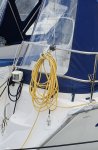
Mains cable coil

There is one other very important reason not to do this... a coil of cable with a current going through it produces a magnetic field.

Left near a compass it can permanently magnetise the compass.

Don't ask how I know this. :rolleyes:
 
There is one other very important reason not to do this... a coil of cable with a current going through it produces a magnetic field.

Left near a compass it can permanently magnetise the compass.

Don't ask how I know this.
Basic schoolboy physics says that the magnetic field would reverse direction 50 times a second producing no net field to affect the compass.
 
Basic schoolboy physics says that the magnetic field would reverse direction 50 times a second producing no net field to affect the compass.

Also being you have a line and neutral in the same cable in which the instaintance current is flowing in the opposite directions any magnetic field would be neutralized.
 
Also being you have a line and neutral in the same cable in which the instaintance current is flowing in the opposite directions any magnetic field would be neutralized.

I can assure you that if you stick a coil of shorepower cable with power going through it on top of a compass overnight it will permanently magnetise the compass. I have first hand experience of this
 
Basic schoolboy physics says that the magnetic field would reverse direction 50 times a second producing no net field to affect the compass.

In a piece of straight cable that may be the case, but a coil will produce an aligned field due to the effects of the coil.

Please feel free to confirm your beliefs though by trying it on your compass (y)
 
In a piece of straight cable that may be the case, but a coil will produce an aligned field due to the effects of the coil.

Please feel free to confirm your beliefs though by trying it on your compass (y)

That's why you see Concert crews and TV OB crews figure 8 the cables - 2 coils in opposite directions negating each other.
 
When I purchased my boat last year it had quite a big shore power lead coiled on the pushpit. Apparently the boat has been on the same mooring since new in 2006 and wouldn't suprise me if it's the same cable (quite a bit of UV damage). Fan heaters had been used onboard.

No apparent effects to boat or cable. I changed it for a short cable pretty quick though. More because it looked terrible and definitely not ship-shape! Used the rest to make an extension lead for when I need it.
 

Attachments

  • 20210121_123734.jpg
    20210121_123734.jpg
    358 KB · Views: 15
Also being you have a line and neutral in the same cable in which the instaintance current is flowing in the opposite directions any magnetic field would be neutralized.
Agreed. The instantaneous current flows are in opposite directions in the live and neutral conductors, and so would cancel each other out. If you had somehow separated the conductors and had either live or neutral ONLY coiled up near the compass (and the other conductor some way away) you would get a 50Hz alternating magnetic field. The compass is too heavily damped to respond to that, however. A ferrite permanent magnet in a compass needle is pretty robust (high coercivity) so not sure what dolabriform managed to do that wrecked his...
 
When I purchased my boat last year it had quite a big shore power lead coiled on the pushpit. Apparently the boat has been on the same mooring since new in 2006 and wouldn't suprise me if it's the same cable (quite a bit of UV damage). Fan heaters had been used onboard.

No apparent effects to boat or cable. I changed it for a short cable pretty quick though. More because it looked terrible and definitely not ship-shape! Used the rest to make an extension lead for when I need it.

That's no problem as it's not near anything such as a compass and the coils are fairly big and outside so heat will dissipate somewhat. But I agree the aesthetic is not very pleasing ;)
 
Last edited:
Agreed. The instantaneous current flows are in opposite directions in the live and neutral conductors, and so would cancel each other out. If you had somehow separated the conductors and had either live or neutral ONLY coiled up near the compass (and the other conductor some way away) you would get a 50Hz alternating magnetic field. The compass is too heavily damped to respond to that, however. A ferrite permanent magnet in a compass needle is pretty robust (high coercivity) so not sure what dolabriform managed to do that wrecked his...

Have you tried it?
Have you put a large coil of powered up mains cable on top of your compass and observed the results?
On another note, coil up some mains inside the boat and stick it on top of your fluxgate, and see what happens
 
<btw> It didn't deflect the compass, it just stayed stuck pointing where it was. I left for a month and it didn't come unstuck ( as in I waited for a month before replacing the compass ). So maybe that will help to diagnose what happened internally.
I spoke to the manufacturer and they were aware of this happening to others
 
<btw> It didn't deflect the compass, it just stayed stuck pointing where it was. I left for a month and it didn't come unstuck ( as in I waited for a month before replacing the compass ). So maybe that will help to diagnose what happened internally.
I spoke to the manufacturer and they were aware of this happening to others
Sounds like you managed to demagentize it, which is quite an achievement. I've got a crappy old sighting compass somewhere, so I will see what a mains lead does to it later...
 
Yes it sounds like the magnets of the compass were demagnetised. When doing magnetic particle crack testing of crankshaft (for aircaft) The crankshaft can end up magnetised. A problem for planes compass. Shaft should be removed from the magnetising coil too a distance before field is turned off. If you switch off with the shaft in the field it may be switched off at a peak of current leaving it magnetised.
Anyway yes the compass may have been demagnetised by an AC field. But it does not answer the question of how you can get a magnetic field from a cable coil when current is flowing through active and neutral both adjacent both twisted together. ???????????? ol'will
 
That's why you see Concert crews and TV OB crews figure 8 the cables - 2 coils in opposite directions negating each other.
The reason camera cables are figure-eighted is to cancel out mechanical twist in the cable, not magnetic induction. You move the camera away and thus pull more cable from the eight without the cable twisting and snagging on itself
 
Also being you have a line and neutral in the same cable in which the instaintance current is flowing in the opposite directions any magnetic field would be neutralized.
Correct. I spent a couple of years of my life developing test protocols for AC losses in superconductors, and all my test coils were "bifilar" (made with a doubled up piece of wire with two ends emerging side by side) to avoid any inductive effects. I suspect that the compass damage was heat-related.
 
Correct. I spent a couple of years of my life developing test protocols for AC losses in superconductors, and all my test coils were "bifilar" (made with a doubled up piece of wire with two ends emerging side by side) to avoid any inductive effects. I suspect that the compass damage was heat-related.

Compass was mounted on a bulkhead, cable coil was laid on top of the coach roof about a foot above it, so unlikely it was heat
 
Correct. I spent a couple of years of my life developing test protocols for AC losses in superconductors, and all my test coils were "bifilar" (made with a doubled up piece of wire with two ends emerging side by side) to avoid any inductive effects. I suspect that the compass damage was heat-related.

What if the lead is connected or disconnected while on load on the peak of a half cycle? It seems hard to believe there would be enough magnetic flux to demagnetise a compass needle.

My earlier post regarding electrolytic corrosion is no myth though. If you wrap a mains lead around damp metal you do get electrolytic corrosion.
 
Top