Main halyard allowed to exit mast by boatyard launchers- what are my options?

fredrussell

Well-Known Member
Joined
24 Mar 2015
Messages
4,173
Visit site
In a very excited mood I went down to my newly purchased and launched boat (moored at Pin Mill nr Ipswich) today only to find that when the local boatyard stepped the mast they didn't cleat off the main halyard - one end was made fast to the pushpit, the rest of it was in the river under my boat. I'm new to yachting, this being my first, so I reckon I haven't got a hope in hell of proving to the boatyard that it wasn't my error that resulted in this state of affairs. I just can't believe that an experienced yard worker would make such a schoolboy error as to leave a halyard at the mercy of gravity and the wind.

I'll ring them tomorrow, but assuming they're reluctant to rectify this situation post haste (they're obviously very busy at the mo) I'm wondering what my options are to sort this out. I figure I can use the topping lift to raise the main, but I would really like to get that halyard back in place asap. The boat is a Jaguar 23 with pivoting keel, so not a huge amount of ballast there to go shinning up the mast.

The boat came with an A-frame for lowering/raising mast so getting mast down myself is not out of the question, bit with the mast horizontal how does one get the halyard threaded through the mast. I'm assuming that task will be a lot easier with mast vertical so that halyard can be fed in the top 'slot' and its weight will pull it down to exit point at bottom of mast. The only method I can come up with is to let the boat dry out with the 8" protruding keel housing sunk into the mud, and then to get a ladder up the mast to feed halyard down. Obviously if the boat tipped over at this point all could be lost, but thats the only way I can think of doing it. Oh for a bilge keel now...

I realise the boatyard should sort this out, but I can picture my boat being moved to the back of the launching queue. I'll report back tomorrow after speaking to them but in the meantime any advice to a beginner would be most appreciated.
 
I have had fun with this.

With the mast up I had the benefit of our club's mast crane, which has a ladder up the back. Once up there I dropped a weighted finer line down and fished it out at the bottom. I had to do it a couple of times to get it just right. One you have a finer line threaded top and bottom I tied the actual halyard to it and pulled it through.

I did it with the mast down as well, but not sure how. I think I used something stiffer (like an old shroud?) which could be pushed through and down the mast plus some gravity.
 
I amused the neighbours by taking the masthead of my Jaguar 23 to an upstairs window, removing the masthead casting and dropping a golf ball stapled - literally - to a length of twine down the mast then using this to pull the halyard.

In your case, I'd hope the yard would sort it out asap: the problem can't really have been caused by anyone else, can it? If they are unwilling to help, is there anywhere you could take the boat - bridge, waterside building, bigger boat - where you could get access to your masthead to drop a mousing line (a light cord attached to, say, a shackle pin) over the halyard sheave and then use this, at your leisure, to pull the halyard through?
 
Up the mast is the best option. how heavy are you? If you have doubt about stability hang on the topping lift while standing on a pontoon if you can do that without pulling the boat all the way over then you won't tip it over if up the mast. Could you send a someone light up?
 
A horrible problem. I would start with the mast lowered using the A frame and a prop at the transom. If you can locate the boat at a high wharf and rotate the boat so the mast head is over the wharf or even a step ladder you can access the mast top. I would be inclined to remove the top sheave making it easier to get a weight and mouse line in. With the angle of the mast you may be able to get a bit of mouse line in. You would have to raise the mast to near vertical to get the wieght and mouse line to drop. You may then have to lower the mast again to feed in more mouse line if it won't drop with the mast vertical.
With the top shaeve removed it may be pratical to tape a mouse line or the halyard to the existing topping lift. This hopefully will bring the end of the halyard to a point where you can fish it out at the mast bottom. You will have to remove any turning blocks in the mast. If you have slots for the halyards to exit the mast then it bocomes a bit more tricky to fish out the mouse line or topping lift and halyard taped together. A hooked piece of wire or a loop might catch it.
I have always used rigging wire pushed in with the mast horizontal for putting in halyards on new masts. Witha slot exit it is easiest to start at the slot.
I would recommend you set the baot up for self mast lowering. I suggest a quite high A frame or strut at the transom so you just lower the mast to a height you can reachwhile standing on the seats at the transom. Be careful to not allow mast to sway sideways as that will damge the mast base. In flat waters a person may be able to support the mast sideways as it comes down. If you really want to go sailing then I sugfgest you will have to use the topping lift until you cna sort the main halyard problem. Topping lift however will typically have a lot of stretch so not really suitable. good luck olewill
 
Up the mast is the best option. how heavy are you? If you have doubt about stability hang on the topping lift while standing on a pontoon if you can do that without pulling the boat all the way over then you won't tip it over if up the mast. Could you send a someone light up?

A friend of mine tried that with a squib to retreive a lost spinnaker halliard. He put it alongside the quay at Lowestoft & pulled the main halliard to tip the boat a bit to reach the mast

He got to wear the " Dick of the week" jacket when his mast broke-- Worst thing was that it was a borrowed boat
 
Try this! With mast lowered, remove topping lift sheave and pull out a little. Run a mouse around the halyard sheave and fish out and attach to topping lift rope securely below sheave. Replace topping lift sheave.Attach a rope to boom end of topping lift. Then pull topping lift rope to foot of mast and halyard mouse should appear at foot of mast. Then repeat sheave process at foot. Take particular care with correct lead of mouse. When halyard fixed then pull down rope attached to topping lift and re fasten to boom.How do I know this works? Guess! But my mast was keel stepped!
 
Easiest way I found to run wires and lines when the mast was down, was to use an old piece of rigging wire out of the skip which is stiff enough to push along the mast with mouse line tied to it. Always a good idea to thread 2 mouse lines and leave the spare in place for future jobs.
 
I use whipping twine with a few smallish nuts ( threaded type not Brazil )- this will go through the top sheave, then with the mast raised a few feet that end, jiggle mast until the nuts can be grabbed through the lower sheave with a bent bit of wire.

This does of course mean lowering the mast, but with a similar sized boat I have found this the only practical way, and not really too much hardship with a pivoted step; not stable enough for a person to go to the top, but very surprisingly high when looking at dock walls which had previously seemed towering...
 
I have found using a length of bicycle chain good as a mousing line weight. It flexes round the sheaves but is then heavy enough to the act as a weight. Good luck
 
If you think about it, your weight up the mast isn't going to exceed the force of the wind in the sails. So, if the boat is stable enough to sail, you should be able to climb the mast. Of course, this only applies to ballasted vessels; it isn't true for dinghies! It might be a bit wobbly up there, but it is unlikely you'd tip her over.
 
I'd suggest that either
a) The boat is stable enough for someone to go aloft (albeit with some extra care as you only have one "halyard" up there just now), or
b) If not, then she could readily be "hove down", without breaking anything (cf post #7). Heaving down used to be a regular technique to careen sailing ships - albeit they would add a lot of extra stays etc to distribute the loads fairly.

One approach would be to try heaving her down simply by, say, two people standing on a pontoon (or the hard) pulling on a shroud hand over hand, perhaps with a third relatively gently pulling on the topping lift from further away. If this proves too hard, then surely she's stable enough for one person to go aloft?
 
Last edited:
One approach would be to try heaving her down simply by, say, two people standing on a pontoon (or the hard) pulling on a shroud hand over hand, perhaps with a third relatively gently pulling on the topping lift from further away. If this proves too hard, then surely she's stable enough for one person to go aloft?

We have done that with lifting keel Sonatas (with their keels up) a couple of times at our club.
 
If you think about it, your weight up the mast isn't going to exceed the force of the wind in the sails. So, if the boat is stable enough to sail, you should be able to climb the mast. Of course, this only applies to ballasted vessels; it isn't true for dinghies! It might be a bit wobbly up there, but it is unlikely you'd tip her over.
+1 to that.
I've been up in a light, lift keel 24ft'er at sea. And I'm not light!
Only snag is if it's a fractional rig as I would t want to go up on the topping lift.
 
Assuming that the topping lift goes inside the mast then fix TWO light lines to the bottom of the topping lift.

Pull the topping lift from the boon end until both light lines have exited the top of the mast.

Remove one of the light lines and fix to the main halyard to pull it through the mast. Use the other light line to pull the topping lift back through the mast to its original position.

Job done.

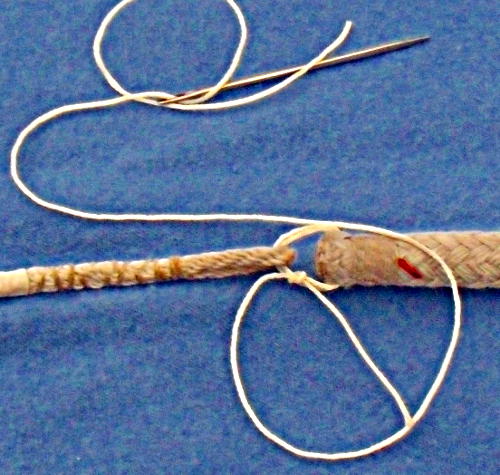
For safety's sake I would sew the light lines to the topping lift and halyard rather than just taping them.
 
If the mast is to be taken down, surely a fish tape is the way to go? Having discovered that tool, I have used it in various tasks on the boat and mast.
 
For safety's sake I would sew the light lines to the topping lift and halyard rather than just taping them.

Or stitch loops on the ends like this:-

attaching-messenger-line.jpg
 
Top