Lowering and raising a Moody 30 mast. Possible or not?

Yeoman_24

Well-Known Member
Joined
15 Jun 2014
Messages
176
Location
Gloucestershire
Visit site
Done some forum searching but just found loads of broken links. (Might just be my rubbish old iPad and searching skills of course!).

Has anyone ever lowered the mast on a Moody 30 or similar and if you have (or haven’t and have ideas, advice and suggestions) I’d love to hear about it.

I have 3 strong crew including me, all ready and raring to go if it is possible!

Thanks.
 
See my comments re Refueler's question on mast lowering. Yes masts are regularly dropped for bridgs here on boats a lot bigger than 30ft. However you need gear to get organised. Assuming you have a deck stepped mast on a base that will hinge the mast backwards. You need a prop at the transom stayed and secured to catch the mast. You nedd a tackle on the forestay or a halyard to lower and raise the mast. You need a gin pole or better 32 poles to improve the angle of pull of the tackle when the mast gets lower than 45 degrees. You need a way to keep the mast on centre as it traverses down and up. This can be done with a person just holding the mast. However if you are on water look out for waves or wash that rocks the boat. Just keep searching this forum. ol'will
 
Done some forum searching but just found loads of broken links. (Might just be my rubbish old iPad and searching skills of course!).

Has anyone ever lowered the mast on a Moody 30 or similar and if you have (or haven’t and have ideas, advice and suggestions) I’d love to hear about it.

I have 3 strong crew including me, all ready and raring to go if it is possible!

Thanks.


I'd say it's possible (as long as there is a pivot at the foot) but fraught with problems. Lowering a mast that size has a fierce momentum. If your A frame, or stays, go tight you can damage the deck, or the opposite happens and you twist the heel fitting. At a certain point you are lost and an unstructured landing could damage the pushpit, deck and mast

Much better to sort out your set up over winter and try erecting the mast next spring. Once you have felt the weight of the item you will have a better idea. I used to take down the mast of my 26 footer every season, the present boat is a similar size to yours and nothing would tempt me to try it :cautious:
 
The safest and best way is always the yard crane . derrick .... the guys should be experienced and if anything goes wrong - you can always claim on their insurance.

There are others such as myself - who do not have access to such and need to improvise. I'm banged ideas round my head for years since bringing my boat to Latvia. Ideas from renting / buying a trailer 'Cherry Picker' to creating a derrick system at my pontoon area. But my other problem is I need to RAISE the mast other side of the bridges ....

The best for me is in fact a small flatbed van with a Chair lift (Cherry Picker) ... seems a bit OTT ... but think about it ... all those masthead jobs ... my Windex V arms have a mind of their own and never stay correct ... my spinnaker halyard pulled through and needs re-threading .... plus of course able to raise / lower mast with ease. But the cost !!
 
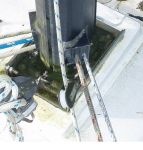
My Seawolf 30 has a hinged base on the mast. I asked the mast maker (Boyce Spars - found an old contact email address) whether it was meant to allow raising and lowering of mast. He said yes, but I think I would lack the courage to use it - the mast is very long (maybe near 14m) and heavy for a 30 foot boat. I used to do this regularly with my first boat by myself - a GK24. Everything was so much lighter. When I haven't had a club crane around I've gone to a marina and had them lift the mast into place.

Mast Base.png
This is a pic from when I bought the boat. Very much tidier now. But you can see the mast base is on a stainless plate which sits inside another stainless plate which is attached to the deck.
 
Last edited:
Always remember that the forces involved can be far too high to be managed by man-power alone unless levers etc. are used to change the angles involved. The obvious way to lower a mast is to use the forestay to lower it. That won't work - as the mast gets lower, the mechanical advantage drops to zero and the tension required to support the mast increases exponentially to infinity! And I have first-hand experience of this - my dad did exactly that when lowering the wooden mast of our first boat, lost control as the forces increased beyond what he could hold and very nearly brained my mother who was waiting to catch it and take it down the last bit! I was about 8 or 9 at the time, but it made a lasting impression on me. You need an A-frame or similar to change the angle so that the forces don't increase beyond those that the equipment and people on hand can manage. The sideways forces are also quite considerable, and you need to consider how to control the side-to-side movement of the mast; the shrouds are rarely positioned so that they will do the job.
 
I doubt that a Moody 30 has a hinged mast foot. I had a Moody 28 and the mast sat in a shoe so has to be lifted. I had the mast taken down a couple of times at a small boatyard. They used a hand powered derrick with a strop under the cross-trees. Some clubs and boatyards have similar derricks but many are becoming obsolete due to regulation.
 
Definitely get the boatyard lower it safely - I have a Moody 33 and the mast is B***** heavy! I have lowered the mast on a Halcyon 23, but ashore on a windless day with 3 helpers.
 
Depends where you are. It can EASILY be lowered between two other yachts with a line through a block hoisted almost to the top of the masts (spinnaker halliard) Disconnect lowers and then pull the strop up to the spreaders and take the strain just enough to support the mast. disconnect caps and foil, lift a little more then walk the foot of the mast to the bow while easing down on the 'crane'boats. / Team required : wincher and tailer on each crane boat ( unless super electric self-tailers!) person at foil drum, one-maybe two at mast base depending on experience, others to shout and give superfluous guidance. Tip - don't stand underneath it in the cockpiti
 
Its interesting how a small change in boat size and mount can alter the job.

My Snapdragon 23 had a tabernacle that was secure and allowed myself and my young son to raise and lower mast without problem ... and without any additional gear.
My Sunrider 25 although only 2ft longer - there is no way just myself and son could do it same. Even with 3 'men' it was still brown trousers !!
 
Boats of that size and bigger regularly lower and raise their masts using the Hardway derrick.
Milady (limited mobility) and I lowered our mast with no problem a couple of years ago. The trick, especially if you're shorthanded, is to let the tide go out so you're parked on the mud, otherwise some bugger is sure to go by making as much wake as he knows how at just the wrong moment.
 
Tudor Club .... sitting on mooring ... son and I lowering mast ... bunch of Jet Ski's shot past making boat lurch about ... son and I managed to hold on to mast and luckily it didn't do any damage.
Langstone Harbour Master - not called by me - was already on to them and caught them just after ...
 
Against my better judgement I helped a friend do it on a 27 footer, and we had some tenses moments. All club boats were ashore, and his bow was nosed up between my stern and the boat next to me.
His mast was hinged at the base, we attached two mast head halyards from the front boats to his jib halyard and took it to the top of the mast. We eased our halyards down together to lower it onto the top of an A frame erected at the back of the pushpit.
It wasn't easy as the mast got lowered the it wanted to slew left and right putting a lot of leverage on the tabernacle. However we were lucky, and with two people struggling on the deck to keep it straight it came down okay, but with hindsight we all felt there was a lot that might have gone wrong.
 
I always ask myself what the cost of repairs would be if it goes tits up. 50 squids for a crane (15 mins) is a darn sight cheaper than re-rigging large areas of deck and replacing knackered stays.
 
Top