Low heat on boat during winter - encouraging mould?

Some people see risk in everything. I am surprised such people go boating.

I guess if you look hard enough on the subject of any type of electrical product or machine or any activity there is probably evidence of something going horribly wrong.

It seems compressor type dehumidifiers are considered slightly greater risk compared to the desiccant type. On both the regular cleaning of air filters is important.
Are Dehumidifiers A Fire Risk : What You Need To Know

The fire I linked to in post 10 was caused by a desiccant dehumidifier, a brand recommended on these forums, and the filter was checked 3 days before the fire.
 
*Dry bilges* matter

I'm quite fanatical about this. After every trip (and of course after lift-out) I lift the centre plate of the cabin sole, pump out any water with a Pela pump, swab the bilges dry, and then spray with disinfectant before putting the sole plate back down. I've fitted a handle to the edge of the plate to make this easier.
 
As other have said, ventilation together with reducing mosture (dry bilges, no leaks) is the key. Heat helps, rather than hinders, as warmer air can hold more moisture than cold air.

Hence heat and ventilation work well together. Ventilation draws in cold air that cannot hold much moisture and as this air heats up its relative humidity will drop. One of the main keys to avoiding mould is to reduce the relative humidity.

I don’t agree with the statement that temperatures under 20°C will stop mould growth (although growth will slow down at very low temperatures), but most species of mould has great difficulty growing in conditions of low relative humidity.


Dehumidifiers also work well for the same reason (although I have never used one). As always you need to balance the risks of leaving heating and/or dehumidifying appliances running when the boat is unattended, but both methods will work to reduce mould.
 
I hope those of you using dehumidifiers are well insured. Only a month ago Iain789 posted photos of his boat after his dessicant dehumidifier caught fire. The boat is a write-off.
Meaco's desiccant dehumidifier is very popular because it has won some awards and apparently because desiccant dehumidifiers extract the most water per hour at temperatures below 10°c.

However Meaco's own website states that condenser dehumidifiers are cheaper to run, on the basis of electricity used per litre of water extracted from the air.

The difference in extraction rates is remarkable - a desiccant dehumidifier extracts several times as much water per hour at low temperatures, and it's the oppose way around above 15°c or 20°c. But that just means that, with water dripping off the ceiling of a 40' boat, the right dehumidifier will get it completely dry in a few hours, and the wrong one will take 2 or 3 days.

Shopping for a condenser dehumidifier I preferred the dimensions of the Seago Smart Dry 2 to any of the Meaco ones. The extraction rates and efficiency seems the same across all models of condenser dehumidifiers - I liked the styling of the Meaco ones, but they were more boxy.
 
...

*Dry bilges...
Absolutely.
Step one. Keep the rain out. All of it! Every last drop.
Venting the boat is great when it's a nice sunny day.
When it's Portsmouth Mizzle outside, you're just changing wet air for more wet air.
Same as in your car, heating helps enormously. When combined with vents or a breathable cover

But if there's pools of water under floorboards, or miles of wet rope, then the air in the boat will always be wet.

The other thing is, getting on the boat frequently all year and wiping down any surfaces prone to condensation with a bit of Dettox or whatever will prevent mold growth.
Ignoring the boat for 4 months is a bad idea.
Get down there, open it up and clean it whenever the sun comes out.
 
I currently have lots of ventilation. Hole in the hull where I've removed the saildrive and a portlight open covered with a tarpaulin. Boats bone dry and fresh inside
 
Meaco's desiccant dehumidifier is very popular because it has won some awards and apparently because desiccant dehumidifiers extract the most water per hour at temperatures below 10°c.

However Meaco's own website states that condenser dehumidifiers are cheaper to run, on the basis of electricity used per litre of water extracted from the air.

The difference in extraction rates is remarkable - a desiccant dehumidifier extracts several times as much water per hour at low temperatures, and it's the oppose way around above 15°c or 20°c. But that just means that, with water dripping off the ceiling of a 40' boat, the right dehumidifier will get it completely dry in a few hours, and the wrong one will take 2 or 3 days.

Shopping for a condenser dehumidifier I preferred the dimensions of the Seago Smart Dry 2 to any of the Meaco ones. The extraction rates and efficiency seems the same across all models of condenser dehumidifiers - I liked the styling of the Meaco ones, but they were more boxy.
I have a Maeco desiccant, since my condenser one failed after many years use. I was surprised how much electricity the new one used at first, but with a sealed boat it drops to very low figures after a couple of weeks. Granules can be useful in small boats, or in my case in the cockpit locker where the charger is sited.
 
Meaco's desiccant dehumidifier is very popular because it has won some awards and apparently because desiccant dehumidifiers extract the most water per hour at temperatures below 10°c.

However Meaco's own website states that condenser dehumidifiers are cheaper to run, on the basis of electricity used per litre of water extracted from the air.

The difference in extraction rates is remarkable - a desiccant dehumidifier extracts several times as much water per hour at low temperatures, and it's the oppose way around above 15°c or 20°c. But that just means that, with water dripping off the ceiling of a 40' boat, the right dehumidifier will get it completely dry in a few hours, and the wrong one will take 2 or 3 days.

Shopping for a condenser dehumidifier I preferred the dimensions of the Seago Smart Dry 2 to any of the Meaco ones. The extraction rates and efficiency seems the same across all models of condenser dehumidifiers - I liked the styling of the Meaco ones, but they were more boxy.
I find the desiccant works fine - even when cooking and drying clothes is the cabin when it’s pouring and all hatches closed. If you are taking litres out of the air the boat must already be very very damp. What we find is that by having the dehumidifier on, all cupboard and wardrobe contents dry too so so little extra moisture gets absorbed fast then dried out over time.
 
The fire I linked to in post 10 was caused by a desiccant dehumidifier, a brand recommended on these forums, and the filter was checked 3 days before the fire.

I don't doubt the facts you have stated.

However a single , or indeed several similar instances of an unfortunate event doesn't make a procedure unsafe or inapprporiate.
If it did we would not be doing a lot of things that are considered part of normal everyday life.

Its clear from past discussions on this forum a lot of boaters do use dehumidifiers with no issues .

There is also reference on the Meaco website to their products being suitable on boats and pbo did a product test which all backs up the principle of using dehumidifiers on boats as being sound and in common use.

Dehumidifiers for Boats Archives - Meaco
PBO Tested: Meaco DD8L Zambezi dehumidifier - Practical Boat Owner
 
I don't doubt the facts you have stated.

However a single , or indeed several similar instances of an unfortunate event doesn't make a procedure unsafe or inapprporiate.
If it did we would not be doing a lot of things that are considered part of normal everyday life.

Of course that's true. But you'll note that in post 10 I just said "I hope those of you using dehumidifiers are well insured." Not every boat owner is fully insured for all eventualities.
 
My tactics is to reduce the humidity by absorbing the moisture by hanging socks filled with road salt above buckets and reduce the ventilation to minimum. Many of my friends rely on good ventilation and do not use any kind of dehumidifiers. I know that some people try to combine the ventilation and dehumidifiers, but for me this does not make any sense. You cannot dry the whole atmosphere.
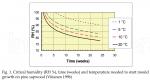
It is the combination of temperature and relative humidity that matters. The following graph is the view from a scientist who has studied this subject for a long time. The GRP boat is not exactly pine sapwood, but I guess this shows the idea.

Mould.png
 
I am the proud owner of 3 dehumidifiers.
The first one was for one of our houses that never seemed to dry out after being built. This was then borrowed by one of my sons who had a flat but no access to an outside wall to for a tumble dryer. I thought I would never see that one again ( sounds familiar ?) so I bought a second one. Then the second son moved into damp basement flat so – yup I lost that one as well. The where both condenser/evaporator type The third, which I have managed to hang onto so far, is a Meaco ( recommend by the forum ) for the boat whan it is out of the wter as this would / could be subject to frost and I have to say it is very efficient. I used it last weekend to dry out the car after washing the seats and carpets – it was dry within a couple of hours. I also use tablet dehumidifiers during the winter when the boat is in the water. So far so good on the mold front. Now the canopy and mailsail bag/cover is a totally different matter!!!!
 
Top