Long term plans, realistic scenario for circumnavigation?

That's a matter of opinion really.
If you go around the world following typical yacht routes for an AWB, how many really long passages are there?
You might find there are about 20 days when vane gear is a real improvement on autopilot.
If you are 3-up or more, hand steering if the pilot breaks won't actually prevent you getting anywhere.
And the relaibility of vane gear is not 100% either, it tends not to get the problems sorted out until you've done a few long passages, I know people who've had it fail before half across the Atlantic.
It's really only essential for singlehanders with limited electrical power.

With regard to the electical power side of things, I've already replaced everything I can with LED versions, have increased battery capacity, added solar and MPPT charger.
I read contradictory articles on the auto pilot debate. Some say don't bother with the vane and others swear by them. I'd imagine that unless you've had an AP break down or run out of power to run it mid passage - it's not an issue.

I'd want to have a small generator on board to at least provide some rudimentary back up in the case of no sunlight for our solar panels. Of course that brings along the issue of storage of fuel etc - but same as outboard.
 
We have an Awb and bathing platform massively more important than windvane almost all the time. We are not planning the Pacific so for us the only passage which would be grim if autopilot breaks is Cape Verde to Barbados - so we are taking two friends with us for that trip and company.
 
I read contradictory articles on the auto pilot debate. Some say don't bother with the vane and others swear by them.

Again..... it depends :)

A quick ARC or round the Med then LX would probably be OK, plenty of places to get it fixed along the way if it dies. Further afield it's a different story, overnight deliveries can take weeks stuck in a dirty harbour wandering round whatever shop/office looks like it might arrive in and you might get hammered for import tax. At least with a wind vane if it breaks chances are you'll get it to work a bit with duck tape and cable ties/epoxy. Also helps a little by not cycling your batteries so much overnight. Then if the batts do die at least you should be able to carry on to the next country/continent where decent batteries are actually available. Hand steering in the tropical sun really isn't something you'll want to make a habit of...
 
We have an Awb and bathing platform massively more important than windvane almost all the time. We are not planning the Pacific so for us the only passage which would be grim if autopilot breaks is Cape Verde to Barbados - so we are taking two friends with us for that trip and company.

Not everyone regards actually sailing their boat as 'grim'.
 
Sea-devil, sounds like you have a good, well-thought through plan.

On the basis of my experience, given there will be just the two of you and you are both getting on towards retirement, that you should plan to replace the Bavaria for a more purpose-designed blue water cruiser. There are a host of reasons for this. Do not be dissuaded by those whose experience of long-distance, long-term sailing is limited, perhaps to an ARC crossing.

I very much agree with Billyo that before you make a firm decision you should take every opportunity to try out long-distance sailing together.
 
This page was reloaded because of a failure,just get out there and take the good and the bad all part of the getting away from regime ted life on land,the sea is our one last escape
 
That's a matter of opinion really.
If you go around the world following typical yacht routes for an AWB, how many really long passages are there?
You might find there are about 20 days when vane gear is a real improvement on autopilot.
If you are 3-up or more, hand steering if the pilot breaks won't actually prevent you getting anywhere.
And the relaibility of vane gear is not 100% either, it tends not to get the problems sorted out until you've done a few long passages, I know people who've had it fail before half across the Atlantic.
It's really only essential for singlehanders with limited electrical power.

The big benefit of the wind self steering is the fact it doesnt use electricity. On a small boat with no generator you will be running the engine to charge batteries. The wind self steering will vastly reduce your power requirements.
Our Windpilot steers very well such that when on a passage of more than 24 hrs we use it rather than the autopilot. Why wouldnt you. We also have a powerful below decks autopilot and a complete spare so we aren't worried about the reliability issue of the autopilot, its just so nice on the Windpilot. What failed on the wind self steering gears you are referring to? We know plenty of people with wind self steering and I can think of a single failure.
A friend of mine has just sailed from Panama to Easter Island to Marquesas to Hawaii using a 40year old Aries. He has no autopilot. It didnt break.
 
The big benefit of the wind self steering is the fact it doesnt use electricity. On a small boat with no generator you will be running the engine to charge batteries. The wind self steering will vastly reduce your power requirements.
Our Windpilot steers very well such that when on a passage of more than 24 hrs we use it rather than the autopilot. Why wouldnt you. We also have a powerful below decks autopilot and a complete spare so we aren't worried about the reliability issue of the autopilot, its just so nice on the Windpilot. What failed on the wind self steering gears you are referring to? We know plenty of people with wind self steering and I can think of a single failure.
A friend of mine has just sailed from Panama to Easter Island to Marquesas to Hawaii using a 40year old Aries. He has no autopilot. It didnt break.

All true, but if you have to balance expenditure, then some people get more value from a generator than a vane gear.
A vane gear is a good thing to have but not an essential. Many people have happily crossed oceans without.

Does anyone have any good data on the typical daily Ah consumption of an autopilot on say an ARC circuit?
I'v heard claims that it can be much less than you might think, once you are properly offshore in ocean breeze?
I've never had the chance to look at it properly.
 
The big benefit of the wind self steering is the fact it doesnt use electricity. On a small boat with no generator you will be running the engine to charge batteries. The wind self steering will vastly reduce your power requirements.
Our Windpilot steers very well such that when on a passage of more than 24 hrs we use it rather than the autopilot. Why wouldnt you. We also have a powerful below decks autopilot and a complete spare so we aren't worried about the reliability issue of the autopilot, its just so nice on the Windpilot. What failed on the wind self steering gears you are referring to? We know plenty of people with wind self steering and I can think of a single failure.
A friend of mine has just sailed from Panama to Easter Island to Marquesas to Hawaii using a 40year old Aries. He has no autopilot. It didnt break.

No the windvane did not break , and then again there are autopilots out there still going strong , I fail to belive in this age that modern Autopilots configured correclty to the condtions and maintained will fail.
I suspect that on production boats these autopilots are desgined and mass produced for cost reasoning to be at the margins of going blue water for any lenght of time, therefore the owner is at fault not the Auto Pilot
I am sure there are Windvanes that break (I have read of such) as again poor maintenance and lack of awarness from the Owner .
If you have plenty of power (Solar. Wind) a good down below overspeced pilot should see you through , how much power are you burning in the middle of the deep blue, switch of your radar , all instruments not needed , etc, sit back and enjoy.
A good Windvane will set you back £5000 I got my Auto piliot by mix and matching for less than £3000 so there is a price as well
This is not to so do not get a windvane as those that have them swear by them but do not be afraid not to have one as I said before it will turn into an anchor bashing thread :p
As said before you will spend less time at sea than you think and more relaxing on the hook or marina , take this into mind,
Some good books to read , I find books better that youtube as there is more depth and understanding of what is going on

https://www.amazon.co.uk/Voyagers-H...=beth+leonard&qid=1560531697&s=gateway&sr=8-1

https://www.amazon.co.uk/Heavy-Weather-Sailing-Peter-Bruce/dp/1472923197/ref=sr_1_1?keywords=heavy+weather+sailing&qid=1560531746&s=gateway&sr=8-1


https://www.amazon.co.uk/Get-Real-G...rds=rick+page&qid=1560532060&s=gateway&sr=8-1

https://www.amazon.co.uk/World-Cruising-Routes-Jimmy-Cornell/dp/1472947819/ref=sr_1_1?
keywords=jimmy+cornell&qid=1560532201&s=gateway&sr=8-1


https://www.amazon.co.uk/World-Voyage-Planner-Planning-Anywhere/dp/1472954734/ref=sr_1_2?keywords=jimmy+cornell&qid=1560532233&s=gateway&sr=8-2
 
Some brilliant replies here, lots for us to think about. Please do keep the comments coming as we have a lot to think about.

Currently sat on the boat looking around thinking about the long term, definitely needs to be thought about.
 
And I'm with you there, but the wife is blessed with the shortest legs ever seen on a human (or at least that's what it feels like) with the result that despite fender steps it's a challenge to board the dinghy safely alongside as the boat has really high topsides. I'm going to hazard a guess however that the benefit of the vane on passage outweighs the annoyance of squeezing around it at anchorage?

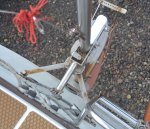
I don't have a 'bathing platform' but do have a windvane and an offset ladder... limited 'squeezing around' involved.... pic should give the general idea...

The better vanes don't have a big footprint..... Monitors and Aires take up a fair bit of space...... Hydrovane is much the same as mine...
 

Attachments

  • DSC_0627 (1).jpg
    DSC_0627 (1).jpg
    175.1 KB · Views: 0
Last edited:
That's a matter of opinion really.
If you go around the world following typical yacht routes for an AWB, how many really long passages are there?
You might find there are about 20 days when vane gear is a real improvement on autopilot.

Hmmmm..... across the Atlantic..... Panama to Marquesas.... Papeete to Tonga... Tonga NZ.... Indonesia to the Cape.... The Cape back to the Carib.

The boat is 36 feet... you can add more crew -just in case -, and more batteries, and more solar, and a gen set, and an extra autopilot - just in case- and not forgetting a few more inches to your boot topping....

Having once spent three weeks hand steering 'watch and watch' I have to tell you it gets old very quickly....

An autopilot and a windvane is the best plan.....
 
If I was going off on a circumnavigation, there is no way I would go without a windvane of some kind.
If I had to choose beteeen a vane and an autopilot, vane every time on a basis of calculated risk and inherent things to wrong. That's just my opinion, but nothing I have read on these boards or elsewhere has ever made me think I'm wrong.
 
>Nonsense you Bavaria will handle it , your not expecting to go out in storm force winds and as most people are doing following the Milk run and keeping a good idea on the weather ,

We were on the ARC finish line in 20007and the boats had 35 knot gusting 50 there were broken booms, broken spinnaker poles, broken rigging jury rigged and a broken rudder also jury rigged and torn spinnaker and sails beyond repair. We had the same over Biscay and it wasn't in the forecast, sadly a local fishing boat was lost with all hands. We had the same in the English channel, no forecast, with a secondary low with 50 knot winds gusting 80. So if long if long distance sailing always expect and prepare for bad weather, look at the barometer every hour.
 
Some brilliant replies here, lots for us to think about. Please do keep the comments coming as we have a lot to think about.

Currently sat on the boat looking around thinking about the long term, definitely needs to be thought about.


I would just pose one question, have you ever been out in significant weather (40Knts) for 24Hrs or longer in open water in your boat? If you haven't then it might just be worth your while expanding your experience starting of in a few jaunts in stronger inshore conditions. If you have then you probably know the answers to most of your questions.
As to a wind vane then a hydrovane is the answer to your specific problem and it would still allow access via the stern and give you a secondary / emergency rudder as well.
 
>Nonsense you Bavaria will handle it , your not expecting to go out in storm force winds and as most people are doing following the Milk run and keeping a good idea on the weather ,

We were on the ARC finish line in 20007and the boats had 35 knot gusting 50 there were broken booms, broken spinnaker poles, broken rigging jury rigged and a broken rudder also jury rigged and torn spinnaker and sails beyond repair. We had the same over Biscay and it wasn't in the forecast, sadly a local fishing boat was lost with all hands. We had the same in the English channel, no forecast, with a secondary low with 50 knot winds gusting 80. So if long if long distance sailing always expect and prepare for bad weather, look at the barometer every hour.

Agreed , but it is a poor person that does not keep an eye on the weather , they cant all be wrong :p
For the ARC this group all tend to fly straight across from Gran Canaria heading west ,in some cases because they are racing ,
For Best results head south the Cape Verde were you will them swing West , the Trade Winds would be well Established and you should only encounter Squalls , the direct route the ARC tend to take can be variable as the weather patterns have not settled down and you can get some unsuprising changes:ambivalence:

My route will take me to Cape Verde longer yes but I am in no hurry ,were as the ARC are stuck to a timetable and boats need to leave .on a certain date.
I have a few years before I go I might change my mind about the Vane when I curse my auto pilot and hit it a few times with my Hammer (Big Boy):D
 
Funny how this thread seems to have veered off onto the question of 'vane or no vane'. I'm in the 'vane' camp but obviously people manage without.
It's not really got much to do with the choice of boat, though. Have a look at the photo gallery on the Hydrovane website, for example, to see how they manage to work with all sorts of different stern shapes.

For me, I don't really see any downsides to having a vane. I suppose you could buy one brand new and have it professionally fitted, and then you're talking thousands of pounds. But they do come up secondhand, and fitting them is not difficult.
 
Top