Lofrans Tigres fail

There are 2 anchorages on the lee side of Fatu Hiva, one is 'very rolly, not suitable for overnight stops' the other is the 'bay of virgins' which is rocks until the shelf, then 25+ metres, steeply falling away. The land provides shelter from the 3,000 miles of Pacific fetch to the east, but the mountains cause catabatic winds, we recorded 50kts in one gust. We got in as close as we could and dropped in about 27m, the 80m *was* the 3:1 you are advocating (it's also all we have!)

By the way, the Rocna website recommends 5:1 for setting, even if you subsequently take some back in.
 
Last edited:
There are 2 anchorages on the lee side of Fatu Hiva, one is 'very rolly, not suitable for overnight stops' the other is the 'bay of virgins' which is rocks until the shelf, then 25+ metres, steeply falling away. The land provides shelter from the 3,000 miles of Pacific fetch to the east, but the mountains cause catabatic winds, we recorded 50kts in one gust. We got in as close as we could and dropped in about 27m, the 80m *was* the 3:1 you are advocating (it's also all we have!)

By the way, the Rocna website recommends 5:1 for setting, even if you subsequently take some back in.

Maybe as Rocna are selling anchors they want to give their anchors the best fighting chance and, as cautious suppliers, are erring on the side of safety.

The conversation is frequent but enough of our members have anchored at 3:1, some with Rocna anchors, and some at this scope thinking it was better so they thought 5:1 (or whatever) but it was actually 3:1. They have enjoyed strong winds - and their anchors have not broken free. These experiences by reputable members here are sufficient for me (I take notice of this information :) ) that 3:1 is more than adequate to use to set most modern anchors - we would always deploy more rode once we were sure of the power set.

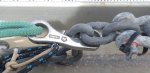
My 3:1 is based on laziness, parsimony and 'my' logic. If I deploy at 5:1 and the anchor does not set - I need to take in more rode. If the anchor, modern, does not set at 3:1 there is something seriously wrong - its clogged or the seabed is too hard or maybe unseen weed. If the seabed is too hard it would not matter if it was 3:1 or 10:1 - it will still be hard (and in fact I have not experienced a sediment so hard as to defeat a modern anchor). I accept hard seabeds exist - but I have no experience. If the seabed is 3:1, sedimentary and the anchor does not set then if there is a change of wind or tide...... - we would not sleep well - so move.

My 3:1 is a bit like the power set - its part of the confidence test of the seabed. If the anchor sets at 3:1 - it will be safe at 5:1 etc.


We too have a minimalist rode (only 75m) and only 6mm. but we have 30m snubbers and I'm comforted by this graph.

The nylon, only 10m in this case, offers far more snubbing effect than the chain

IMGP0049.jpeg

Lots of compromises to be considered - and as I said - there is no one right answer (which is why anchor threads might be contentious but they suck out valuable experiences.

Jonathan
 
Chain hooks....

Some slight thread drift

People complain that if their snubber drags on the seabed the chain might fall off if using a chain hook. A recommendation is that this failure will not occur if using a soft shackle. Sadly I have found threading a soft shackle through a 6mm chain link is a challenge (that I don't need) so I cannot comment on the use of soft shackles.

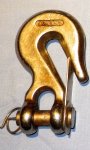
You can modify, or make additions to some chain hooks to make them more secure. Here os have taken a clevis hook and added a thin piece of scrap stainless to make a gate to retain the chain. If you make the gate with care, not too tight, not too lose (a Goldilocks gate) then you can attach and remove the hook single handed by using your thumb to flick the gate.

If your bridle is always under tension then it will never drag on the seabed - commencing you bridle at the transom means that you have a deck length of elasticity and you can have the chain hook above the water surface and your hook will never be on the seabed, read the post to the end :)
IMGP5009.jpeg

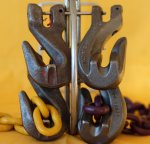
Withard have a much more sophisticated gate, a pin on a spring. The pin is lethal as it can bend (in use - been there, experienced that) and the only way to retrieve the chain (I found) was with a Mole wrench - and who has a more wrench in their pocket when they retreive the anchor. We retired our Witchard hook from our snubbers (bridle) and used it as our back up, the green is dyneema, but the pin is an unnecessary fiddle and we use a forged hook from the lifting industry - see the hook below on the 'rack' - we use one of the design on the left.


IMGP4967.jpeg

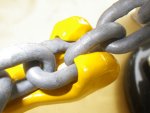
WE have tried claws from the lifting industry - and do not recommend. In the illustration - the anchor would be to the right. Under tension the link in the jaw would be tight in the recess. In order to release the secured link you need to lift the 2 links to the right to allow the retained link to be released. The link on the right has to be lifted over the lip of the claw to allow the link in the recess to be moved to the left.

Great if there is no tension.

IMGP5069.jpeg

The best hooks are forged and from the lifting industry. The hooks on the left are current state of the art and the 2 hooks on the right an earlier iteration - but more than adequate and cheap (as chips). Both hooks offer support along the length of the link that is held in the jaw on the hook. Additionally the adjacent link, that would be under tension, has its crown nestled in the crown shaped recess - so the tension is taken by 2 links.

Sadly these hooks are not sold galvanised - but you can buy them so cheaply - use them till they are grotty, buy a new one.

IMG_1697.jpeg

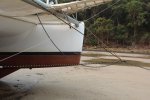
Our cat, beached. Even if the bridle were to hang vertically the bridle plate would not touch the seabed - yet each arm runs back to the transom. We thus have plenty of elasticity for everyday need - but can simply deploy more bridle if the wind picks up - and if the wind is up the bridle will be stretched out - no-where near the seabed.
IMG_0038.jpeg

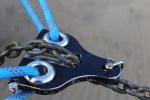
Our bridle plate is designed round use of a bridle, ideal for beamy mono-hulls as well as multihulls. It would not take much imagination to design a 'similar' snubber hook for a monohull. Many chain hooks are made from metal plate and bend, I have read of the Witchard hook, above, bending and I have bent the Oscalutti and Mantus hook. The bridle plate illustrated is made from Duplex stainless, and painted, but could be made from Quench and Tempered steel and galvanised. The LFRs are 2 part and threaded and made from 316.

This is 6mm chain (about 6 years old now), polished like black stainless and 10mm snubbers, kernmantle dynamic rope. The little gate, bottom left on the plate, is made from hard drawn stainless (and is very difficult to bend)

IMG_4743.jpeg

Sincere apologies for the thread drift - knowledge or experiences are of little value if not shared.

I know, I know - what has this to do with a Lofrans windlass - not much - think outside the box :)

Jonathan
 
I would nor suggest power setting with a snubber.

When you are anchored and all set up then your snubber is attached and you have a lazy loop of chain freely hanging.

Snubbers fail - in just over 20 years we have had 2 fail - without any previous sign of deterioration. When they fail it is a sound like gunshot - you will not fail to notice. Failure of a snubber can be from a variety of cause abrasion being but one. But snubbers fail as a result of repeated cyclical loading. If you power set you are stressing the snubber - why do it?

However as your snubber can fail, and I'm talking about one that noticeably stretches - commonly it will be at least 10m long then you need a fall back snubber - something that will protect the windlass in case of snubber failure. This 'snubber' could be a chain lock. Ours is a very short dyneema strop with a chain hook (and we use the same device to secure the anchor on passage). Our dyneema strop is attached to a strong point independent of the windlass. If you are to power set - do not use the long elastic snubber - use the chain lock or some other device, like our dyneema strop with chain hook. If you have sat at anchor for some days and your anchor is an efficient example of the new designs then when you come to retreive it can take time to break the anchor out. A chain lock or inelastic snubber with chain hook allows you to tension the rode (to break the anchor out) without stressing the windlass. This sort snubber is thus multi functional and is cheap as chips, short length of rope (as strong as the chain) a decent chain hook - the common problem is - what to attach to?

If you use the elastic snubber - you reverse up, the yacht gains momentum, the catenary straightens but eventually the energy stored in the catenary and elasticity (potential energy) is more than the energy produced by the engine and momentum (your momentum decreases as the catenary and elasticity come into play) - you have a transient maximum tension in the rode and then the yacht moves forward. You can continue this cycle as many times as you want. But the transient maximum tension will not set the anchor efficiently - the seabed has little time to adjust. If you use the snubber - you can note how much it stretches - which might indicate to you its too beefy - you need stretch.

But a dyneema strop or mechanical chain lock only has the catenary to contend with (and if you do the power set at 3:1 - less catenary) and you are not stressing your elastic snubber.

Snubbers, like sails, like sheets and halyards are consumables, we carry spares (snubbers make good mooring lines and can be used in combinations as shore lines).

But snubbers are not THAT expensive - if you are flush......

There is no one right answer in anchoring, it depends on your yacht, you (the skipper) your ground tackle - you have to make the most of what you have which may be different to the yacht alongside you.

Jonathan
We always power set with the snubber. It may help having a big engine. We simply start with tickover revs in reverse. Once the chain has straightened out and lifted a little off the bottom, I slowly increase revs up to about 3/4 throttle. At that point the snubber has stretched out gently to its stretched length. The anchor sets easily like this with no dramatics. There is no vicious snatch load on the snubber like we would get from a big squall. There is no boat momentum involved in power setting the anchor in this way so the snubber gets an easy time.
Once the engine is pulling hard against the stretched snubber in a steady state situation, all the engine force is transferred to burying the anchor in the same way as steady state without using a snubber. It works for us
 
We always power set with the snubber. It may help having a big engine. We simply start with tickover revs in reverse. Once the chain has straightened out and lifted a little off the bottom, I slowly increase revs up to about 3/4 throttle. At that point the snubber has stretched out gently to its stretched length. The anchor sets easily like this with no dramatics. There is no vicious snatch load on the snubber like we would get from a big squall. There is no boat momentum involved in power setting the anchor in this way so the snubber gets an easy time.
Once the engine is pulling hard against the stretched snubber in a steady state situation, all the engine force is transferred to burying the anchor in the same way as steady state without using a snubber. It works for us

There is no one right way - what works for you is the correct way.

Jonathan
 
We always power set with the snubber. It may help having a big engine. We simply start with tickover revs in reverse. Once the chain has straightened out and lifted a little off the bottom, I slowly increase revs up to about 3/4 throttle. At that point the snubber has stretched out gently to its stretched length. The anchor sets easily like this with no dramatics. There is no vicious snatch load on the snubber like we would get from a big squall. There is no boat momentum involved in power setting the anchor in this way so the snubber gets an easy time.
Once the engine is pulling hard against the stretched snubber in a steady state situation, all the engine force is transferred to burying the anchor in the same way as steady state without using a snubber. It works for us

I was pondering this a bit further.

If you take a 50kg weight and are to lift it with a single block. You lift it off the ground - and in order to hold it in location you need to balance the 50kg - you need to hold the 50 kg. If you let it go - it falls to the ground (it has potential energy).

If you stretch your snubber you need to hold that tension with the engine, the engine continues to provide energy and the tension in the rode remains constant. In order to set the anchor more deeply you need to increase the revs - some of this revs (energy) are needed to stretch and then hold the stretch in the snubber - some is imposed on the anchor and it sets more deeply. But using an elastic snubber demands that some of the energy produced by the engine is 'wasted' in stretching and maintaining the stretch of the snubber. A bit like my weight and block - if you get tired holding the 50kg weight - it will fail to the ground - you need to invest energy simply to hold it steady.

Catenary is different - if you look at my graph above when you get to about 300/400kg there is no or minimal increase in the energy acceptance by the chain, the catenary is almost a straight line - not so the nylon - it will continue to stretch, accept energy from the engine - until it fails. The bigger your engine, the harder the seabed the more energy will be directed to the snubber - not 100% to setting the anchor more deeply.

There is another little experiment - which I use at lectures to show the benefit of a snubber:

Take 0.5 metre of nylon cord and 0.5m of bungy (the sort you use to secure luggage). Take a 2 x 1kg weights and attach a weight to the end of the 2 lengths of 'textile'. Now stand facing forward, hands, arms outstretched and have someone drop both weights simultaneously from a point at the height of your hands. You may drop the weight held by the nylon - you cannot resist its kinetic energy (your anchor sets more deeply) but the one on the bungy is easy to resist - the kinetic energy of the falling weight is converted to potential energy in the bungy. (or your snubber). Hold them in steady state and both 'weights' will feel the same - but how many people hold their engine in reverse for a sufficient length of time.....?

There is a very crude rule that a Diesel engine will develop a maximum tension in a rode based on the idea of 10hp will provide 100kg of tension. It depends on whether you are testing. with chain or dyneema and the efficiency of the prop, in reverse. The 10 times rule is based on using dyneema - all or most of the energy of the engine is thus directed at setting an anchor - if a dyneema rode - there is no stretch and no catenary. But it will not be a dyneema rode as dyneem floats and will get round your or a neighbours prop.

But stick with 10hp equals 100kg of tension.

To bury a 15kg anchor to its maximum hold, about 2,000kg, would need a 200hp engine (which is why in anchor testing people use small anchors (maybe 15kg) and large engined vessels. - think of the YM tests in 2006. But with a 15kg anchor and a 30hp engine you will only set your anchor - almost superficially - it will be in the upper and soft layer of the seabed. The bigger your anchor - the less deeply (as a proportion of its total weight (or size) it will bury. To maximise the 'power set' you need to hold that tension for a finite period of time as the anchor sets (buries) increasingly slowly the deeper it dives (the seabed resistance increases). If you use your snubbers - like my bungy and 1kg weight experiment - it takes time for the arrangement to reach equilibrium - unless you remove the bungy (snubber).

Most of us have small engines - if you want to maximise the energy produced by your engine - do not use a snubber, power set at, around 3/4 of maximum cruising revs and hold the high revs for a period of time. Your anchor will benefit from both the high revs and your patience in allowing it worm its way, slowly, into the deeper seabed. But if you have a 15kg anchor and a 30hp engine - it will only set to 1/7 (approx) of its ultimate hold (2,000kg divided by 300). If you chose a bigger anchor - less. If it is completely buried its hold is still 300kg - but the seabed is soft (sheer strength increases with the square of depth).

You will see this on some 'anchor testing' recorded on video. On the surface as you increase the revs in the engine the anchor is set. Watch the video and notice the number of times the anchor is still, imperceptibly, moving - it has not yet reached equilibrium - it has not yet reached its maximum hold with that energy input. Think of the man in the 'setting' vessel - he thinks it is stationary and lacks the patience to give it more time to prove itself.

Our snubbers are 'stretchy, I can see them stretching as a gust hits our yacht. But the stretch is slow - about as long as I power set. But when I power set I'm not stretching a snubber.

There is no right way - what works for you is right. But you need time for the anchor to take advantage of the increasing power - the seabed does not collapse quickly, your snubber stretches slowly - be patient.

As an aside - this is one reason to use a 3:1 scope - less catenary to overcome when you power set an anchor - at 5:1 more catenary.

Jonathan
 
If you are power-setting with an elastic snubber, no energy is being wasted once the snubber has stretched as much as it wants to. Surely that would only take about 2 seconds?
 
If you are power-setting with an elastic snubber, no energy is being wasted once the snubber has stretched as much as it wants to. Surely that would only take about 2 seconds?

The elastic snubber, the chain and seabed all take time to accept the force put on them. It is commonly mentioned that a modern anchor sets in its own shank length - I don't believe you think it sets in 2 seconds!

For the seabed this is perfectly illustrated in some of the Panope videos - he thought the anchor had locked so he terminated the test - but if you watch the videos - the anchor is still moving. Geem for one , but he is not alone, has mentioned this, I think in the Rocna maligned thread - but his comments and the implications have been ignored (or not explained). If you conduct tests using a shore base winch with an anchor in the intertidal zone you can watch and as the anchor dives more deeply the winch increasingly slows as the tension (hold) develops. The hold of the anchor is defined as when the anchor stops moving and the 'in line' load cell records the tension in the rode (or the hold of the anchor). Having conducted such tests I can assure you a 2t winch takes a long time to set an anchor such that you can be assured you are measuring hold.

If you watch your chain straightening - initially the yacht moves back quickly but as the catenary straightens the yacht moves more and more slowly and takes more than 2 seconds.

If you have short snubber or it is too beefy it will have minimum elasticity (and is better used as the fall back if the elastic snubber fails).

If you have an elastic snubber it will not reach 'equilibrium' until the anchor is stationary and all the catenary (under the conditions determined by your rode and tension) have reached their ultimate 'location'. ie The catenary is stable and the anchor is not moving. If you are using a 'mixed', rode snubber and chain then the elastic snubber works with the catenary - they both are developing potential energy - so until the chain reaches its ultimate catenary shape (for the eventual imposed tension) the snubber will not reach its ultimate stretch - and the ultimate tension will not develop until the anchor stops moving. It is impossible to determine when your anchor has stopped moving - all you can do is - be patient.

I think you are dreaming if you think this occurs in 2 seconds - just think of the videos and the slow moving anchor.

If you want to short circuit all of this set you anchor with a scope of 3:1, not 5:1 and with no snubber.

When we anchor on our 3 month cruise we tend to anchor almost every day and sometimes twice in a day. We might stay in the same rough location but we need to move to set our crayfish pot and if we want to climb one of Tasmania's hills we would move to the base of the hill, anchor, and move maybe to another location when we return.

Elastic ropes are rated for their expected life by the number of cycles they endure. Power setting is an unnecessary cycle to impose on your snubber - there is an alternative. We have broken 2 snubbers, ie 2 ropes that make up the bridle in 20 years (and now carry a complete spare bridle) There was no sign of abrasion.

If you are not convinced on the reduction in life of your snubber as a result of use try this:

When To Retire A Climbing Rope

specifically the section titled "2 Energy Absorption". The blog is on kermantle climbing rope but applies to 3 ply or graded nylon (and I assume other elastic ropes).

You will possibly be interested in all the pre-amble - as an unused rope would be retired at 10 years.

Your snubber, like your sails, sheets and halyards is a consumable. If you are flush by all means use your snubbers when you anchor, but carry spares. Hope that your snubber does not fail when it is blowing 50 knots (and always have a fall back to protect your windlass).

You can prolong snubber life by having a larger diameter rope - but then you will lose elasticity.

In the picture of our cat in post 21 we have around 30m of snubber deployed, The rode is at 10:1, we have 10m down the deck and about 10m between bow and bridle plate. If our snubber, we lose one 'arm', maybe 2 but we have very little chain deployed, but I might say we have a 40m rode (30m of elasticity and 10m of chain). You might say we are actually using a mixed rode. Just look at the graph above - and visualise the advantage uf having elasticity available in a confined package vs a very long (and heavy) rode. We are not taking up much room in an anchorage and our fall back is a short dyneema strop. We can rig up a new snubber and maybe need to deploy a few more metres of chain.

There is no one right answer - anchoring is about compromises and what allows you to be comfortable.

Jonathan

Finally

If you want to know what happens when your snubber fails read this article again, which underlines snubbers fail and chain hooks bend. Think how useful it would be if you have a 30m snubber plus 10m of chain - if the key characters providing the script had had the same configuration there life you,d have been much easier - and note their storm bridle plate (and the one in my post above.

Safety at Sea: Surviving a Powerful Storm in the Med


I don't make these things up!

J
 
Last edited:
If you want to know what happens when your snubber fails read this article again, which underlines snubbers fail and chain hooks bend. Think how useful it would be if you have a 30m snubber plus 10m of chain - if the key characters providing the script had had the same configuration there life you,d have been much easier - and note their storm bridle plate (and the one in my post above.

Safety at Sea: Surviving a Powerful Storm in the Med
I couldnt see a date in the article but would guess September, Those conditions happen from time to time along the S of Mallorca, I've been caught in Santa Ponca, about 15 Nm from Sant Jordi, with 65kts for about 15 mins and big wind shifts. Its a thunderstorm area that time of year and the shape of the island produces very strong winds and tornadoes. Santa Ponca is generally much busier than Sant Jordi so there isnt the space for long scopes normally - most held in that incident except one boat that scythed through the anchorage, catching chains and extracting anchors as it went - fortunately our neighbours protected us :)
 
I was pondering this a bit further.

If you take a 50kg weight and are to lift it with a single block. You lift it off the ground - and in order to hold it in location you need to balance the 50kg - you need to hold the 50 kg. If you let it go - it falls to the ground (it has potential energy).

If you stretch your snubber you need to hold that tension with the engine, the engine continues to provide energy and the tension in the rode remains constant. In order to set the anchor more deeply you need to increase the revs - some of this revs (energy) are needed to stretch and then hold the stretch in the snubber - some is imposed on the anchor and it sets more deeply. But using an elastic snubber demands that some of the energy produced by the engine is 'wasted' in stretching and maintaining the stretch of the snubber. A bit like my weight and block - if you get tired holding the 50kg weight - it will fail to the ground - you need to invest energy simply to hold it steady.

Catenary is different - if you look at my graph above when you get to about 300/400kg there is no or minimal increase in the energy acceptance by the chain, the catenary is almost a straight line - not so the nylon - it will continue to stretch, accept energy from the engine - until it fails. The bigger your engine, the harder the seabed the more energy will be directed to the snubber - not 100% to setting the anchor more deeply.

There is another little experiment - which I use at lectures to show the benefit of a snubber:

Take 0.5 metre of nylon cord and 0.5m of bungy (the sort you use to secure luggage). Take a 2 x 1kg weights and attach a weight to the end of the 2 lengths of 'textile'. Now stand facing forward, hands, arms outstretched and have someone drop both weights simultaneously from a point at the height of your hands. You may drop the weight held by the nylon - you cannot resist its kinetic energy (your anchor sets more deeply) but the one on the bungy is easy to resist - the kinetic energy of the falling weight is converted to potential energy in the bungy. (or your snubber). Hold them in steady state and both 'weights' will feel the same - but how many people hold their engine in reverse for a sufficient length of time.....?

There is a very crude rule that a Diesel engine will develop a maximum tension in a rode based on the idea of 10hp will provide 100kg of tension. It depends on whether you are testing. with chain or dyneema and the efficiency of the prop, in reverse. The 10 times rule is based on using dyneema - all or most of the energy of the engine is thus directed at setting an anchor - if a dyneema rode - there is no stretch and no catenary. But it will not be a dyneema rode as dyneem floats and will get round your or a neighbours prop.

But stick with 10hp equals 100kg of tension.

To bury a 15kg anchor to its maximum hold, about 2,000kg, would need a 200hp engine (which is why in anchor testing people use small anchors (maybe 15kg) and large engined vessels. - think of the YM tests in 2006. But with a 15kg anchor and a 30hp engine you will only set your anchor - almost superficially - it will be in the upper and soft layer of the seabed. The bigger your anchor - the less deeply (as a proportion of its total weight (or size) it will bury. To maximise the 'power set' you need to hold that tension for a finite period of time as the anchor sets (buries) increasingly slowly the deeper it dives (the seabed resistance increases). If you use your snubbers - like my bungy and 1kg weight experiment - it takes time for the arrangement to reach equilibrium - unless you remove the bungy (snubber).

Most of us have small engines - if you want to maximise the energy produced by your engine - do not use a snubber, power set at, around 3/4 of maximum cruising revs and hold the high revs for a period of time. Your anchor will benefit from both the high revs and your patience in allowing it worm its way, slowly, into the deeper seabed. But if you have a 15kg anchor and a 30hp engine - it will only set to 1/7 (approx) of its ultimate hold (2,000kg divided by 300). If you chose a bigger anchor - less. If it is completely buried its hold is still 300kg - but the seabed is soft (sheer strength increases with the square of depth).

You will see this on some 'anchor testing' recorded on video. On the surface as you increase the revs in the engine the anchor is set. Watch the video and notice the number of times the anchor is still, imperceptibly, moving - it has not yet reached equilibrium - it has not yet reached its maximum hold with that energy input. Think of the man in the 'setting' vessel - he thinks it is stationary and lacks the patience to give it more time to prove itself.

Our snubbers are 'stretchy, I can see them stretching as a gust hits our yacht. But the stretch is slow - about as long as I power set. But when I power set I'm not stretching a snubber.

There is no right way - what works for you is right. But you need time for the anchor to take advantage of the increasing power - the seabed does not collapse quickly, your snubber stretches slowly - be patient.

As an aside - this is one reason to use a 3:1 scope - less catenary to overcome when you power set an anchor - at 5:1 more catenary.

Jonathan
Interesting discussion. Take your 2kg weight arguement. In steady state, both the nylon and the snubber are loading those rodes to 2kg. Forget them functioning as as a snubber they are not absorbing momentum since your arm holding them is stationary and the weight is stationary. Both rodes still have a 2kg load on them. The weight on the elastic didn't get less.
Now apply the same logic to a boat pulling an anchor. Steady state no boat movement so no momentum to absorb such as in a snatch load.
The load in the anchor in a steady state is identical.
There is another interesting aspect of setting with a snubber. If you want to use momentum of the boat to power set you can, unlike with an all chain set up that will create a snatch load and probably cause an anchor to drag.
I used to race British Offroad Championship many years ago. Four wheel drive buggies on tough terrain. Occasionally you would get stuck in deep mud. We would use kenetic energy recovery ropes. The idea was that often a pull with a tight rope between two vehicles would not work so an elastic rope was used. The tow vehicle would set off with a slack rope at full throttle and the extra grunt created by momentum would pull the stuck vehicle out. It was really funny the first time you pull somebody out of the mud like this. They are convinced they are going to experience a huge snatch load, but they don't. They simply surge forward. Do this with a none elastic rope and the massive load simply breaks the rope or the tow hitches.
Try the same thing with a snubber on a boat and you can create a nice constant smooth load that will give you a far better power set than just pulling on your chain or a fully gently extended snubber. You are adding mass and velocity of the boat into the pulling force in a nicely controlled way thanks to the stretchiness of the snubber. I am sure this is why my anchor continues to set deeply in gusty conditions
 
Last edited:
Interesting discussion. Take your 2kg weight arguement. In steady state, both the nylon and the snubber are loading those rodes to 2kg. Forget them functioning as as a snubber they are not absorbing momentum since your arm holding them is stationary and the weight is stationary. Both rodes still have a 2kg load on them. The weight on the elastic didn't get less.
Now apply the same logic to a boat pulling an anchor. Steady state no boat movement so no momentum to absorb such as in a snatch load.
The load in the anchor in a steady state is identical.
There is another interesting aspect of setting with a snubber. If you want to use momentum of the boat to power set you can, unlike with an all chain set up that will create a snatch load and probably cause an anchor to drag.
I used to race British Offroad Championship many years ago. Four wheel drive buggies on tough terrain. Occasionally you would get stuck in deep mud. We would use kenetic energy recovery ropes. The idea was that often a pull with a tight rope between two vehicles would not work so an elastic rope was used. The tow vehicle would set off with a slack rope at full throttle and the extra grunt created by momentum would pull the stuck vehicle out. It was really funny the first time you pull somebody out of the mud like this. They are convinced they are going to experience a huge snatch load, but they don't. They simply surge forward. Do this with a none elastic rope and the massive load simply breaks the rope or the tow hitches.
Try the same thing with a snubber on a boat and you can create a nice constant smooth load that will give you a far better power set than just pulling on your chain or a fully gently extended snubber. You are adding mass and velocity of the boat into the pulling force in a nicely controlled way thanks to the stretchiness of the snubber. I am sure this is why my anchor continues to set deeply in gusty conditions

Your anchor sets deeply in gusty, or strong conditions, because you have a good anchor :). Its the characteristic of a modern anchor - as long as it engages then it will set more deeply - and subsequent to a strong wind 'event' your anchor can be difficult retrieve.

The idea of using a moving yacht to better set an anchor was raised to me by Prof Knox. He was keen on the idea - even using a chain rode as the chain rode does offer or reduce the possibility of a snatch load. Minimising a snatch load needs use of catenary to remove the snatch (and maybe why Rocna suggest a 5:1 setting scope). I was never keen - you cannot control the practice, its a bit hit and miss - and I never felt that our anchors were not sufficiently well set in the first place. One thing I have learnt of modern anchors - get then to engage and if you keep applying increased tension that they will dive more deeply.

Snatch retrieval of bogged vehicles is commonplace here in Oz. Go to any motor retailer (like you have Halfords in the UK) and you can buy complete kits. I had thought, or wondered, if the snatch cord would make a sensible snubber - but never progressed beyond thinking about it. From memory Marlow make snatch cord, I think they might be tape rather than rope, for military applications.

The main reason we don't use a snubber to set an anchor - so not denying the use of momentum - is the degradation of strength of the snubber. As I mention our experience is that as long as the anchor engages - it will set further, on its own accord, during the time you are at anchor - as long as the conditions provide more tension than the power set. Believing that unnecessary use of the snubber will reduce its life and believing that once engaged the anchor will set more deeply without my intervention I simply see no reason to use a snubber in the initial set. our snubber failures have occurred at night and at worst just an inconvenience, the snubber failures in that Med article were more than inconvenient. Ib both case - unexpected. I try to minimise risk and the unexpected. Now we are prepared.

With a modern anchor as long as you actively test the set, some power, I actually see no significant reason to excessively power set - the wind will do it for you. All you need do is ensure the anchor has engaged and is at least 'lightly' set. The critical factor is the anchor must be a good anchor to start with. What works for a Rocna, Spade , Knox or Excel cannot be relied on for a CQR, Bruce or Mantus. I don't differentiate with my comments - I look at worst case and build a recommendation based on that worst case - which is a CQR - so power set! with a slowly increase in revs to about 75% of cruising revs and if you follow this practice there is no snatch - and you will know if the CQR does not set :)

There is another factor that I have mentioned previously.

If you dive on your anchor and touch it you will find it twitches. The constant movement of the chain causes the anchor to move imperceptibly. If your anchor is buried completely use a screw driver as a probe and you will feel the same twitching. You will not notice the effect if the chain is on the seabed - the chain must be hanging free (which usually means there is some breeze). A twitching anchor will modify the shear strength of the seabed and as the anchor is under constant tension the combination of tension and reduced seabed shear strength and a design with a propensity to dive - may thus encourage the anchor to dive more quickly and more deeply than you would expect.

One of my granddaughter (second year engineering) has built me a vibration meter (like the one you already have in your phone or tablet) and in the summer (when the sea is warmer) we have a small programme of tests to conduct to quantify some of these parameters. We had hoped to have already completed the first series of tests - but Covid caused postponement. The meter fits into the rear of the anchor and records the data - we 'simply' retreive the anchor and download. once we define what we find - we will then devise a follow up programme - I confess the work is not original - the US Navy have done something similar (to measure the impact of earthquakes on fleet moorings).

There is no one correct practice.

Enjoy the Caribbean - its winter here and this morning it felt like 4 degrees C. We are enduring a prolonged cold snap and the ski fields have opened early!

Take care, stay safe

Jonathan

Jonathan
 
Your anchor sets deeply in gusty, or strong conditions, because you have a good anchor :). Its the characteristic of a modern anchor - as long as it engages then it will set more deeply - and subsequent to a strong wind 'event' your anchor can be difficult retrieve.

The idea of using a moving yacht to better set an anchor was raised to me by Prof Knox. He was keen on the idea - even using a chain rode as the chain rode does offer or reduce the possibility of a snatch load. Minimising a snatch load needs use of catenary to remove the snatch (and maybe why Rocna suggest a 5:1 setting scope). I was never keen - you cannot control the practice, its a bit hit and miss - and I never felt that our anchors were not sufficiently well set in the first place. One thing I have learnt of modern anchors - get then to engage and if you keep applying increased tension that they will dive more deeply.

Snatch retrieval of bogged vehicles is commonplace here in Oz. Go to any motor retailer (like you have Halfords in the UK) and you can buy complete kits. I had thought, or wondered, if the snatch cord would make a sensible snubber - but never progressed beyond thinking about it. From memory Marlow make snatch cord, I think they might be tape rather than rope, for military applications.

The main reason we don't use a snubber to set an anchor - so not denying the use of momentum - is the degradation of strength of the snubber. As I mention our experience is that as long as the anchor engages - it will set further, on its own accord, during the time you are at anchor - as long as the conditions provide more tension than the power set. Believing that unnecessary use of the snubber will reduce its life and believing that once engaged the anchor will set more deeply without my intervention I simply see no reason to use a snubber in the initial set. our snubber failures have occurred at night and at worst just an inconvenience, the snubber failures in that Med article were more than inconvenient. Ib both case - unexpected. I try to minimise risk and the unexpected. Now we are prepared.

With a modern anchor as long as you actively test the set, some power, I actually see no significant reason to excessively power set - the wind will do it for you. All you need do is ensure the anchor has engaged and is at least 'lightly' set. The critical factor is the anchor must be a good anchor to start with. What works for a Rocna, Spade , Knox or Excel cannot be relied on for a CQR, Bruce or Mantus. I don't differentiate with my comments - I look at worst case and build a recommendation based on that worst case - which is a CQR - so power set! with a slowly increase in revs to about 75% of cruising revs and if you follow this practice there is no snatch - and you will know if the CQR does not set :)

There is another factor that I have mentioned previously.

If you dive on your anchor and touch it you will find it twitches. The constant movement of the chain causes the anchor to move imperceptibly. If your anchor is buried completely use a screw driver as a probe and you will feel the same twitching. You will not notice the effect if the chain is on the seabed - the chain must be hanging free (which usually means there is some breeze). A twitching anchor will modify the shear strength of the seabed and as the anchor is under constant tension the combination of tension and reduced seabed shear strength and a design with a propensity to dive - may thus encourage the anchor to dive more quickly and more deeply than you would expect.

One of my granddaughter (second year engineering) has built me a vibration meter (like the one you already have in your phone or tablet) and in the summer (when the sea is warmer) we have a small programme of tests to conduct to quantify some of these parameters. We had hoped to have already completed the first series of tests - but Covid caused postponement. The meter fits into the rear of the anchor and records the data - we 'simply' retreive the anchor and download. once we define what we find - we will then devise a follow up programme - I confess the work is not original - the US Navy have done something similar (to measure the impact of earthquakes on fleet moorings).

There is no one correct practice.

Enjoy the Caribbean - its winter here and this morning it felt like 4 degrees C. We are enduring a prolonged cold snap and the ski fields have opened early!

Take care, stay safe

Jonathan

Jonathan
We don't power set with a slack snubber. We have no need since we have an 86hp engine and a 22" prop. We have ample grunt. There are boats if a similar size to us with half the engine power. For the same size anchor they couldn't power set as deep as us. Using a slack snubber might be handy when you are short of engine power
With regard to snubber life, we have only snapped one. I retire them once they look a little worn. The way we set really doesn't load up the snubber as much as a 19t boat with momentum would do in a sudden gust. We set without the use of momentum.
Power setting is interesting. Our full revs is 2000rpm. We cruise normally at 1200rpm which gives us 6kts in flat water. 1200rpm also top of the torque curve and fuel efficient. We power set to 1700rpm with the snubber. We use a Spade anchor. No idea if our method of anchoring would work on an old style anchor but it's very reliable for us
 
We don't power set with a slack snubber. We have no need since we have an 86hp engine and a 22" prop. We have ample grunt. There are boats if a similar size to us with half the engine power. For the same size anchor they couldn't power set as deep as us. Using a slack snubber might be handy when you are short of engine power
With regard to snubber life, we have only snapped one. I retire them once they look a little worn. The way we set really doesn't load up the snubber as much as a 19t boat with momentum would do in a sudden gust. We set without the use of momentum.
Power setting is interesting. Our full revs is 2000rpm. We cruise normally at 1200rpm which gives us 6kts in flat water. 1200rpm also top of the torque curve and fuel efficient. We power set to 1700rpm with the snubber. We use a Spade anchor. No idea if our method of anchoring would work on an old style anchor but it's very reliable for us

The issue with a reliance on momentum or the monetum developed in a gust is that though the energy is transferred to the snubber - its transitory.

The gust develops, the yachts moves back, the catenary flattens and the snubber stretches - but the gust then dies and the yacht moves forward. If we recall Panope's video of the moving anchor - it is moving slowly and a transitory gust is not going to have much impact. The gust also needs to develop more tension in the rode than the previous gust - or the anchor will not move, at all (unless there is some other effect - like twitching). It is the same if the yacht reverses up - the combined potential energy of the flattening catenary and the stretching snubber increases and then becomes greater than the energy available from the engine - the yacht slows and stops and is then pulled forward by the release of the potential energy in the rode. Its transitory

Your bogged vehicle is not similar to our situations. The bogged vehicle will normally have its engine running, the pull out vehicle backs up and at some point applies the brakes and becomes a fixed point, or keeps reversing - the bogged vehicle then enjoys the transfer of energy to them, through the snatch strap and in addition runs forward in gear. If the pull vehicle is not held stationary nor continues to reveres, away from the bogged vehicle, the bogged vehicle will stay where it is.

To set an anchor needs a long steady pull, with increasing tension as the anchor dives, again think of the Penope videos, how long he 'sets' the anchors - yet they are still moving. You can only use a yacht as you do a pull out vehicle if you can hold the yacht stationary and allow the potential energy in the rode to impact the anchor - not possible - except for a few seconds.

The advantage of backing up slowly and straightening the catenary is that the engine will commonly be able to hold the yacht stationary. at 3:1. Unless you have deployed too much rode, or you carry too large linked chain and assuming you are not anchoring in 30m - then you can flatten the catenary and the engine can be run with the yacht stationary and you then do not have a transitory tension - it can be sustained. Not so with a snubber as it will continue to stretch and stretch - and then it and the catenary will pull the yacht forward. You could of course repetitively attack the anchor going back and forth - but the seabed will each time resist movement (it needs time) and as you increase the cyclical loading of the snubber - its life gets shorter.

An illustration of the time needed. Your anchor is well set, you are to leave, you shorten up the rode until it is vertical and then you sit and wait, and wait and wait - for the anchor to break out. The seabed does not react to a transitory tension - it needs time. This retrieval process is commonly advised - but the patience required is less than that to set an anchor as when you retreive you have a lever, the shank, acting on the fluke.


The final rule is one we all know - if something on a yacht is to go pear shaped it will happen at the most inconvenient time. Just read the article on the Med storm. Their Witchard hook was fine - until it wasn't . Ground tackle does not fail if you are pottering about - it fails when the wind is singing and the chop is concerning.


I too have been critical of the Panope tests and my comments, intended as being supportive, have been ignored and unanswered. However his moving anchor has been informative. A well known anchor maker suffered the same issue - they respond to their problems by removing the offending video. I, or course, never thought they would remove the vid - so did not save it.

Setting an anchor deeply and removing from a deep set demand both tension and time at tension, as Panope demonstrates and as you demonstrate to yourself every time you retrieve a deep set anchor. High tension might be wasted if it is transitory (think Panope) or your bow roller and windlass at retrieval.

Take care, stay safe

Jonathan.
 
Last edited:
Ok, so new windlass ordered to Tahiti, should arrive in 2 weeks (I'll believe it when I see it).

Changes to set up and future operation as follows:

1. I've made a dyneema strop with a chain-hook on it for power-setting and breaking free.
2. I'll keep the clutch cones and gypsy surfaces polished and greased
3. I'll Duralac all the fasteners I can find to make servicing easier in future.
4. The casing is corroded junk, but I should have a decent number of spares from the old one (I'm going to have to grind off the inner clutch cone though).
5. I'll be taking the chain right off the gypsy once the snubber is secured.
 
Last edited:
Ok, so new windlass ordered to Tahiti, should arrive in 2 weeks (I'll believe it when I see it).

Changes to set up and future operation as follows:

1. I've made a dyneema strop with a chain-hook on it for power-setting and breaking free.
2. I'll keep the clutch cones and gypsy surfaces polished and greased
3. I'll Duralac all the fasteners I can find to make servicing easier in future.
4. The casing is corroded junk, but I should have a decent number of spares from the old one (I'm going to have to grind off the inner clutch cone though).
5. I'll be taking the chain right off the gypsy once the snubber is secured.

Good Morning

Not bad :)

Might I suggest you paint the new motor with some sort of mastic. If you were in the UK I'd suggest the stuff they use to seal the underside of cars to protect them from the salt used to coat roads in winter. I recall it was called Ziebart - but my memory may well be wrong as the last time I recall seeing it was 40 years ago (or thereabouts). I have this nagging suspicion salt on roads on Tahiti will simply be met by a troubled smile (very much like Oz and HK 'salt on roads!!!???"). But the motor casing is mild steel and it is subject to constant dousing every time you retreive the anchor. I might also suggest a baffle between fall of chain and motor - but maybe that is going too far. :)

Taking the chain off the gypsy when the snubber is secured should be unnecessary. Just have a lazy bight and a short stropped snubber

However I make an assumption. I assume you use a snubber to offer elasticity and this will be thin, long (10m minimum) and stretchy. It will not have the strength of your rode and you will choose it for its elesticty and accept a reduction in strength. You will also have another device, confusingly also called a snubber, but that will be a short strop that will be attached to a strong point and will act as the fall back (should your snubber fail) and you will use it when you power set and as backup to the clutch to secure the anchor when at sea. This short snubber will have a chain hook and will not use the windlass as the strong point. If can be made from any rope - but it should be at least as strong as the chain (think, maybe dyneema). You will have to find your own strong point - a central deck cleat or something rigged between 2 bow cleats or a dedicated pad eye (this latter seems a faff - see what you can use).

The long snubber, and I suggest at least deck length, might advantageously commence at the transom, run through stanchion bases?, or between toe rail and stanchions - if you start at the transom you have a deck length snubber + a little bit forward of the bow. This way you don't have a 10m snubber forward of the bow - its within an arm stretch. 3 ply or braided nylon and I might suggest 10/12mm upto 40' and 12/14mm upto 50' - but it depends a bit on weight and windage.

If your yacht is beamy I'd strongly recommend a bridle. I'd also suggest you consider buy more than 10m (or deck length) and then when the wind gets up you can simply deploy more snubber, from the cockpit.

A reason to have only short length of snubber forward of the bow is that you can replace the snubber at the same location should the original fail (don't get worried about failure - your snubber should last 5-10 years). But you can also add a storm snubber quite easily without the need to deploy more chain - advantageous if you have a yacht moored aft of you. Basically a transom locations increases you options.

If you have a bowsprit with bob stay I can offer you other options - send me an email by PM and I can send you some pdfs and make other suggestions. Or - if you don't like the email idea - I can answer questions and hopefully illustrate with photos - but I don't have links for the pdfs.

Some use soft shackles to attach chain to snubber but you can also use some form of chain hook - forged hooks are the most sensible. You will know by now - steer clear of the Wichard hook. There must be a supplier of lifting gear in Tahiti, even if only to service the port facilities - they might merit some effort to visit (and I am sure they will stock Van Beest (as one of VB's production units is in France (their Excel range). I use some of their components and they are top of the range.

I'd recommend a gorgeous restaurant up on the NE coast, right on the water, - but I've forgotten its name (as well). :(. The French Navy used to anchor in the bay on which the restaurant is located and the restaurant became a sort of shore based officer's mess.

Take care, stay safe

Jonathan
 
Top