Lithium, do tell 🤔

billyfish

Well-Known Member
Joined
6 Oct 2020
Messages
1,011
Visit site
So how difficult, expensive, is it to change from lead acid to lithium and how much longer will the batteries last. I've a modest 30hp motor sailer with the usual stuff. All led lights and a small fridge, radio, gps plotter etc. How hard can it be ?
 
Self install? Or drop-in?

I am building a 560AH x 24v power system from 16 EVE 280K cells. This gives 13kWH more or less of power. The cells cost less than 1000 euros, so about half of the cost of the lead batteries which they will replace, and which store only 1/3 of the power.

The trick however is that you need a lot of other gear -- BMS's, contactors, monitors, B2B charger, etc. etc., and a lot of wiring, and a battery box. You'll spend some money on all that but in the end you'll have a ton more power and much less weight and bulk, and they will last many thousands of cycles vs. a few hundred at best for lead. So it's certainly cheaper in the long run.
 
So how difficult, expensive, is it to change from lead acid to lithium and how much longer will the batteries last. I've a modest 30hp motor sailer with the usual stuff. All led lights and a small fridge, radio, gps plotter etc. How hard can it be ?
Unless you intend dramatically increasing your usage of electricity or spend long periods away from charging sources (eg shorepower) there is little point in changing a perfectly good system. The typical consumption of a small boat like yours is is between 60 and 80 amps a day minus your couple of hours motoring a day when cruising which will give you maybe 20-30A back so a 200Ah bank (100 usable) will give you 2 days a way without any problems. Add a bit of solar will increase that time, starting with a fully charged bank either by shorepower or solar when you are not using the boat helps.

Batteries are only storage and the main barrier to higher usage is the ability to replace your usage. Monitor your usage, determine your generating capacity and this helps determine storage capacity. In terms of what type of storage you use depends in part on how many cycles you expect to have in any period. For a weekend and holiday sailor this is in the range of 30-50pa which gives a typical lif of 5-7 years for basic FLA and 10 years+ for AGM and gel, for example. lithium potentially indefinite in that type of usage. So it depends on your time horizon whether you are prepared to invest in the capital cost of conversion.
 
If you invest in lithium, depends how you do it, but you inevitably end up with e larger, or much larger storage facility.

You and you partner + brood are firmly convinced you, they, have access to more power and buy more stuff (as do you). Hair dryers, bread maker, radar, auto pilot, air fryer, induction hob (most of which depend on an inverter) - suddenly you will find your power consumption goes up and you end up having to recharge as frequently as you did when you simply were 'camping' on water. Your quality of life increases immeasurably but the necessity to watch power usage does not change.

If you do a search for Lithium installations you will find many are threads describing the addition of more batteries - to support the increased need.

Parkinson's, marine, Law - your need for power is always slightly larger than your ability to store and replace it.

:)

I'm convinced of the ability of Lithium to improve your life style on the water - but don't penny pinch buy bigger than you need - and you will not need to upsize so quickly.

Jonathan
 
I'll try to make this concise.

LiFePO4 batteries, the only type anybody should consider using on their boat, have many, many advantages over lead acid. But they behave a bit differently and to keep yourself safe you will need to make some changes.

1: Firstly, some terminology. You'll hear people talking about a Battery Management System. This is a circuit board which protects the battery from overcharge, deep discharge, short circuits, etc. Unless you're building your own battery from four cells, you don't need to worry about it. It will be built in to the battery. The better ones have Bluetooth so you can alter the settings and see what's going on inside, cell by cell.

2: LiFePO4 batteries will eat up all the power you can throw at them, because they have low 'internal resistance'. This is a good thing. Your solar panels, generator, etc will pump amps in to them at the same rate until they are full. Contrast with lead which needs hours of float charging to get to full.
2a: the downside of this is that when they are full, they will shut off quite abruptly. If you're using your alternator to charge them, this can do bad things to it. There are various ways to avoid damage, the most popular being a DC-DC charger. Or do as I do and just charge from solar alone.

3: that BMS is there to protect the battery, and if you do something silly like cause a short, or draw too much current, it will shut the battery down. So your lights will go out. It shouldn't happen, but you need to be aware if the possibility. On a lead acid system, you get more warning because the voltage drops more. So best to have some sort of plan to keep vital gear running- you don't want to lose your autopilot or plotter in the middle of the night.

4: cables, fuses, isolators. LiFePO4 batteries can generate very large currents, so now is a good time to look at your whole system and upgrade any components that aren't up to the task. In particular, you must install a suitable fuse as close to the battery as possible. The currents we're talking about can arc across a blown fuse, so you need one rated for lithium, such as a class T.

5: finally, you'd better check that your shore power charger and solar charge controllers are lithium compatible.


Not quite as concise as I'd hoped but I think that covers the essentials. It seems like a lot to get your head round but the advantages are compelling. You may never need to buy another battery. You'll never again have problems starting your heater on a cold morning. You might be able to ditch your generator and never have to run your engine just to top up the battery.
And the best thing is, at today's prices if you were starting from scratch it would actually be cheaper to go lithium than lead.
 
Unless you intend dramatically increasing your usage of electricity or spend long periods away from charging sources (eg shorepower) there is little point in changing a perfectly good system. The typical consumption of a small boat like yours is is between 60 and 80 amps a day minus your couple of hours motoring a day when cruising which will give you maybe 20-30A back so a 200Ah bank (100 usable) will give you 2 days a way without any problems. Add a bit of solar will increase that time, starting with a fully charged bank either by shorepower or solar when you are not using the boat helps.

Batteries are only storage and the main barrier to higher usage is the ability to replace your usage. Monitor your usage, determine your generating capacity and this helps determine storage capacity. In terms of what type of storage you use depends in part on how many cycles you expect to have in any period. For a weekend and holiday sailor this is in the range of 30-50pa which gives a typical lif of 5-7 years for basic FLA and 10 years+ for AGM and gel, for example. lithium potentially indefinite in that type of usage. So it depends on your time horizon whether you are prepared to invest in the capital cost of conversion.
I think these are very sensible and very important points.

There are a lot of enthusiasts on this board, including me, who will sing the praises of these systems all day long.

But the only purpose for these systems is providing power during extended periods away from charging sources. It makes little sense to invest time and money into changing anything, if you have a small boat with small power requirements, that is mostly used for day sailing, or sailing from harbour to harbour.

Could be some drop-in solutions make sense even for that case, but critical thinking should be applied.
 
So how difficult, expensive, is it to change from lead acid to lithium and how much longer will the batteries last. I've a modest 30hp motor sailer with the usual stuff. All led lights and a small fridge, radio, gps plotter etc. How hard can it be ?
Perhaps you can be more specific - what is a modest 30hp motor sailor - brand, model...? How, and who, uses it. What are your ambitions.

Jonathan
 
So how difficult, expensive, is it to change from lead acid to lithium and how much longer will the batteries last. I've a modest 30hp motor sailer with the usual stuff. All led lights and a small fridge, radio, gps plotter etc. How hard can it be ?

How much longer will they last? Ask an AI and you'll get this which is ballpark correct.

"Lead-acid batteries typically last for a few hundred cycles (e.g., 300-500 cycles), while lithium-ion batteries can last for thousands of cycles (e.g., 3000-5000 cycles). This translates to a longer overall lifespan, with lithium-ion batteries often lasting 10 years or more in high-usage environments, compared to 2-5 years for lead-acid batteries."

... IMO if you are thinking of such an investment then it is probably time to look at energy budgets and charging solutions generally.

As far as cost for Li is concerned, it's a trade off as always.

At one end of the spectrum you can source cells, BMS etc. from China, build your own batteries and come out with a relatively cheap system but there will be a learning curve, and most probably other issues if you don't know exactly what you are doing. If you can find someone on the forums with the system you want and can copy it, that saves a lot of the hassle.

The other end is a drop in replacement for LA which will be more expensive than a self-built system.

... the issue is estimating how much capacity you actually need, as this can save a lot of money as you will not be buying an over-specified system.

The first thing to do is work out your energy budget. This is essential if you want a cost effective system that will cover your needs, rather than someone else's.

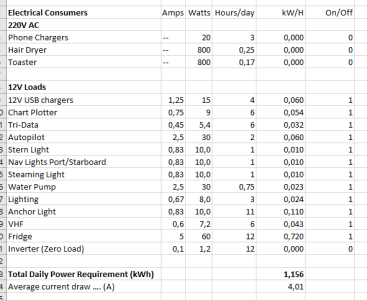
As an example, this was the energy budget from my last boat, a Bavaria 36 in the Adriatic used for extended holidays of up to 4 weeks without shore power. Create something similar to get your own energy requirements based on your usage and equipment.

Daily budget:

1755671511885.png

Then comes the question of how do you replace this energy every day? For me this was a mix of solar and motoring - as I wanted to stay anchored for a few days, this meant I wanted a solar system that would cover my needs.

This site MPPT Calculator - Victron Energy can be used based on your cruising ground and the amount of solar you can fit on your boat to predict how much energy you can generate on an average day.

For my boat I settled on 300W of solar as adequate. This gives the following daily yield for the summer months when I use the boat. The prediction turned out to be pretty accurate.

1755673175369.png

Add in some headroom for bad days, changes to usage patterns plus a bit of reserve and I ended up with 420Ah of 12V lead acid batteries to ensure they were never heavily discharged.

Lithium equivalent was 200Ah which will perform far better and charge far faster than lead acid.

I sold the boat before fitting a lithium house bank and have a far more complex lithium system for my current boat.

Systems to have a look at ...

https://www.victronenergy.com/uploa...nal-Li-ion-battery-circuit-suggestions-EN.pdf

https://www.victronenergy.com/uploa...enerator-MPPT-100-50-Orion-XS-BMV-712-(1).pdf

https://www.victronenergy.com/uploa...S-example-with-3KW-12V-MultiPlus-230-Volt.pdf

https://www.victronenergy.com/uploa...s-MultiPlus-3kVA-12V-230V-50Hz-Drop-in-Li.pdf
 
Last edited:
Unless you intend dramatically increasing your usage of electricity or spend long periods away from charging sources (eg shorepower) there is little point in changing a perfectly good system. The typical consumption of a small boat like yours is is between 60 and 80 amps a day minus your couple of hours motoring a day when cruising which will give you maybe 20-30A back so a 200Ah bank (100 usable) will give you 2 days a way without any problems. Add a bit of solar will increase that time, starting with a fully charged bank either by shorepower or solar when you are not using the boat helps.

Batteries are only storage and the main barrier to higher usage is the ability to replace your usage. Monitor your usage, determine your generating capacity and this helps determine storage capacity. In terms of what type of storage you use depends in part on how many cycles you expect to have in any period. For a weekend and holiday sailor this is in the range of 30-50pa which gives a typical lif of 5-7 years for basic FLA and 10 years+ for AGM and gel, for example. lithium potentially indefinite in that type of usage. So it depends on your time horizon whether you are prepared to invest in the capital cost of conversion.

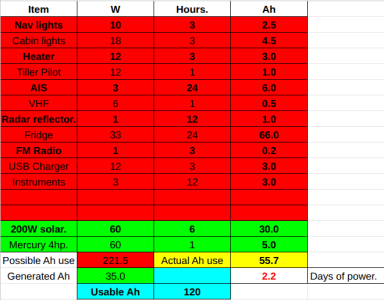
I roughed up this very elementary Excel based on my use, which pretty much follows Tranona's post, along with my own usage with LED throughout, North of Scotland guaranteed sunshine, and sailing most of the day.
As shown, I do have 2X100W solar on my spray hood and a 60W generator on the outboard, which charge my 3 batteries, which are 245Ah all for 'domestic/house' use, as I have a manually started outboard.
I monitor the usage assiduously.

Edit: After posting I saw Baggywrinkles post, which is the same but 'bigger' I think, compared to my wee GK24.
1755675709763.png
 
Last edited:
Well, thank you all much to Mull over this winter . As usual it will come down to how much is spent on the house or the boat. I think I already know the answer. To convert is going to be a big hit. So probably looks like upgrading what I have.
 
Unless you intend dramatically increasing your usage of electricity or spend long periods away from charging sources (eg shorepower) there is little point in changing a perfectly good system. The typical consumption of a small boat like yours is is between 60 and 80 amps a day minus your couple of hours motoring a day when cruising which will give you maybe 20-30A back so a 200Ah bank (100 usable) will give you 2 days a way without any problems. Add a bit of solar will increase that time, starting with a fully charged bank either by shorepower or solar when you are not using the boat helps.

Batteries are only storage and the main barrier to higher usage is the ability to replace your usage. Monitor your usage, determine your generating capacity and this helps determine storage capacity. In terms of what type of storage you use depends in part on how many cycles you expect to have in any period. For a weekend and holiday sailor this is in the range of 30-50pa which gives a typical lif of 5-7 years for basic FLA and 10 years+ for AGM and gel, for example. lithium potentially indefinite in that type of usage. So it depends on your time horizon whether you are prepared to invest in the capital cost of conversion.

Not yet used it on a boat yet, but I purchased a Bluetti 180. A portable Lithium power station. Charges from 3 sources, has 240v, 12v and USB output.

Earned its money doing other jobs and will be used on our next vessel.

Best bang for your buck is a decent solar set up. My 400W runs 2 fridges and a Dometic 40 Ltr. Freezer 24/7 in the summer. We do have a big bank, 660AH, of which 440AH is dedicated house.
 
Unless you intend dramatically increasing your usage of electricity or spend long periods away from charging sources (eg shorepower) there is little point in changing a perfectly good system. The typical consumption of a small boat like yours is is between 60 and 80 amps a day minus your couple of hours motoring a day when cruising which will give you maybe 20-30A back so a 200Ah bank (100 usable) will give you 2 days a way without any problems. Add a bit of solar will increase that time, starting with a fully charged bank either by shorepower or solar when you are not using the boat helps.

Batteries are only storage and the main barrier to higher usage is the ability to replace your usage. Monitor your usage, determine your generating capacity and this helps determine storage capacity. In terms of what type of storage you use depends in part on how many cycles you expect to have in any period. For a weekend and holiday sailor this is in the range of 30-50pa which gives a typical lif of 5-7 years for basic FLA and 10 years+ for AGM and gel, for example. lithium potentially indefinite in that type of usage. So it depends on your time horizon whether you are prepared to invest in the capital cost of conversion.
If you were planning a LA installation this isn't a bad theory. But when considering a LFP installation the section i highlighted above comes into play, often in a significant way. For instance, with a 200Ah LA battery bank the last 20% will be very slow to replace, whereas a LFP battery will take as much charge as you can throw at it. So, a couple of hours of engine running will give you much more power with an LFP installation. Solar panels will put as much power into the LFP battery as they can harvest, with LA they can only put in as the batteries will accept.

Of course, it may turn out that one doesn't need any additional power, or as you say, a little solar is enough, in which case LA is perfectly OK. But, if that is the case, stick with basic FLA batteries because moving to expensive AGM or Gel batteries will likely cost more than LFP.
 
Of course, it may turn out that one doesn't need any additional power, or as you say, a little solar is enough, in which case LA is perfectly OK. But, if that is the case, stick with basic FLA batteries because moving to expensive AGM or Gel batteries will likely cost more than LFP.
Not necessarily the case. a typical 100Ah leisure battery is between £100-120 . I am just replacing the Numax bow battery and direct replacement was £106. Instead I have bought an Exide HK960 which was £134 (and has a higher CCA). In a house bank application (where I also have Exides) they would give a 50% longer life for a 30% price premium with the added advantage of higher charge acceptance and lower self discharge rates - useful in boats that spend more time not being used than used. I had the same batteries in my Bavaria and still good when I sold at 6 years.
 
Not yet used it on a boat yet, but I purchased a Bluetti 180. A portable Lithium power station. Charges from 3 sources, has 240v, 12v and USB output.

Earned its money doing other jobs and will be used on our next vessel.
The second line is the key - useful for other jobs for which they are designed, but very poor value for use just on a boat compared with upping your fixed capacity, never mind lugging about such a heavy lump every time you want to use it on the boat.
 
  • Like
Reactions: vas
Not necessarily the case. a typical 100Ah leisure battery is between £100-120 . I am just replacing the Numax bow battery and direct replacement was £106. Instead I have bought an Exide HK960 which was £134 (and has a higher CCA). In a house bank application (where I also have Exides) they would give a 50% longer life for a 30% price premium with the added advantage of higher charge acceptance and lower self discharge rates - useful in boats that spend more time not being used than used. I had the same batteries in my Bavaria and still good when I sold at 6 years.
314Ah of LFP cells + a top of the range BMS is £350, usable AH = 250. To get the same AH with your Exide batteries you would need 5 of them (237Ah), cost = £670

You also suggested Gel. An Exide ES1200 110Ah Gel battery costs £306. 4 of these would cost £1224 and give you 220 usable Ah.

The "higher charge acceptance and lower self discharge rates" of either of the above options would be minuscule compared to LFP.

There are cases where LA still makes sense, but those are getting fewer due to the falling costs of LFP. Where those cases do exist it only makes sense to stick to basic, budget priced LA batteries.
 
A Fogstar 100Ah is about £220, and gives you the same effective storage as two 90Ah lead acid batteries.
Fogstar are a very reputable make with many happy customers.
So you can see that the price difference between lithium and lead has almost completely vanished.

The benefits of switching are there from day one, and the lithium will massively outlast and outperform the kind of lead acid you can buy for the same money.

The only reason to buy lead now is if you don't use the boat very much, you motor a lot, or you always plug in to shore power at the end of the day.

For anybody who spends a few nights at anchor and has a fridge, heater, etc, then lithium is the way to go and has been for several years.
 
Top