Lithium, do tell 🤔

The second line is the key - useful for other jobs for which they are designed, but very poor value for use just on a boat compared with upping your fixed capacity, never mind lugging about such a heavy lump every time you want to use it on the boat.

Not so sure Tranona.

As you say, heavy, but still easily managable.

Why would you move it once on the boat? I certainly will not. I will run the charging wires to its location and use the output sockets on the device to power what I want to power.

It is self contained, inverter, charger, BMS and three types of output sockets, three charging input sockets. Comes with all leads, but they are a bit short. There are thousands in use around the world in camper vans, few complain except those who do not understand and expect more than can be got from one. I am fully aware of its limits, and was before I blued my dosh.

A tad over £500 quid, blutooth control should you wish it, very compact.

Plus it is a true 'hook up and play' device. Charge input through solar or the engine battery while motoring, fast charge if a 240 supply is handy.

Already allowed me to have the use of BIG power tools away from an electrical supply with no noisy generator hammering away. Battery tools, even pro ones, would not sniff the job. It needed a heavy SDS impact drill for a considerable time to bore three 25mm holes in concrete to a depth of more than 6 inches for a security device. Also powered my sons pressure washer at his detatched, powerless garage so he could clean his motorbikes.

It most certainly is not a universal panacea, and is quite expensive. On the other hand, it is ''ready to go directly out of the box and requires little technical expertise to install and use.
 
I've looked at changing to lithium when present batteries expire but decided against. Our 450ah (4x T105s) and 320w of solar provide what we need but in sunnier location than UK. Weighing up the costs of changing over and possibility of more insurers imposing restrictions, it just isn't worthwhile - in our case.
 
I've looked at changing to lithium when present batteries expire but decided against. Our 450ah (4x T105s) and 320w of solar provide what we need but in sunnier location than UK. Weighing up the costs of changing over and possibility of more insurers imposing restrictions, it just isn't worthwhile - in our case.
How much does a set of Trojans cost you, and how long do they last?
 
314Ah of LFP cells + a top of the range BMS is £350, usable AH = 250. To get the same AH with your Exide batteries you would need 5 of them (237Ah), cost = £670

You also suggested Gel. An Exide ES1200 110Ah Gel battery costs £306. 4 of these would cost £1224 and give you 220 usable Ah.

The "higher charge acceptance and lower self discharge rates" of either of the above options would be minuscule compared to LFP.

There are cases where LA still makes sense, but those are getting fewer due to the falling costs of LFP. Where those cases do exist it only makes sense to stick to basic, budget priced LA batteries.
I know you (and others) go on about all these benefits - but the majority of weekend holiday cruisers do not need that.

As Sea Change says "For anybody who spends a few nights at anchor and has a fridge, heater etc then lithium is the way to go" - but many don't and harbour hop so have access to shorepower and manage just fine the the sort of capacity that comes 2-300Ah of LA. If replacing then AGM with their longer life are a sensible choice - the price premium over FLA is less than the longer life. !0 years is a long time horizon for many boat owners.
 
They're about 7 years old now and replacement from Spain around €900 but no add-ons for b2b, charger etc. With import VAT, duty, carriage, etc. pointless comparing to UK prices for all battery types.

You've done very well to get seven years out of them. I can certainly see the attraction of replacing like for like. Less hassle.

€900 for 225Ah useable at 12v is far more expensive than lithium, though. Even adding in a DC-DC charger and a new fuse, lithium is likely to come out ahead. If you have a beefy shore power charger that isn't lithium compatible, you could just use it to charge the engine battery and then run the DC-DC to charge the lithium. Not an efficient way of doing things but it saves a bit of outlay.
The only other components that might need changed are PWM charge controllers, which would need to be swapped for MPPTs that are lithium compatible. But that's a worthwhile upgrade in itself.

The cost argument no longer holds water unless your boat is pretty small and simple. But lots of people have better things to do than crawl around their bilges changing wiring and installing blue boxes.
 
I know you (and others) go on about all these benefits - but the majority of weekend holiday cruisers do not need that.
I'm aware that LFP aren't needed for everyone, i have repeatedly said so. In post #19 i said "There are cases where LA still makes sense, but those are getting fewer due to the falling costs of LFP. Where those cases do exist it only makes sense to stick to basic, budget priced LA batteries."
As Sea Change says "For anybody who spends a few nights at anchor and has a fridge, heater etc then lithium is the way to go" - but many don't and harbour hop so have access to shorepower and manage just fine the the sort of capacity that comes 2-300Ah of LA. If replacing then AGM with their longer life are a sensible choice - the price premium over FLA is less than the longer life. !0 years is a long time horizon for many boat owners.
The key with sticking with LA is to not spend money that you don't have to spend, like AGM or Gel that you keep promoting, you're stuck in lead acid mentality.

10 years from budget AGM, not likely. Batteries get a hard life on a boat, often abused and more often than not short lived. I spend a decent part of my working life changing batteries,, some not very old at all. That's another benefit of LFP, properly installed, with a correctly setup charging system and BMS they get an easy life and will last for a very, very long time.
 
You've done very well to get seven years out of them. I can certainly see the attraction of replacing like for like. Less hassle.

€900 for 225Ah useable at 12v is far more expensive than lithium, though. Even adding in a DC-DC charger and a new fuse, lithium is likely to come out ahead. If you have a beefy shore power charger that isn't lithium compatible, you could just use it to charge the engine battery and then run the DC-DC to charge the lithium. Not an efficient way of doing things but it saves a bit of outlay.
The only other components that might need changed are PWM charge controllers, which would need to be swapped for MPPTs that are lithium compatible. But that's a worthwhile upgrade in itself.

The cost argument no longer holds water unless your boat is pretty small and simple. But lots of people have better things to do than crawl around their bilges changing wiring and installing blue boxes.

As far as I'm concerned, I see no sense in changing a system which works well during half the year living aboard. Were we short on power then there would be a case for changing but I can find better things to do than buggering about changing for the sake of it. I'm not against lithium, just don't need/want them thanks.
 
As far as I'm concerned, I see no sense in changing a system which works well during half the year living aboard. Were we short on power then there would be a case for changing but I can find better things to do than buggering about changing for the sake of it. I'm not against lithium, just don't need/want them thanks.
That was our approach also. Current system seems to work fine, and the increasing insurance company restrictions a worry.
Spending time on anchorage in the UK, hot water is generally our biggest constraint, as always have hot shower each day, as well as dishes etc. Doubt electric immersion heater would be very efficient without a lot of solar - and sunlight - in northern climate. Hence generally have to run engine once a day for hot water anyway.
 
That was our approach also. Current system seems to work fine, and the increasing insurance company restrictions a worry.
Spending time on anchorage in the UK, hot water is generally our biggest constraint, as always have hot shower each day, as well as dishes etc. Doubt electric immersion heater would be very efficient without a lot of solar - and sunlight - in northern climate. Hence generally have to run engine once a day for hot water anyway.

We have 1500w inverter so the 500w heating element works OK but we're no doubt starting at a higher water temperatures with below decks 30+ recently. Panels through Victron MPPT produce mainly around 1.2kwh daily, occasionally up 1.72kwh if been heating water for an hour or two. Lowest battery voltage I've seen is 12.23v.
 
As far as I'm concerned, I see no sense in changing a system which works well during half the year living aboard. Were we short on power then there would be a case for changing but I can find better things to do than buggering about changing for the sake of it. I'm not against lithium, just don't need/want them thanks.

Totally understand that.

I chose lithium because I did the sums and realised that the installation cost was about the same, and the life cycle costs far far lower. Seeing as I'm an incurable tightwad it was a no brainer to choose lithium.
 
I'm aware that LFP aren't needed for everyone, i have repeatedly said so. In post #19 i said "There are cases where LA still makes sense, but those are getting fewer due to the falling costs of LFP. Where those cases do exist it only makes sense to stick to basic, budget priced LA batteries."

The key with sticking with LA is to not spend money that you don't have to spend, like AGM or Gel that you keep promoting, you're stuck in lead acid mentality.
The "extra" to go to AGM is £30 a battery as I explained. Suggest you read my post#6 properly, particularly the bit about typical annual cycles. for the majority of boats the 3000+ cycles of lithium is meaningless, when the typical is 50 or so pa - 10 years for an AGM. Of course they may not last as long if abused, but it is really not difficult to keep batteries in good shape.

Is "lead acid mentality" a new disease? Is it recognised by social services so that one can claim benefits and not work?
 
As far as I'm concerned, I see no sense in changing a system which works well during half the year living aboard. Were we short on power then there would be a case for changing but I can find better things to do than buggering about changing for the sake of it. I'm not against lithium, just don't need/want them thanks.
Same point of view. We alternate between years of coastal day sailing and 1-2 years of full time cruising, while coastal I have no need for all that energy, when sailing to weird places I consider self sufficiency as a top priority, I had to replace batteries and ancillaries and lead acid, automotive alternators etc replacements can be found anywhere (I even had batteries brought by a friend private plane from a Cat dealer), god forbid thinking about replacing lythium or its many fancy electronics (and no, FedEx won't deliver anything anywhere, even with Tom Hanks). Next time for a longish trip it will be lead acid again, I can live with the limitations.
 
The "extra" to go to AGM is £30 a battery as I explained. Suggest you read my post#6 properly, particularly the bit about typical annual cycles. for the majority of boats the 3000+ cycles of lithium is meaningless, when the typical is 50 or so pa - 10 years for an AGM. Of course they may not last as long if abused, but it is really not difficult to keep batteries in good shape.

Is "lead acid mentality" a new disease? Is it recognised by social services so that one can claim benefits and not work?
It's a fairly recent disease, mostly affects the elderly and the hard of learning, no extra benefits are available ;)
 
I consider self sufficiency as a top priority, I had to replace batteries and ancillaries and lead acid, automotive alternators etc replacements can be found anywhere (I even had batteries brought by a friend private plane from a Cat dealer), god forbid thinking about replacing lythium or its many fancy electronics (and no, FedEx won't deliver anything anywhere, even with Tom Hanks). Next time for a longish trip it will be lead acid again, I can live with the limitations.

I had the same worries and came to the opposite conclusion.
If you set off on a multi year bluewater cruise you'll very likely need to replace your lead acid back along the way. Take the case of Sailing Florence on YouTube who after five years found their Trojans were no longer keeping up with demand. They had to replace them in the Seychelles at huge expense.

If you fit Lithium, then you shouldn't have to replace them. I hesitate to say that they'll last forever, but at this point in time it's safe to say at least a decade, perhaps longer. Based on cycle life alone, my should last 40 years. Maybe treat it like your inboard- if it's brand new when you set off, you're not likely to worry about replacing it along the way.

And if you do somehow kill your lithium, and you can't find replacements where you happen to be, you can just buy lead acid batteries instead, change a few settings, and off you go.
 
I have 8x Trojan T105's, and paid about £1200 for them. They are good for a few hundred cycles.

That's 450Ah useable, so £2.60/Ah.
The first battery I built, 4yrs ago, was £1.50/Ah. Prices have obviously fallen a lot since then. Ready built Fogstar batteries are about £2.20/Ah. Cheaper brands are available.

The Trojans are the expensive choice, and more so if you consider the life cycle of ~500 cycles vs 3000+.

I can't think of the last time I met a liveaboard cruiser who was still using lead acid. It still makes sense for a lot of people who can't be bothered with the hassle of changing though.
 
It's a fairly recent disease, mostly affects the elderly and the hard of learning, no extra benefits are available ;)
The disease you describe has little to do with listening and learning 9or age) but more to do with understanding and being able to make ones own decisions based on ones own requirements.

I suspect it is also a "disease" that will afflict the vast majority of boat owners for many years to come.
 
I have just done this swap.

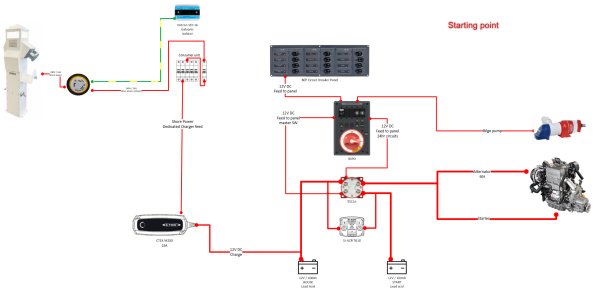
My start point was 2 x Lead Acid 100Ah batteries, one start and one house.

They were linked with a Blue Sea Systems Si-ACR that allowed by directional charging, from the (60A) alternator or from the CTEK M200 mains charger when on shore power.

No issues apart from battery life on the house side - Fridge, instruments, Starlink, Laptop charge and some limited motoring / little shore power meant I ran the battery pretty low a couple of times. Easily fixed by either reducing power use (who wants warm beer?! Not me!) or less ideal, running the engine longer / more frequently.

Space is limited on my 45 year old 33 foot cruiser racer, so adding additional capacity via an extra battery wasn't possible.

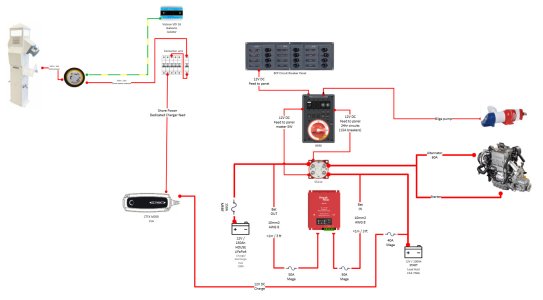
My solution was to replace the SI-ACR with a DC-DC (aka battery to battery / B2B) charger and replace the house Lead Acid with a LiFePo4. As the Si-ACR was already wired to bridge the two Lead Acid sides, adding a B2B was straightforward and only needed a pair of fuses and an earth adding. Given the space constraints of the old Lead Acid house battery, it made sourcing the LiFePo4 slightly harder, but in the end I found one that's a "drop in" size-wise.

My B2B charger is a Sterling BB1240 and the battery is a Sterling LP12150. I can run "off grid" for 2-3 days without issue, (still early days) I see the charge from the engine / alternator running at around 32A with a 70% State of Charge on the house battery, giving a "full" battery in 1-2 hours form 70%. I can still charge from shore power if needed.

List price, cost ~ £900 with cables, fuses etc etc, but there are discounts to be had out there. There's a YouTuber with a 10% Sterling code on his channel. The products turn up on FleaBay too and I was able to resell the SI-ACR and the "old" Lead acid battery. My cost to change probably ~5-600 all in.

Images: the starting point and the updated.


M

Sigmara_LeadAcid.jpg

Sigmara_LiFePo4.jpg
 
Top