

You are using an out of date browser. It may not display this or other websites correctly.
You should upgrade or use an alternative browser.
You should upgrade or use an alternative browser.
Lithium batteries - are they worth it?
- Thread starter Koeketiene
- Start date
Poey50
Well-Known Member
NOT a recommendation but an indication of where LFP is going, bearing in mind the subject heading of this thread. 90ah of LFP is about equivalent usable capacity to 200ah of sealed lead acid but occupying a space for a nominal 12 volt battery of approximately 8" x 6" x 5". (For latecomers read the rest of this thread and linked threads and articles before reaching for your credit card.)
US $210.0 30% OFF|4PCS VariCore 3.2V 90Ah LiFePO4 battery can for 12V batteries Lithium iron phospha 90000mAh Can make Boat batteries,Car batteriy|Battery Packs| - AliExpress
US $210.0 30% OFF|4PCS VariCore 3.2V 90Ah LiFePO4 battery can for 12V batteries Lithium iron phospha 90000mAh Can make Boat batteries,Car batteriy|Battery Packs| - AliExpress
Last edited:
Sybarite
Well-Known Member
Google "SV Delos" and lithium batteries. Or, "Sailing Uma."Thinking of upgrading the battery bank of the 'new' boat and installing Lithium batteries.
Are they worth the extra cash?
Do they really last longer?
Would love to hear from people with first hand experience.
PS. I didn't read through the whole thread and so, sorry if somebody has already mentionned this.
GHA
Well-Known Member
And another offering, looks interesting as a drop in addition/replacement?
Poey50
Well-Known Member
And another offering, looks interesting as a drop in addition/replacement?
Looks good - especially if using at partial C charging and discharging.
Great for adding to a lead acid set-up (which I think is what you are planning) but I wouldn't use a drop-in for replacement on a boat for reasons as previously stated. For my DIY build the 270ah cells cost £620 delivered (they arrived safely a week ago) so that one is still 2-3 times the cost per ah. But a reassuringly robust construction. Some look terrible when torn down as seen in some Will Prowse videos.

Zing
Well-Known Member
Are your units like this? How does it work with that blue plastic coating? Is it insulation to protect a short to the main case? I read on Jack Rickard's site that it is there for that purpose, but if insulation is required then a film does not look like it would be substantial enough. Is it tied to positive or negative?NOT a recommendation but an indication of where LFP is going, bearing in mind the subject heading of this thread. 90ah of LFP is about equivalent usable capacity to 200ah of sealed lead acid but occupying a space for a nominal 12 volt battery of approximately 8" x 6" x 5". (For latecomers read the rest of this thread and linked threads and articles before reaching for your credit card.)
US $210.0 30% OFF|4PCS VariCore 3.2V 90Ah LiFePO4 battery can for 12V batteries Lithium iron phospha 90000mAh Can make Boat batteries,Car batteriy|Battery Packs| - AliExpress
Do you know who the manufacturer was? Have you tested yet - full discharge and what do you think?
Last edited:
Poey50
Well-Known Member
Are your units like this? How does it work with that blue plastic coating? Is it insulation to protect a short to the main case? I read on Jack Rickard's site that it is there for that purpose, but if insulation is required then a film does not look like it would be substantial enough. Is it tied to positive or negative?
Do you know who the manufacturer was? Have you tested yet - full discharge and what do you think?
All good questions.
Yes my pack is made up of 4 x 3.2v 271 ah aluminium case prismatic cells with the characteristic blue plastic covering. It looks like the absolute minimum to provide insulation and it can get damaged quite easily - OK perhaps for a static power wall in the garage but not for a mobile system. I have a 0.5mm fibreglass sheet between each cell and on every surface of the housing (see photo at #104 above) touches the cells.
170x300mm 0.5 to 3mm Glassfibre Sheet Epoxy Glass G10 FR4 Fibreglass Plate ? | eBay
I'm part-way through testing them. Stage one was to top-balance them and then I did a capacity test of the whole pack using one of the fairly inexpensive capacity testers that are now available. The pack capacity at 10amps (not a C20 test but one more in line with my real usage) was 270.3 ah. In fact one of the cells finished earlier than the others, bringing the test to an earlier end, but I suspect that is due to a less than perfect connection as I stacked the terminals slightly casually. I'm half-way through a capacity test of the individual cells and within 2-3 days I'll know how well matched they are.
I bought them from R J Energy - the trader (Carl) writes very good English and this is someone that I'm aware of through Will Prowse's DIY Solar forum and the Lithium Batteries on a Boat Facebook group. Many successful sales are reported and some have been using these cells for a couple of years. Significantly one person reported that they had a duff cell and it was exchanged under the warranty - a 5 year warranty is offered. On the site you will see an impressive looking factory and certificates - almost certainly bogus. The sellers are really traders of these cells as far as I can gather. But they do seem to deliver on capacity and if you demonstrate that you are connected to the above forums then the seller would be mad to rip you off as this would potentially affect thousands of sales. If asking for a quote it is the delivered to your door price that you need - covering transport and duties. You pay 6% extra for credit card or PayPal - well worth it. 280ah cells from Xuba Electronics are another very popular buy at the moment.
But - as ever - buyer beware.
3.2 v 271ah, 3.2 rechargeable battery, 3.2 volt lithium ion battery, prismatic cell
Last edited:
ip485
Well-Known Member
I think the absolute key here is the purpose to which you intend to put your battery bank.
For those who cruise, but are rarely "off grid" I would suggest it is a complete waste of money and effort.
The key is when you are off cruising and are using all the power you would wish, is it a struggle to to keep the bank above 75% for days on end? Are you runing the Genset or engine for unacceptable periods of time just to keep the batteries up to charge?
My conclusion some while ago is that running the engine (at anchor) or even for that matter while sailing if there are good winds and it really isnt necessary is ideally a very poor way of operating. Inevitably it is noisy, wastes fuel and adds to W and T.
Of course this is all in an ideal world, and if you are in the second category and can afford it, the ability to put lots of energy back into the bank very quickly is a God send.
For those who cruise, but are rarely "off grid" I would suggest it is a complete waste of money and effort.
The key is when you are off cruising and are using all the power you would wish, is it a struggle to to keep the bank above 75% for days on end? Are you runing the Genset or engine for unacceptable periods of time just to keep the batteries up to charge?
My conclusion some while ago is that running the engine (at anchor) or even for that matter while sailing if there are good winds and it really isnt necessary is ideally a very poor way of operating. Inevitably it is noisy, wastes fuel and adds to W and T.
Of course this is all in an ideal world, and if you are in the second category and can afford it, the ability to put lots of energy back into the bank very quickly is a God send.
Poey50
Well-Known Member
I think the absolute key here is the purpose to which you intend to put your battery bank.
For those who cruise, but are rarely "off grid" I would suggest it is a complete waste of money and effort.
I think until fairly recently I would have agreed with you. Certainly, up to now, the economics have favoured those who are off-grid and cycling their batteries every day. But the costs are now coming down substantially. My total spend is around £1500 including all charging. (About the price of a mainsail for my boat.) If I don't damage them it is not unreasonable to expect 15 years from them. The reason for this is that I will mostly only be cycling them around between 20 and 80% state of charge and not in high temperatures. But the full charge is always available to me. I have a 32 foot boat with limited amount of solar panels due to the size so the ability to harvest and store all the solar energy when available is valuable. I imagine a £100 per year spend on batteries is not unusual and of course the energy density of my one pack is equivalent to about 5 of the usual sized 100ah lead acid batteries.
This deals with issues of longevity.
Last edited:
Zing
Well-Known Member
Thanks.All good questions.
Yes my pack is made up of 4 x 3.2v 271 ah aluminium case prismatic cells with the characteristic blue plastic covering. It looks like the absolute minimum to provide insulation and it can get damaged quite easily - OK perhaps for a static power wall in the garage but not for a mobile system. I have a 0.5mm fibreglass sheet between each cell and on every surface of the housing (see photo at #104 above) touches the cells.
170x300mm 0.5 to 3mm Glassfibre Sheet Epoxy Glass G10 FR4 Fibreglass Plate ? | eBay
I'm part-way through testing them. Stage one was to top-balance them and then I did a capacity test of the whole pack using one of the fairly inexpensive capacity testers that are now available. The pack capacity at 10amps (not a C20 test but one more in line with my real usage) was 270.3 ah. In fact one of the cells finished earlier than the others, bringing the test to an earlier end, but I suspect that is due to a less than perfect connection as I stacked the terminals slightly casually. I'm half-way through a capacity test of the individual cells and within 2-3 days I'll know how well matched they are.
I bought them from R J Energy - the trader (Carl) writes very good English and this is someone that I'm aware of through Will Prowse's DIY Solar forum and the Lithium Batteries on a Boat Facebook group. Many successful sales are reported and some have been using these cells for a couple of years. Significantly one person reported that they had a duff cell and it was exchanged under the warranty - a 5 year warranty is offered. On the site you will see an impressive looking factory and certificates - almost certainly bogus. The sellers are really traders of these cells as far as I can gather. But they do seem to deliver on capacity and if you demonstrate that you are connected to the above forums then the seller would be mad to rip you off as this would potentially affect thousands of sales. If asking for a quote it is the delivered to your door price that you need - covering transport and duties. You pay 6% extra for credit card or PayPal - well worth it. 280ah cells from Xuba Electronics are another very popular buy at the moment.
But - as ever - buyer beware.
3.2 v 271ah, 3.2 rechargeable battery, 3.2 volt lithium ion battery, prismatic cell
The fibreglass sheets look like a good idea.
Your test results are good. That will be a relief.
The supplier is being a dick with his cycle life at 6,000. I don't believe they have improved that much recently.
A pity they don't let you know who makes them as it would be good to establish their reputation. It must be a big factory producing them with substantial equipment as these things surely aren't assembled in sheds.
I would also be concerned to make the housing watertight. If the shell is conducting then it would only take a little water to damage the aluminium case if it stood on the water for a while or worse if there was any electrical activity to short it to the sea or maybe to somwhere else, like a seacock/through -hull and to do a lot of collateral damage.
Poey50
Well-Known Member
I would also be concerned to make the housing watertight. If the shell is conducting then it would only take a little water to damage the aluminium case if it stood on the water for a while or worse if there was any electrical activity to short it to the sea or maybe to somwhere else, like a seacock/through -hull and to do a lot of collateral damage.
My housing is designed to be a snug fit in the moulded battery box of my Sadler so I don't have great worries about water ingress - and if I do I'll have bigger problems than batteries. But these cells are happiest at the same temperatures as humans and because of compactness, lighter weight, and no requirement for venting, many people put them in cabin lockers.

dulls
N/A
You have a lawn mower on your boat? Now that s sailing....
I have my old LA bank, which is still attached to the inverter so, if I want to charge my razor, or the Dyson, or the toothbrush, or use the printer, or the lawn mower, strimmer, brush cutter, and a few other AC things, I use the inverter, and deplete the LA bank. For a variety of reasons, they only charge from the alternator, so I have to run the engine and, because of their nature, I have to get them back up to 100% soon after use. It takes a long time, and is irritating.
By the end of next week, I should have a way of easily switching the 240V charger and solar to charge the LA bank, rather than the Li bank but, even then, it has to be done very soon after use, and will take a long time and be irritating
There will come a point where I get the inverter connected to the lithiums, so the LAs will be merely a back up, and be fully charged more or less 24/7.
So the freedom to use and charge, (always at the max available, with no reducing to tail current), when convenient is one huge advantage and cost saving. When I say convenient, a full charge, (95% or so), lasts about 5 days of full time living aboard, (8 days with one 250w solar panel and some sunshine). I was charging the LAs at least every 2nd day, and the last 10% took ages every time.
Mine were second hand, having been new in 2006. If they last as long as they might do, (many years), they will have been cheap to buy and set up, as well as being cheaper and much more convenient to run.
Only time will tell but, so far I'm loving them.
As a matter of interest, about a month before I bought them, I posted that, as a destroyer of batteries, there was no way I would ever risk the money needed for a Lithium Bankor

Poey50
Well-Known Member
How does it work with that blue plastic coating? Is it insulation to protect a short to the main case? I read on Jack Rickard's site that it is there for that purpose, but if insulation is required then a film does not look like it would be substantial enough. Is it tied to positive or negative?
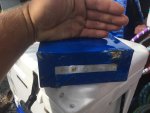
I didn't deal with some of the detail of this question. Yes the aluminium case is positively charged and, as said the blue plastic is barely adequate on its own. Most vulnerable of all is the base which doesn't have the plastic coating. This cell, from someone on the Lithium Batteries on a Boat Facebook group, was one of three that was on a damp painted base and presumably subject to some galvanic corrosion. As said I have fibreglass on any place that touches as well as between all cells and in addition I will paint any nicks in the plastic with layers of liquid insulation and then additionally cover all areas of blue with nylon mesh tape that will help to bind the final pack together prior to being held in light compression in the case.
In many respects the heavily plastic cased Winston cells are more suitable, other than their larger size and the fact they are between 2-3 times the cost. On reflection I think I will paint the bases with several layers of insulating liquid as an additional precaution.
Attachments
Last edited:
GHA
Well-Known Member
Think I'll go for some sort of drop in when prices go down a bit more in addition to T105's, just easier than building a BMS from scratch, fun though that would be.Looks good - especially if using at partial C charging and discharging.
Great for adding to a lead acid set-up (which I think is what you are planning) but I wouldn't use a drop-in for replacement on a boat for reasons as previously stated. For my DIY build the 270ah cells cost £620 delivered (they arrived safely a week ago) so that one is still 2-3 times the cost per ah. But a reassuringly robust construction. Some look terrible when torn down as seen in some Will Prowse videos.
I suspect a lot of cruisers would actually be a lot more successful with drop in lithium, a high proportion I meet just aren't made technical enough to keep lead acid in good shape, so many times you hear 'my bank is fully charged before lunch, little green float light comes on'
Then blame the batteries when they die within a few years and have all the hassle of sourcing new ones and delivery.
If drop ins prove reliable then I suspect a lot of cruising boats would be better off with lithium, though with a bit if failure or stupidity you could trash a bank near instantly compared to the torture so many trojans have to put up with,,
ip485
Well-Known Member
I think until fairly recently I would have agreed with you.
Yes, you are right. I agree as prices fall, and especially if you are taking a view of the economics over the life of the bank, this is undoubtedly true and will change our thinking. Of course there will remain those at current prices that prefer the less costly option of replacing the batteries with conventional ones, accepting they may well need replacing again in 5 years, at least with the price differential as it is, and who, for the reasons I have said, may not get any benefit other than the long term cost saving.
I also think that some may continue to be put off by the need to change some other parts of their system (for example chargers). I think I am correct that it is not always possible to use the existing chargers.
guardian
Well-Known Member
Great thread, really informative. Been looking at batteries for both the Sprinter and Centaur, anybody have anything good/bad to say about these guys in the link below? They look like a direct replacement for Lead/acid and available in many guises Although i'm a little cold on buying from China after getting phone hacked through a software download for a hardware purchase via Aliexpress i guess just buying batteries is reasonably safe other than being sold ones with dud cells.
Cheers
HD Series 12v Battery, HD Series 12v Battery direct from Shenzhen Polinovel Technology Co., Ltd. in CN
Cheers
HD Series 12v Battery, HD Series 12v Battery direct from Shenzhen Polinovel Technology Co., Ltd. in CN
Poey50
Well-Known Member
Great thread, really informative. Been looking at batteries for both the Sprinter and Centaur, anybody have anything good/bad to say about these guys in the link below? They look like a direct replacement for Lead/acid and available in many guises Although i'm a little cold on buying from China after getting phone hacked through a software download for a hardware purchase via Aliexpress i guess just buying batteries is reasonably safe other than being sold ones with dud cells.
Cheers
HD Series 12v Battery, HD Series 12v Battery direct from Shenzhen Polinovel Technology Co., Ltd. in CN
Best to start here and read the whole thing and then decide if "drop-in replacements" are drop-in replacements. Spoiler alert .. they're not.
LiFePO4 Batteries On Boats - Marine How To
Poey50
Well-Known Member
Think I'll go for some sort of drop in when prices go down a bit more in addition to T105's, just easier than building a BMS from scratch, fun though that would be.
I suspect a lot of cruisers would actually be a lot more successful with drop in lithium, a high proportion I meet just aren't made technical enough to keep lead acid in good shape, so many times you hear 'my bank is fully charged before lunch, little green float light comes on'
Then blame the batteries when they die within a few years and have all the hassle of sourcing new ones and delivery.
If drop ins prove reliable then I suspect a lot of cruising boats would be better off with lithium, though with a bit if failure or stupidity you could trash a bank near instantly compared to the torture so many trojans have to put up with,,
I think there is - or will soon be - a market for simple, robust integrated, maintenance-free idiot-proof systems. If the charging and temperature limits and balancing are automatically controlled then there is no maintenance required. One big step forwards would be for someone to offer a 12 volt pack with a quality BMS inside with seperate terminals for charge and load. That way if the BMS disconnects the charge circuit for high voltage you can still draw a load. And vice versa .. if your battery is empty you would still be able to charge it. As things stand with 'drop-ins' any crossing of temperature or charge parameters will send the battery into a deep uncommunicative sulk.
Last edited:

vas
Well-Known Member
thanks for all the info presented, one quick Q which I cannot seem to find a reasonable answer on my (admittedly quick) search.
Would the drop in combos eventually work with normal LA settings (like deep discharge Trojans which I now have) or would they need new chargers?
I'm asking as I have a Victron Multiplus (combo charger inverter) a Victron MPPT 100/30 solar AND a Sterling Pro-digital advanced alternator regulator.
If I have to replace all of them it's definitely a no go and I'll stick to Trojans T105REs. I'm not alone in this multicharger situation, so hope it would work!
any pointers welcomed
V.
Would the drop in combos eventually work with normal LA settings (like deep discharge Trojans which I now have) or would they need new chargers?
I'm asking as I have a Victron Multiplus (combo charger inverter) a Victron MPPT 100/30 solar AND a Sterling Pro-digital advanced alternator regulator.
If I have to replace all of them it's definitely a no go and I'll stick to Trojans T105REs. I'm not alone in this multicharger situation, so hope it would work!
any pointers welcomed
V.

KompetentKrew
Well-Known Member
Can you explain what's wrong with this, please?… so many times you hear 'my bank is fully charged before lunch, little green float light comes on'
They're referring to lead-acid batteries, not lithium, right?
Other threads that may be of interest
- Replies
- 28
- Views
- 698