Lithium and fuses

interestingly he claims to have an involvement in manufacture and development of the batteries.
He’s a reseller, I doubt he knows a lot of detail. If he was involved in the design and manufacture it’s unlikely he could have done so from an AWB mid Atlantic.
 

To be fair to the guy I don't think he was always on an awb mid Atlantic. He claims to be a cofounder of Dakota Lithium.
I watched their whole series, they were at sea when it started and he didn’t take time out to go and design batteries. He certainly is a cofounder I wouldn’t disagree there, and he’s a nice guy too but I don’t think he’s an electrical specialist. Probably good at running the business though.
 
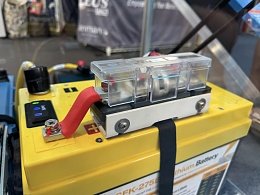
This guy does a nice installation with a T class fuse on each positive terminal by using a short copper bar bent and bored to suit and covered with insulation.
The company had these for sale at one stage, although it was something you could DIY with copper bar and a suitable T class fuse holder. I agree they look like a good solution especially for larger batteries.

Below is a photo from their ad. They are no longer listed on the website (maybe they are just out of stock), but the photo may help anyone who wants to go the DIY route:

This is the website:
Electrical - Fuse Blocks & Fuses

IMG_7752.jpeg
 
Last edited:
.....
The graph above is for a shorted 160Ah Winston Thundersky cell, and tops out at 1080A.

ABYC insist on Class-T fuses, so most likely ISO will merely copy their lead; but wouldn’t it be nice to see a properly detailed study (with citations) to explain their recommendations…
That's a very interesting bit of research...can't claim I understood or even read all of it but the short circuit part is pretty self explanatory.

I am going to go with 150A class T fuses in holders fitted directly on the batteries as in the video in #59.

Mousser Electronics sell these with holders cheaper than MRBFs so a no brainer for me.


Guess it is better to move slowly in case one is going in the wrong direction..
 
I am going to go with 150A class T fuses in holders fitted directly on the batteries as in the video in #59.

Mousser Electronics sell these with holders cheaper than MRBFs so a no brainer for me.
That should be a good solution.

It is the T-class fuses themselves (rather than the fuse holder) that is often expensive. Do Mousser have a good price on the fuse or just the fuse holders?

Also be aware that unlike some other fuse types, such as ANL fuses T class fuses are different sizes depending on the amperage rating:

Length: 61.9mm (110-200A), 69.9mm (225-400A), 77.8mm (450-600A)
Bolt hole size: 8.7mm (110-200A), 10.3mm (225-400A), 12.3mm (450-600A)

The fuse holder has to be the appropriate size for the amperage rating you wish to use.
 
Last edited:
That should be a good solution.

It is the T-class fuses themselves (rather than the fuse holder) that is often expensive. Do Mousser have a good price on the fuse or just the fuse holders?

Also be aware that unlike some other fuses, T class fuses are different sizes depending on the amperage rating:

Bolt hole size: 8.7mm (110-200A), 10.3mm (225-400A), 12.3mm (450-600A)

The fuse holder has to be the appropriate size for the amperage rating you wish to use.
https://www.mouser.ie/c/?fuse size / group=Class T

It's a UK phone number.
 
There's a 325Amp fuse and holder for just shy of 50 euros. I am going to use 125Amps for 37 euros..including holder

what region are you?
We are in the Caribbean at the moment. For reference the cost of a 400A T class fuse is typically around $40 from Amazon USA. There are likely cheaper sources, but I have not done any serious shopping.
 
Last edited:
We are in the Caribbean at the moment. For reference the cost of a 400A T class fuse is typically around $40 from Amazon USA. There are likely cheaper sources, but I have not done any serious shopping.
The problem is Amazon don’t deliver to many places in the Caribbean. In St Martin can get stuff sent to an address in Miami and ‘Business Points’ gets it shipped over for a relatively small fee. It takes a week or so.
 
I was paying £50 for a class T and £5 for MRBF, so I'll admit that did sway my decision a little...
12V planet are have separate listings for 'Cube Fuses' at £5 and 'MRBF fuses' at double the price. Dangerous potential for confusion? Not sure if the two are physically compatible, but I wouldn't want to be fitting the cheaper one thinking it up to MRBF spec (am assuming it's not).
 
I don’t see your reasoning. They can deliver the same number of amps as a larger battery and could easily weld an incorrect fuse which is the purpose of these specialist fuses. You still need the protection either way.
They can't. As the battery Ah rating goes up, so doesn't the aic fusing requirements. There is lots of evidence from smarter people than me that the short potential on a 100Ah lithium will generate circa 1000A or so. This is well within the capability of low AIC fuses. Put together a 16 x280A cells and you are in totally different territory.
 
The problem is Amazon don’t deliver to many places in the Caribbean. In St Martin can get stuff sent to an address in Miami and ‘Business Points’ gets it shipped over for a relatively small fee. It takes a week or so.
Thanks John.
Agreed, it is the place for parts and deliveries.
 
The battery fuse is there to protect the wiring, as are most (not all) fuses. Fit a fuse that's rated for the wiring, or a bit less. If your BMS is rated at, say, 100A max, you could fit a 100A NH fuse, close to the battery.
I have a low current domestic system scaled around just powering instruments, radio, lights etc.

Has appropriately low power BMS (JDB, 60A maybe) and thin wires. Charged by Victron 20A DC-DC charger. 100Ah LifePO4 battery. Fitted with 40A MRBF fuse. Fusing on domestic side is just as it was before LifePO4, apart from fuse on battery.

Hence low fuse current requirement. Bit frustrating when Class T won’t go low enough. Seems like I’m in a minority of one. Class T would be 20x over-specified if reports of 1000A peak current above are true.

Hopefully the regs do/will accommodate my situation. Will think about trying to look up exactly what regs say.
 
Has appropriately low power BMS (JDB, 60A maybe) and thin wires. Charged by Victron 20A DC-DC charger. 100Ah LifePO4 battery. Fitted with 40A MRBF fuse. Fusing on domestic side is just as it was before LifePO4, apart from fuse on battery.

Hence low fuse current requirement. Bit frustrating when Class T won’t go low enough. Seems like I’m in a minority of one. Class T would be 20x over-specified if reports of 1000A peak current above are true.

Hopefully the regs do/will accommodate my situation. Will think about trying to look up exactly what regs say.
Your particular installation will help reduce the required IC rating.

The thin wire adds to the total resistance a short is likely to experience, and hence it reduces the peak short-term current that is possible. Naturally, a thinner wire demands an appropriate and lower fuse rating, but it also, at least in theory, reduces the IC rating needed for the fuse.
 
I have a low current domestic system scaled around just powering instruments, radio, lights etc.

Has appropriately low power BMS (JDB, 60A maybe) and thin wires. Charged by Victron 20A DC-DC charger. 100Ah LifePO4 battery. Fitted with 40A MRBF fuse. Fusing on domestic side is just as it was before LifePO4, apart from fuse on battery.
What are "thin" wires ?
Hence low fuse current requirement. Bit frustrating when Class T won’t go low enough.
NH fuses go lower/
Seems like I’m in a minority of one. Class T would be 20x over-specified if reports of 1000A peak current above are true.
You're confusing the max current rating of the fuse (40A in your case) with how much current can pass through the fuse without it welding itself together and failing to break the circuit. That's the point of class T and NH fuses.
Hopefully the regs do/will accommodate my situation. Will think about trying to look up exactly what regs say.
If you are in the UK, regs do not currently specify the type of fuse for Lithium installations. The US regs apparently say Class T only.
 
Your particular installation will help reduce the required IC rating.

The thin wire adds to the total resistance a short is likely to experience, and hence it reduces the peak short-term current that is possible. Naturally, a thinner wire demands an appropriate and lower fuse rating, but it also, at least in theory, reduces the IC rating needed for the fuse.
What's thin wire ? What's the current carrying capacity of "thin" wire ?
 
What's thin wire ? What's the current carrying capacity of "thin" wire ?
The current capacity of any-sized wire is easy to look up.

Regardless of your definition of a "thin" and "thick" conductor (assuming identical materials), what I have written in the quoted post (post #77) is accurate. Quantifying the values, any way you wish, does not alter the soundness of the principle.

Can you think of an exception?
 
Last edited:
Top