Lithium and fuses

need 40A only
This fuse isn’t for the circuit, you should also have one for that, maybe a mega/midi fuse in a distribution box. This is purely to protect against battery shorts.
JM states that his BMS has built Short Circuit protection
There are shorts and there are shorts. Usually a BMS can disconnect in a small event but anything big and it’ll weld closed so is not sufficient for real protection.
 
The BMS will offer some protection in the event of a moderately high current being drawn from the battery. Typically they are designed to shut down if more than say 100-200A is drawn from a 100Ahr battery. However, in the event of a short circuit, a very high current of potentially many thousands of amps can briefly flow. The BMS is not designed to protect against these high short circuit currents. A short circuit current will likely destroy the BMS and may weld the internal circuitry closed, preventing the BMS from subsequently interrupting the current.

Thus, a fuse is still needed for adequate protection against a short circuit fault in addition to the BMS which is in every lithium battery. Even some fuses cannot adequately interrupt the very high short circuit currents that lithium batteries can produce. Hence, the need for specialised fuses with a very high IC (interrupt capacity) rating, such as a T class fuse with a 20kA IC rating.
Understood, except there are YouTube clips in which Lithium batteries are tested for short circuit and many seem to work fine. Certainly the ones in the 300 aH Epoch batteries I’ve chosen. One also had to assess the risk. The only way I can see a short circuit happening is if I design the wiring in such a way I can drop a spanner across the terminals AND I’m careless enough to do it!

I think I’ll stick with fusing with an MBRF type or a MEGA fuse close to the battery. How much extra risk am I carrying?
 
Understood, except there are YouTube clips in which Lithium batteries are tested for short circuit and many seem to work fine. Certainly the ones in the 300 aH Epoch batteries I’ve chosen. One also had to assess the risk. The only way I can see a short circuit happening is if I design the wiring in such a way I can drop a spanner across the terminals AND I’m careless enough to do it!
I know some of the larger Epoch batteries have a class T fuse mounted inside the case so there is no need for any external battery fuse with these batteries.

However, I don’t think this applies to the smaller models. If they do not have the internal fuse fitted, I would always add an external fuse rather than relying on the BMS.
 
I think I’ll stick with fusing with an MBRF type or a MEGA fuse close to the battery. How much extra risk am I carrying?
I would not use a MEGA fuse; these only have a very low 2kA interrupt rating. The MRBF fuses are much better with a 10kA IC rating. There is near-universal agreement that the 10KA rating is too low for large lithium batteries (for example +300Ahrs). These should have a class T or NH fuse somewhere in the system, although some advocate an additional MBRF fuse on each battery post as a cheap and easy way to provide some protection for the wire between battery and the bus bar

The advice on smaller lithium batteries (for example 100Ahrs) is much less clear. Many knowledgeable people believe that an MRBF fuse on each battery terminal is adequate protection on its own. Others are equally dogmatic that a fuse with a 20kA rating is needed in any lithium system.
 
Last edited:
However, in the event of a short circuit, a very high current of potentially many thousands of amps can briefly flow. The BMS is not designed to protect against these high short circuit currents. A short circuit current will likely destroy the BMS and may weld the internal circuitry closed, preventing the BMS from subsequently interrupting the current.....

It seems the real question is how many "thousands of amps" can be found in a 120ah 12v lithium battery.

If it's less than 5k , even if they are doubled up they will still be less than the 10, 000 amp IC of an MRBF.

Is there also a risk caused by batteries themselves going wrong and causing a short across another which is connected in parallel with it. ? If so, to be fully safe do we not need a T fuse at each battery?

Can anyone say, with authority, what the potential current in amps is from a 120ah 12v battery? Or is there some way to calculate this.?
 
It seems the real question is how many "thousands of amps" can be found in a 120ah 12v lithium battery.
This question is indeed at the crux of what IC rating the fuse needs. Unfortunately, it is a difficult question to answer. We need to know how much current the battery can deliver, even if it can only sustain this peak for a very short time frame, perhaps milliseconds. This is because these short time periods can be enough to weld the terminals of the fuse together, and once this has occurred, the fuse may not break the circuit even if the current subsequently drops well below the IC rating.

The battery manufacturers will often publish the maximum current the BMS can conduct continuously, or a peak result over a few seconds, but this is not the information that is needed.

I don’t have an answer.

The only deduction that can be made is if the experts feel a large lithium battery is not safe when relying on a fuse with a 10kA IC rating, they must feel that in some fault circumstances the battery is capable of delivering over 10,000 A for brief periods.

Or is there some way to calculate this.?
Some have used battery internal resistance measurements to try and theoretically predict the current. Many battery manufacturers will list the internal resistance of their product, or it can be measured with clever meters. Some like to match the internal resistance of the cells when constructing a DIY lithium battery, so the meters are not uncommon. Once the resistance is known, Ohm’s law can be easily used to theoretically predict the current.

Unfortunately, the consensus seems to be that the resulting prediction is not accurate.
 
Last edited:
Why risk something that could cause additional damage to equipment or start a fire, for the sake of fitting the correct fuse ?

You will all be complaining if enough bodged Lithium installations cause a fire or two and your insurance companies refuse to pay out and/or they all start insisting that all Lithium installations must be carried out by professional installers. Some insurance companies already insist on pro' installations only.
 
Last edited:
Why risk something that could cause additional damage to equipment or start a fire, for the sake of fitting the correct fuse ?

You will all be complaining if enough bodged Lithium installations cause a fire or two and your insurance companies refuse to pay out and/or they all start insisting that all Lithium installations must be carried out by professional installers. Some insurance companies already insist on pre installations only.
A good friend of mine has a professionally fitted system.
It has an ANL master fuse.
 
Problem for me is finding a Class T fuse rated less than 110A – need 40A only.
The battery fuse is there to protect the wiring, as are most (not all) fuses. Fit a fuse that's rated for the wiring, or a bit less. If your BMS is rated at, say, 100A max, you could fit a 100A NH fuse, close to the battery.
 
Yes, divide the maximum cell voltage by the internal resistance of the cell. Comes out around 20kA
I've seen the internal resistance of LFP cells described as being essentially zero... leading to a near infinite current flowing.
Presumably the resistance of the bus bars, BMS internal circuitry, and the cables leading to the fuse, starts to play a significant role when we're dealing with these sorts of numbers?
 
I've seen professional installations with no fuses ! But, that doesn't mean we should all follow suit. ;)
I just worry that insurance companies will blindly insist on 'professional installation' with no industry standard to work to. It would be better if they specified a technical standard (like the type of fuse etc). But that's not how they generally do things.
 
Hopefully Paul will explain in more detail. I was under the same impression as you that MRBF on each battery was a good design. If there is a dead short somewhere, it still has to go through the class T.
It's debatable whether MRBF fuses are adequate for 280Ah batteries, so why risk it ? What was the saving by doing so, you had to buy the Blue Sea bits, how much did you save, rather than buying a second T class fuse. Or, what was the cost of all of your fusing, as opposed to a couple of NH fuses ?

Cost aside, a short before the T class "master" fuse totally relies on the MRBF fuses. I would rather fit a T class or NH fuse to each batter, followed by an isolator switch for each battery, the a busbar.
 
I just worry that insurance companies will blindly insist on 'professional installation' with no industry standard to work to. It would be better if they specified a technical standard (like the type of fuse etc). But that's not how they generally do things.
Completely agree with you on all points. I suspect that it won't be long before specific requirements for Lithium installations will be part of the ISO, heavens know what that will look like though.
 
I've seen professional installations with no fuses ! But, that doesn't mean we should all follow suit. ;)
I just watched Ryan and Sophie on YouTube doing a lithium upgrade with not a fuse in sight, interestingly he claims to have an involvement in manufacture and development of the batteries.


This guy does a nice installation with a T class fuse on each positive terminal by using a short copper bar bent and bored to suit and covered with insulation.
 
When a LiFePO4 cell is short circuited, the situation is not straightforward.

First of all, the figures published for cell ‘resistance’ are usually impedance measurements at (1 kHz), not the cells internal resistance (which is measured in a different way).

Even if you had the right figure for internal resistance, when a cell is shorted its terminal voltage is zero; in this situation, what is the driving EMF (probably not 3.2V), and what is the internal resistance path (unlikely to be the same as a cell's internal resistance at say 1C discharge)? It’s difficult to know what’s going on inside a shorted cell; probably only the Chinese know the full story. It’s definitely not just a case of “Ohms Law”.

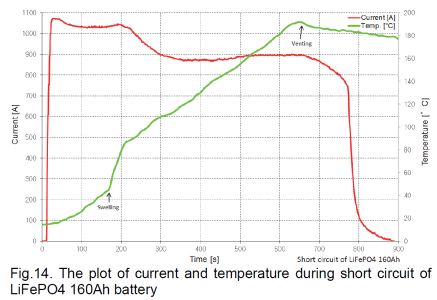
The only academic paper I can find covering this subject is:

https://www.researchgate.net/figure...rcuit-of-LiFePO4-160Ah-battery_fig5_316171277


1739995418060.png

The graph above is for a shorted 160Ah Winston Thundersky cell, and tops out at 1080A. It’s worth noting that Winston cells are likely to have a higher short circuit current than the usual ‘blue’ prismatics, because Winston’s are made with multiple parallel internal ‘pouches’, whereas EVE’s etc. only have two (much longer) pouches. It’s quite possible that the short circuit current produced by a typical ‘drop-in’ battery could be a fair bit lower; even with a failed and short-circuit BMS.

ABYC insist on Class-T fuses, so most likely ISO will merely copy their lead; but wouldn’t it be nice to see a properly detailed study (with citations) to explain their recommendations…
 
Top