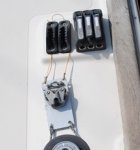
Lines led to cockpit. What's the downside?

Tends to be what people say when they have run out things to say. They spoke of progress when I bought a Bri Nylon shirt.


Stuck to my back like a bloody albatross.


.

Really! I am not advocating anything, just that I don’t think tech has anything to do with at mast or in cockpit sail handling. If you read my posts on this thread I suggest good design, maintenance and experience is what is important, not that one method is better than the other.

To take a point. Pilot Cutters are still built new, they represent a development of tech that was efficient. Some folks buy that type of boat. The latest offerings from many current boat builders offer in cockpit controls, with modern tech, yet a small number of posts appear every year from folks who still manage to have problems with in mast reefing, which usually transpired to be poor understanding of how to use the system.
 
Could not agree more. You may have the wrong end of the stick :)

I am gently poking fun at those who, when they are stuck for a comment, tell us how very modern they are.

.

I apologise if my response appeared tetchy due to grabbing the wrong end of the stick, as you noticed.
 
Easer / better with ropes led back for a whole raft of reasons, particularly when sailing short handed:
- ropes closer to helm - safer if need to avoid other boats or pot buoys, easier to align sail with lazy jacks etc
- quicker - saves time not needing to clip on and go forward, also massively quicker to drop sail when needed
- dryer - rarely sail with oilskins and almost never boots, so can reef etc from spray hood - when go on deck in breeze often may get a wave which gets you wet
- safer - no need to leave cockpit, particularly important at night (and even experts like Taberly have died thinking they knew better and gone on deck without harness on)

So ropes at mast are workable, but like hank on jibs (vs furlers), technology has moved on and ropes led back are better in almost all respects (and doesn’t prevent using extra crew at mast to smoke halyards up in a race)

PS. Somebody on here keeps saying “but going on deck to do halyards is essential to keep in practice“, which is clearly nonsense - by this thinking, we should pull halyards up from masthead to keep in practice with going up the rig. I am happy to go forward when necessary, but prefer not to be forced to do so just to hoist, reef or drop sail.
I don't dispute that going on deck in your boat sounds like a problem but just about everything you sight as an issue is not an issue in my boat.
Our boat weighs in at between 18 and 19 tonnes. The motion is not like a lightweight modern boat. Side decks are wide and uncluttered. Guardrail/wires are high and bar tight. The mast has five winches. One for every job. We have substantial granny bars above waist height and curved around your back. No need to hang on with one hand. Jack stays run inboard via base of mast. Reefing at the mast is super fast and made easy as we don't have a topping lift. We have a sprung mechanical strut that automatically takes the weight of the boom when reefing. No lines in the cockpit other than Genoa sheets and Genoa reefing lines aft. Zero friction as the only sheeve that the main halyard passes over is at the top of the mast then over the winch.
Falling over the side of our boat is hard to do unlike on smaller boats with a raised coach roof. We have flush decks and acres of space. We also have high topsides so a dry boat.
On your boat I am sure at the cockpit is 'better' in my boat at the mast is better. We wouldn't dream of changing it. Can you imagine a Bristol Channel pilot cutter with reefing in the cockpit? It wouldn't be better or appropriate
 
Last edited:
I don't dispute that going on deck in your boat sounds like a problem but just about everything you sight as an issue is not an issue in my boat.
Our boat weighs in at between 18 and 19 tonnes. The motion is not like a lightweight modern boat. ………..

Not sure weight is a huge factor here - not sure what weight it was (a tad more than yours), but the steel 70 foot BT Challenge yacht I sailed on had the ropes led back from the mast :)
And motion at sea not a problem/factor on my boat either. But each to their own.
 
In my past, I've cruised shorthanded om boats normally raced with 5 or 6 or more on board.
When you have a race boat, each evolution like a kite gybe or a reef needs several things to be done.
On a race boat you might have different people doing many of the steps, therefore those control need to have some space between them.
When cruising, you may need to do each step yourself, therefore it's good if there is less space between the controls
On a dinghy we think of some controls as being 'for the helm' some 'for the crew' and some both might need to access at different times.

So maybe the fundamental is to think through each evolution and think who need to reach what?
I think my boat might have 3 modes:
Single handed, not using autohelm
Single handed plus autohelm
Two up, autohlelm optional.

There are certain things you need to be able to do if the autohelm decided not to play or if the crew is doing something more urgent.
Putting the kite up is generally optional.
Taking the bugger down may not be!
 
Putting the kite up is generally optional.
Taking the bugger down may not be!
I have an asymetric. Unfortunately it is not a furling one.
I do have to take it on the fordeck to set up read to hoist.
But having done that I hoist, then drop under the boom, from the cockpit. The asymetric, now being in the cabin, can be sorted & bagged at will. Then I take the end of the halyard back to the pulpit & collect the bag, & pull the sheets back & clip ready for use later on.
So I do have some deck work but I keep it to a minimum.
So having the spinnaker halyard back to the cockpit is a useful option

It is much safer than dancing around on deck, balancing & staring at the sky trying to get a silly snuffer to un jam, then lower it without it ending in the oggin & bagging it.
 
As others have said, the main downside once it's done is friction, but use quality ball bearing blocks and that won't be much of an issue. I mentioned the possibility of doing this on my new Catalac to my rigger, and he said I'd need a new boom, which is correct if I run reefing lines and outhaul through the boom, but I could always run the boom lines along the outside, as I did on my Snapdragon, so that isn't insuperable. Cost would be significant - triple clutch each side, turning blocks on the deck and so on, so I'm going to see how I get on at the mast, as a cat should be a lot easier, but on a small monohull in rough seas, I reckon lines aft are an important safety feature.

My top tip would be to include a downhaul for the main. It wouldn't have to be heavy, I used 3mm cord on my Snapdragon, but it does mean you can get it down into the lazyjacks reliably from in the cockpit, then tidy up once you're parked up. On an 8m Catalalc, I'd probably use 4-5mm, no more.
 
you need more than a triple clutch each side.
3 reefs, halyard, outhaul, topping lift, kicker is already 7 lines or 10 without single line reefing + 1 for your downhaul.
 
On a bigger boat, sure, but a small boat will likely have only two reefs. In fact many 3 reefed boats only have 2 lots of string, which always struck me as a bit daft, because by the time you need that 3rd reef, you probably don't want to be leaving the cockpit. It was the need to go to the mast to drop the (double reefed) main in F8 that decided me to bring the lines aft.

Jissel managed with triple clutches - main halyard, topping lift and reef 1 on one side; kicking strap, lazy jacks and reef 2 on the other. The outhaul was quite manageable on the end of the boom. I needed the kicker and lazyjacks aft because the boom was a headbanger, so was pulled up out of harm's way (harm to me that is ;) ) when we dropped the main.
 
As others have said, the main downside once it's done is friction, but use quality ball bearing blocks and that won't be much of an issue. I mentioned the possibility of doing this on my new Catalac to my rigger, and he said I'd need a new boom, which is correct if I run reefing lines and outhaul through the boom, but I could always run the boom lines along the outside, as I did on my Snapdragon, so that isn't insuperable. Cost would be significant - triple clutch each side, turning blocks on the deck and so on, so I'm going to see how I get on at the mast, as a cat should be a lot easier, but on a small monohull in rough seas, I reckon lines aft are an important safety feature.

My top tip would be to include a downhaul for the main. It wouldn't have to be heavy, I used 3mm cord on my Snapdragon, but it does mean you can get it down into the lazyjacks reliably from in the cockpit, then tidy up once you're parked up. On an 8m Catalalc, I'd probably use 4-5mm, no more.
If you need a down haul for the mainsail then you have not sorted the friction. The weight of the sail should do the job for you without bits of extra string to tangle & complicate things.

As for clutches- you need something to stop the lines off anyway & they are neater than cleats.

A small problem with leading lines outside the boom, then down to the mast foot is that when you gybe the length changes because the lines are not on the centre - as they would be if through the centre of the boom. One cannot get all the turning blocks at the back of the mast. Some have to go at the side & that is where the problem comes with lines from the boom, unless one can work out a neat solution.
 
you need more than a triple clutch each side.
3 reefs, halyard, outhaul, topping lift, kicker is already 7 lines or 10 without single line reefing + 1 for your downhaul.
With this set up I can have , second & third reef, Spinnaker halyard, topping lift, outhaul, MOB hoisting line, cunningham.
All from this one bank.
topping lift clet (2) (216 x 232).jpg
 
If you need a down haul for the mainsail then you have not sorted the friction. The weight of the sail should do the job for you without bits of extra string to tangle & complicate things.
The sail went up easily enough, but it was fairly new and quite stiff, so needed a hand to fold itself more than to drop itself.
 
" My top tip would be to include a downhaul for the main. "


That is indeed a good idea I feel foolish for not considering sooner. My main often sticks on the way down and I have to get up and stuff it into the stackpack by hand. How does one rig a downhaul? I've never used one.

Simon.
 
" My top tip would be to include a downhaul for the main. "


That is indeed a good idea I feel foolish for not considering sooner. My main often sticks on the way down and I have to get up and stuff it into the stackpack by hand. How does one rig a downhaul? I've never used one.

Simon.
The last reef might do the job..
At least on mine it does, ( I uses two line reefing...)
 
" My top tip would be to include a downhaul for the main. "


That is indeed a good idea I feel foolish for not considering sooner. My main often sticks on the way down and I have to get up and stuff it into the stackpack by hand. How does one rig a downhaul? I've never used one.

Simon.
We have a short main downhaul - just from the headboard to the third car down, and attached by a Velcro loop (as a “fuse”, in case ever got jammed on anything, but has never done so).
This downhaul does mean a trip to the mast - but not needed if need to dump the sail in a hurry, as blowing the halyard it all comes down in a run. Downhaul only used when lower slowly to fold neatly into stack pack for a full “harbour stow”, as then there is no momentum or weight of cloth to pull the last bit down.
 
Top