LiFePO and lead acid.

jamie N

Well-Known Member
Joined
20 Dec 2012
Messages
6,519
Location
Fortrose
Visit site
Pretty much the only subject to mention on here just now!
My thoughts were that I'd 2 very ancient 2012-13 70aH Halfords leisure batteries fitted, which still maintained a charge, and gave no signs of trouble, that I'd removed from my previous boat. However, I didn't want to have them begin to fail mid season, when I'm hoping to be 'somewhere else', so they were going to replaced, as I don't want to be greedy.
I bought my present GK24 a couple of years ago, which already had a new 105aH LA battery, and is still in VGC. These batteries are only for domestic use, as the boat's powered by an outboard.
The dilemma was "Should I convert to LiFePo?", which would mean ditching the perfectly good 105aH that I've got, and then fitting a LiFePo, with a suitable charging system, and probably a 2nd battery as I don't like having a single point of failure for a critical item, or simply stay old school replacing the batteries with a near 'like for like', and carry on?
Being that I'm 70 years old, and the LA batteries will see me out, and I'm 'saving' a few bob by being old fashioned and not altering too much, which gives me in fact 285aH of rated battery (I know it's only 1/2 actual that's usable), I think that it's a reasonable decision to have taken right now. It's most likely that the price will continue to reduce of LiFePo, but my age won't, and the added weight won't noticeably hinder my sailing.
The point of the post is that I believe that this is one of the few times that taking a technical small step forward to a more efficient system, really wouldn't have been the best way ahead, given these specific circumstances. I'm sure that the next owner in a few years won't have a dilemma at all, it'll be an obvious thing to install LifePo, or whatever is the super volt source at the time.
If I'm wrong, and people wish to sponsor the LiFePo alternative, I can do a swap for some new and tested LA batteries which have had only one careful owner....
 
Why change what works ??

I am also 70yrs old and carrying batterys is no fun even with boats at bottom of garden etc.

My 24ft Mobo ... my 25ft Motor sailer .... both have dual Lead Acid battery setups .. and I see no reason to change.

My 38ft racer has a triple battery Lead Acid setup .. one for engine start - the other two are the domestic .... Change ? Why ? When the domestics die - maybe I will look at LiFePo4 replacement ... but its going to be years before that happens.

Lead Acid is simple.

Putting LifePo4 - means changing setup ...
 
Apologies, I should clarify that I've already replaced the batteries with lead acid equivalents, a pair of 90aH Tayna items for £133, which I'm content with.
The thread was simply to see others view of the wisdom.
Cheers for the above comments though. (y) 🥃
 
Last edited:
Apologies, I should clarify that I've already replaced the batteries with lead acid equivalents, a pair of 90aH Tayna items for £133, which I'm content with.
the thread was simply to see other's view of the wisdom.
Cheers for the above comments though. (y) 🥃

Both for 133 quid ? That's not bad price ... when I compare to over here .. you can pay near that for one !!
 
Why change what works ??

I am also 70yrs old and carrying batterys is no fun even with boats at bottom of garden etc.

My 24ft Mobo ... my 25ft Motor sailer .... both have dual Lead Acid battery setups .. and I see no reason to change.

My 38ft racer has a triple battery Lead Acid setup .. one for engine start - the other two are the domestic .... Change ? Why ? When the domestics die - maybe I will look at LiFePo4 replacement ... but its going to be years before that happens.

Lead Acid is simple.

Putting LifePo4 - means changing setup ...
LifePO4 is a game changer for some people, but not for everyone. In your case, i think you made the right decision.
 
Apologies, I should clarify that I've already replaced the batteries with lead acid equivalents, a pair of 90aH Tayna items for £133, which I'm content with.
the thread was simply to see others view of the wisdom.
Cheers for the above comments though. (y) 🥃
I did the same. Got 12 years out of the previous batteries and no issues, so also did a like for like swap. Simple and effective.
The other factor is the increasing number of hassles reported in terms of insurance cover for DIY “lithium battery” installations.
 
Pretty much the only subject to mention on here just now!
My thoughts were that I'd 2 very ancient 2012-13 70aH Halfords leisure batteries fitted, which still maintained a charge, and gave no signs of trouble, that I'd removed from my previous boat. However, I didn't want to have them begin to fail mid season, when I'm hoping to be 'somewhere else', so they were going to replaced, as I don't want to be greedy.
I bought my present GK24 a couple of years ago, which already had a new 105aH LA battery, and is still in VGC. These batteries are only for domestic use, as the boat's powered by an outboard.
The dilemma was "Should I convert to LiFePo?", which would mean ditching the perfectly good 105aH that I've got, and then fitting a LiFePo, with a suitable charging system, and probably a 2nd battery as I don't like having a single point of failure for a critical item, or simply stay old school replacing the batteries with a near 'like for like', and carry on?
Being that I'm 70 years old, and the LA batteries will see me out, and I'm 'saving' a few bob by being old fashioned and not altering too much, which gives me in fact 285aH of rated battery (I know it's only 1/2 actual that's usable), I think that it's a reasonable decision to have taken right now. It's most likely that the price will continue to reduce of LiFePo, but my age won't, and the added weight won't noticeably hinder my sailing.
The point of the post is that I believe that this is one of the few times that taking a technical small step forward to a more efficient system, really wouldn't have been the best way ahead, given these specific circumstances. I'm sure that the next owner in a few years won't have a dilemma at all, it'll be an obvious thing to install LifePo, or whatever is the super volt source at the time.
If I'm wrong, and people wish to sponsor the LiFePo alternative, I can do a swap for some new and tested LA batteries which have had only one careful owner....
Stick with lead acid. Buy from a cheaper place than Halfords. Keep it simple.

My opinion in this scenario.
 
Pretty much the only subject to mention on here just now!
My thoughts were that I'd 2 very ancient 2012-13 70aH Halfords leisure batteries fitted, which still maintained a charge, and gave no signs of trouble, that I'd removed from my previous boat. However, I didn't want to have them begin to fail mid season, when I'm hoping to be 'somewhere else', so they were going to replaced, as I don't want to be greedy.
I bought my present GK24 a couple of years ago, which already had a new 105aH LA battery, and is still in VGC. These batteries are only for domestic use, as the boat's powered by an outboard.
The dilemma was "Should I convert to LiFePo?", which would mean ditching the perfectly good 105aH that I've got, and then fitting a LiFePo, with a suitable charging system, and probably a 2nd battery as I don't like having a single point of failure for a critical item, or simply stay old school replacing the batteries with a near 'like for like', and carry on?
Being that I'm 70 years old, and the LA batteries will see me out, and I'm 'saving' a few bob by being old fashioned and not altering too much, which gives me in fact 285aH of rated battery (I know it's only 1/2 actual that's usable), I think that it's a reasonable decision to have taken right now. It's most likely that the price will continue to reduce of LiFePo, but my age won't, and the added weight won't noticeably hinder my sailing.
The point of the post is that I believe that this is one of the few times that taking a technical small step forward to a more efficient system, really wouldn't have been the best way ahead, given these specific circumstances. I'm sure that the next owner in a few years won't have a dilemma at all, it'll be an obvious thing to install LifePo, or whatever is the super volt source at the time.
If I'm wrong, and people wish to sponsor the LiFePo alternative, I can do a swap for some new and tested LA batteries which have had only one careful owner....
A well set up victron Battery monitor and some solar charging would be a useful investment for you to properly understand the state of charge and get some top up of the batteries when not tied up on shore power.
 
I'm probably one of the biggest proponents of LFP batteries on this forum, but they're not necessary or right for every single boat and application.

If you mostly day sail from a marina berth, and you have modest electrical needs, lead acid is likely to work perfectly well.

If you spend months at a time living aboard without access to shore power and rarely running your engine, then it's crazy not to use LFP.
 
My last boat had solar and Lead Acid .... it would drop 12-15% overnight and charge back to 100% by lunchtime. Had 12V 370Ah batteries and no inverter. Boat was a 36ft AWB with 300W of solar on the bimini. Typical loads for that type of boat (Plotter, Autopilot, Instruments, Windlass) - lights all switched for LEDs.

If you have good LA capacity and don't do deep discharges, then stick with Lead Acid. Never touch a running system.

Li Batteries need a few extra components that adds to the cost, (DC-DC Charger).
 
I added two lifepo, but also kept the bank of three LA . Not sure it was worth the effort and cost except when singlehanding across the channel and can run the autopilot and radar as much as I want and the speedy recharging once across. Think you have made the right choice.
 
I added two lifepo, but also kept the bank of three LA . Not sure it was worth the effort and cost except when singlehanding across the channel and can run the autopilot and radar as much as I want and the speedy recharging once across. Think you have made the right choice.
That's what I did too.
There was nothing much wrong with my lead acid system- one engine start and two domestic batteries. But I wanted to add a freezer, inverter, switch to electric cooking, and add a lot of extra solar to power it all.
The lead acids lived in the engine room, and I didn't want to put lithium batteries in there. So there was nothing much to gain by ripping them out.

The system I ended up with was a bit unconventional: the lead acid starter remained, obviously, and the two 110Ah house batteries were still wired up to a handful of circuits- some of the cabin lights, the water pump, and the lights in one of the heads. All the other domestic circuits went to the new lithium. It was more by accident than design but it meant that if either battery system failed, I could still move around down below and use the bog.
A later addition was to wire up the navigation equipment (autopilot, lights, plotter, instruments) to both banks, with the positives switched using keyed isolators. As there was only one key, which can only be removed in the off position, it was impossible to accidentally put the two systems in parallel. I would run the nav stuff off the lithium when sailing, and from the lead acid when motoring.
In addition to the alternator, 200w of solar charged the lead acids. The remaining 1000w charged the lithium. There was no other form of charging.

This worked brilliantly for several years until we sadly lost that boat in a hurricane. The new boat is set up slightly differently, as the old house lead acids were completely dead. Everything except engine start and windlass runs off the lithium. I haven't bothered putting any solar power to the lead acids, I've found that running the engine every couple of weeks seems to be enough to keep them topped up.

But for somebody who doesn't live aboard, it's all a bit overkill. The main advantage of switching to lithium for a lightly used boat would be that you'd probably never have to think about your batteries ever again. It would be fit and forget- once you'd designed the system.
 
I did a fairly major upgrade to the domestic system on Jazzzcat a couple of years ago. going from two rather tired 60AH batteries to three 110AH. At the time, Lithium was still pretty expensive, so I stuck with LA. I think if I were doing it now, I'd go with LiFePO, probably with two 100-odd AH batteries. If I need to change the LA system again, I'll do my sums then, because, ATM, there doesn't seem to be a huge difference in the price per usable AH between Plain LA leisure batteries and decent LiFePO ones, and in a few years, Li may well be cheaper.
 
A well set up victron Battery monitor and some solar charging would be a useful investment for you to properly understand the state of charge and get some top up of the batteries when not tied up on shore power.
Yup, I've in fact got a pair of PWM controllers that came with my 200W of solar, and manage to keep a good charge with everything in normal use from springtime onwards, that's with a fridge, heater and the usual use of boat electrics. I'm a GK24 with an outboard, so winches aren't an issue, and the outboard charges at a modest 5A/60W.
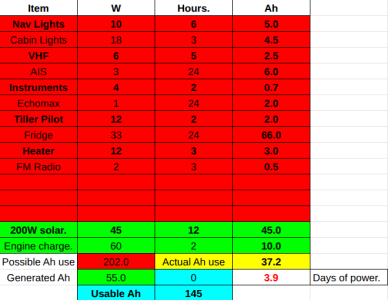
I made up an Excel of my electric usage, as many others have, and it indicates that I'll be OK for 3-4 days with 'cloudy skies', and pessimistically normal use. Last year the bank voltage never went beneath 12.7VDC with these items, and the 'old' batteries, which made me happy. I've developed a paranoia about it, having a quite leaky boat previously, which made me prioritise power for the bilge pumps; everything else was a bonus! (sort of).
As it's a GK24 and I'm not a dwarf PORG, then if I'm 4 days away from a pub marina, it'd be in the papers.
1769341302488.png
I think that if I'd been younger, and expecting, rather than hoping, to keep sailing for another decade I'd have gone LiFePo though.
Cheers for the opinions of others though.
Virtual beers all round.🍻
 
No probs, it was split over a few posts and I think my assumption was that you used the other for engine but makes sense now
 
Top