Lifejackets

Quandary

Well-Known Member
Joined
20 Mar 2008
Messages
8,214
Location
Argyll
Visit site
A few years back we replaced our XM Quickfit lifejackets with Spinlock Deckvests, well designed product with a good harness arrangement for using with jackstays but the downside is that you do feel a bit like a trussed up turkey in one. When we go ashore in the dinghy they are a pain to stow or carry around so I am investigating re employing the XMs solely for this purpose. I have checked air retention and I am about to order re-arming kits. My wife, who has sailed with me all her married life is still not that water confident and insists, as a condition of her presence, that everyone wears an LJ when under way or when going ashore in the dinghy at night.
It occurred to me that if I used 25gm. rather than the standard 33gm. cylinders there would be sufficient buoyancy for close inshore but the jacket might be soft enough to make swimming or getting back in to the dinghy a lot easier, when they are inflated hard they support you but you might not be able to do much?
Is this a bad idea?
 
My immediate thought is yes, a bad idea. If not fully inflated then you will have a moveable air-pocket .... i.e. it may not support you like it should, the air may accumulate in the part behind your neck while providing no buoyancy under your chest - making it more difficult to keep your face out of the water when swimming.

I may be wrong, but a semi-inflated lifejacket may take more effort to swim in than a fully inflated one - plus anyone panicking may then try and fully inflate it with the mouth tube instead of swimming to safety.

I'm no expert and I've never tried swimming in a semi inflated jacket, but I can imagine the thing ballooning behind my head.
 
Unless you want spares, you don't need to replace the cylinders if they are not corroded or empty. Just the release cartridge is all that's needed.

But to answer question, no don't do it.
 
My immediate thought is yes, a bad idea. If not fully inflated then you will have a moveable air-pocket .... i.e. it may not support you like it should, the air may accumulate in the part behind your neck while providing no buoyancy under your chest - making it more difficult to keep your face out of the water when swimming.

I may be wrong, but a semi-inflated lifejacket may take more effort to swim in than a fully inflated one - plus anyone panicking may then try and fully inflate it with the mouth tube instead of swimming to safety.

I'm no expert and I've never tried swimming in a semi inflated jacket, but I can imagine the thing ballooning behind my head.

The air may inflate in the lower chest region, not the neck and make it difficult to keep your head up. Yes bad idea!
 
My immediate thought is yes, a bad idea. If not fully inflated then you will have a moveable air-pocket .... i.e. it may not support you like it should, the air may accumulate in the part behind your neck while providing no buoyancy under your chest - making it more difficult to keep your face out of the water when swimming.

I may be wrong, but a semi-inflated lifejacket may take more effort to swim in than a fully inflated one - plus anyone panicking may then try and fully inflate it with the mouth tube instead of swimming to safety.

I'm no expert and I've never tried swimming in a semi inflated jacket, but I can imagine the thing ballooning behind my head.

I use foam kayak-style jackets in the dinghy. You're not going the wear them that long, they won't be damaged if someone walks all over them, and no one will steal the cheap ones... and it's OK if they do. They are simply better suited to the purpose.

As for "The best argument against democracy is a five-minute conversation with the average voter," I suggest a 5 minute conversation with a politician who would be king. It's much worse (US citizen).
 
The air may inflate in the lower chest region, not the neck and make it difficult to keep your head up. Yes bad idea!

This is exactly what happens sometimes if under inflating. the CO2 finds its way to the bladder section nearest the bottle then migrates to the bladder on the mouth piece sides and finally the neck bit bursts the zip/velcro .....May get all the buoyancy around your bum if the neck section does bot inflate.
 
What ever way you go make sure your bottle is tight.
Yesterday I dropped my virtually unused jacket in a bucket of water.( The firing mechanism was best before 2010)

I deliberately did not check anything. Dropped in with a puff of co2 it half inflated... The bottle was not fully tight.... I know I habitually check this and would doubt that I had not checked that one before it was last used...

I bought two new ones this year much tidier... Decathalon do a tidy model also...
 
What ever way you go make sure your bottle is tight.
Yesterday I dropped my virtually unused jacket in a bucket of water.( The firing mechanism was best before 2010)

I deliberately did not check anything. Dropped in with a puff of co2 it half inflated... The bottle was not fully tight.... I know I habitually check this and would doubt that I had not checked that one before it was last used...

I bought two new ones this year much tidier... Decathalon do a tidy model also...

The MAIB have reported on that. Thanks for the reminder.
 
What ever way you go make sure your bottle is tight.
Yesterday I dropped my virtually unused jacket in a bucket of water.( The firing mechanism was best before 2010)

I deliberately did not check anything. Dropped in with a puff of co2 it half inflated... The bottle was not fully tight.... I know I habitually check this and would doubt that I had not checked that one before it was last used...

I bought two new ones this year much tidier... Decathalon do a tidy model also...

One point to add, make sure the bottle is tight and the rubber bottle seal is not perished. A tight bottle on a perished seal will also only partially inflate.

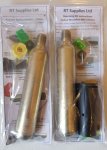
My advice is buy a complete re-arm kit because it includes a cover (green bits) to indicate if the manual inflate has been activated, a new bottle (of the correct weight for the jacket), a new salt tablet for the firing mechanism (yellow on the left - Roberts Alpha V90000 - and in the big black bit on the right - UM Mk5) but also, a new rubber bottle seal.

It is tempting to skimp by just buying a salt tablet, but the rubber seal is just as important.

ReArm.jpg

When re-arming, I check everything is tight and blow the old bottle manually to inflate the jacket and check for bladder integrity, deflate it and re-pack it and then fit the new re-arm kit - worth the cost of a CO2 bottle to check the jacket IMO.
 
Last edited:
If you are being instructed to wear a flotation device in a dinghy (not a bad idea anyway) have you looked at the clothing-type PFD? I have a Baltic Sandhamn gilet which is a PFD and stylish enough to wear to the pub.
 
Last edited:
Your wife is quite right! Here in Ireland lifejackets must be compulsorily worn when on deck on all vessels below 7m. In practice, I have observed that people who have trained on vessels under 7m will habitually wear a lifejacket on any size vessel, it becomes as natural as fastening your seatbelt in a car.
Under-inflating your LJ is a bad idea, as discussed above. Over-inflating is equally risky as the LJ is likely to burst.
The standard advice for when you fall overboard (in our latitudes and higher), is not to swim, but to adopt a foetal position, so as to to preserve your body heat within your clothing for as long as possible, (swimming would wash out the warm water and replace it with cold), and wait for rescue. A group of people in the water should attach themselves together so that no-one drifts away from the group.
IMHO re-activating the old XM LJs for dinghy use is a good idea as they are fairly compact if you need to put them in a bag and carry them around when ashore.
 
Last edited:
If you are being instructed to wear a flotation device in a dinghy (not a bad idea anyway) have you looked at the clothing-type PFD? I have a Baltic Sandhamn gilet which is a PFD and stylish enough to wear to the pub.

Was this you?

lbm_7c5be3e50f5733fd0e7a6c04ef0ddc58_429_600_ffffff_85.jpg


Tested and approved as a 50N buoyancy aid (ISO 12402) the Sandhamn provides discreet practical safety.
  • Two outer pockets
  • Inside pocket
  • Detachable crutch strap
  • Retro- reflective on the back
  • Manufactured and approved to EN ISO 12402 (50N)
  • D-ring to attach to emergency switch lanyard

https://www.crew-safe.co.uk/acatalog/Baltic-Sandhamn-Gilet.html

... the detachable crutch strap obviously really is detachable. :encouragement: ... doesn't look too bad at all.
 
This is exactly what happens sometimes if under inflating. the CO2 finds its way to the bladder section nearest the bottle then migrates to the bladder on the mouth piece sides and finally the neck bit bursts the zip/velcro .....May get all the buoyancy around your bum if the neck section does bot inflate.

“Does bot inflate” given the earlier part of the quote made me laugh.
 
The intention is to use the Quickfit ljs for going ashore in the dinghy, in this situation there are two main areas of hazard at either end of the trip, our S31 has a fold down grp step forming the after end of the cockpit and when this is used the ss boarding ladder is in the water, relatively easy transfer; however many villages like at Gigha and Craighouse have 'upgraded' their pontoons to accommodate the tenders from cruise ships, these new pontoons are much higher, there are few hand grips other than the cleats and I have not noticed any safety ladders. we find them hard to use.
When inflated with a 33gm cylinder the quickfit has one chamber, fat and hard at each side of the chest and round the back of the neck, it goes nowhere near the bum. If partially inflated (a 25gm. cylinder will contain 75%) the air will be in the highest part behind the head,and both front ends, being lower, will be soft, if I kick my legs up the air could move from around the neck but a squeeze will send it back, I can not see how I would float in any other position than nearly vertical vertical with my head out of the water. There is also thoption to add air if required by mouth. When I try to climb over the side of the dinghy or drag my body over the high edge of the pontoon the lj will not resist my movement in the way it would if stiff and hard.
In my OP I stated that we had Deckvests with harness and leg straps for sailing, the Quickfits would only be deployed for going ashore by dinghy, having tried on the Quickfits bone hard after automatic inflation I would dread having to do anything athletic in them particularly as we have two metal knees and a metal hip between us. There is a difference between our proposed use and falling out of a yacht offshore which perhaps some of you do not recognize?
I have tried manual inflation to what looks like 75% and it is much more comfortable, the next step might involve a trial immersion.
 
Last edited:
If you are only concerned about staying afloat while trying to get out of the water right by a dinghy or ladder, then a lifejacket is not the thing. It would seriously inhibit your ability to save yourself although it would keep you afloat. I would have thought a buoyancy aid is the thing in these circumstances, it is what every watersports enthusiast uses to keep afloat while they recover themselves.
 
Top