Legs again

fisherman

Well-Known Member
Joined
2 Dec 2005
Messages
19,675
Location
Far S. Cornwall
Visit site
I keep turning over this problem for a small long keeler, trying to avoid holes in the hull. Would it be possible to shackle a leg to the chainplate and shroud? The upthrust would be on the chain plate, and a shackle at the top, higher the better, round the shroud for stability. Would it be better to have a plate permanently fixed to the shroud/chainplate for the leg to bolt to? Would it need transverse stiffening? Is it even feasible?
 
The fitting made by Yacht Legs is a very elegant solution, which if made by an engineering workshop would be considerably cheaper than the YL company would charge you (£160 when I last asked). There are photos on my website at Installing Yacht Legs No open holes in the hull, just two bolts per side.

I have seen legs installed as you suggest but it seems a crude method to me.
 
I fashioned a set of legs from fence posts. The tops of the legs were lashed to the midship cleats via a hole in the legs to prevent them pushing up. Legs were tied together at the bottom so had to be 'launched' over the bow and fed backward. Fore and aft ropes were also required. Lots of rope and a faff to mount/unmount but OK for once or twice a year and winter storage.
 
I’ve got a Hurley 18 with legs fitted using a single hole each side through the hull: they go through a glassed in reinforcing plate. Holes blanked by a bolt and rubber washer when not in use. It’s a relatively simple modification and easy to use with the legs located well aft of the chain plates so you couldn’t use them to mount the legs anyhow.
The legs need lines run fore and aft to keep them in place but that’s pretty common. Boats in Mylor if you’d like to come over and look at her.
 
I have an aversion to making holes in the hull and was also concerned about the aesthetics of the hull attachments. However having fitted them they are barely noticeable and are a very neat solution which I doubt you could improve on.
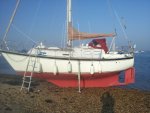
IMG_3370.JPG
 
Little Dorrit have the fore and aft ropes been removed as you prepare to re float on the tide, or can you manage in some situations with out them?
I didn't bother to use them on this occasion as I was only aground for for a single tide and went aground at about high water when the tide is negligible (so would be when I refloat too). I have put a kedge anchor out In the past but not on this occasion conditions were benign. I think the long keel makes the fore and aft lines less important than on a fin keel...or at least that's my assumption. I think in rapidly rising or falling tides or in windy conditions I would take extra precautions.
 
I always used the lines even when, as in your case, they were not strictly necessary. Two reasons: it makes launch and recovery easier to make the legs up on deck, fit the spigot and then lower the foot down (reverse to recover). Secondly, to act as a safety strop in case I dropped them. They are heavy and cumbersome to place when hanging over the side.
 
I keep turning over this problem for a small long keeler, trying to avoid holes in the hull. Would it be possible to shackle a leg to the chainplate and shroud? The upthrust would be on the chain plate, and a shackle at the top, higher the better, round the shroud for stability. Would it be better to have a plate permanently fixed to the shroud/chainplate for the leg to bolt to? Would it need transverse stiffening? Is it even feasible?

I think avoiding holes in the hull is leading you to other greater challenges. The hull effectively provides both the permanent plate and the transverse stiffening you are looking for.

All you need is a hole in the hull with a nut on a backing pad on the inside, outside edge of hole countersunk, and a matching countersunk head screw (with a rubber or mastic seal under it) to close the hole when the legs are not in use.

That is the arrangement, together with homemade wooden legs, that I inherited on a Hurley 22 (long fin). (Very similar arrangement to the bottom boat picture on Vyv's legs webpage.) Worked fine except the stout legs were too big and heavy to want to carry aboard generally, so mainly used for winter storage of the boat, and for launching/recovery from a tidal beach.

Fitting the wooden legs single-handed when afloat was a minor wrestle due to having to fight the buoyancy of the thick wooden legs while aligning the bolt. Best to have a ring head bolt through the leg so you can screw it home without a spanner, and then final nip up with a small bar through the ring.
 
yes I have suggested that in the past, mine had a captive 1in s/s bolt, relatively easy to push the leg down and feed the bolt into the hole, big wing nut on the inside. However, I had the advantage of standing on the deck which was below the bolt hole, on a yacht I would be on my knees leaning over upside down, and not be able to reach the inside to put a nut on. Of course I would in that case have a captive nut (welded to a plate screwed to a backing pad) inside the hull and screw the bolt through the leg into it. I think now about a hefty right angled plate secured to the deck/hull topside with a leg fixing on it,the trick is not to fix the leg too rigidly, so it can accommodate any ranging about
 
Top