Lee bowing

Doesn't it also need direction of travel of the boat?

No.
Forget your land frame of reference.
consider a boat with an apparent wind 30 degrees off the bow.
The apparent windspeed is 15 knots
The boat speed is 5 knots
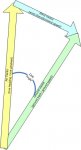
You can draw that in a boat speed+ true wind= apparent wind triangle
The component of the apparent wind at right angles to the boat is 15 sin30 knots
The component of the true wind in that direction is the same. 7.5knots
The component of the apparent wind parallel to the boat is 15 cos30 or 13 knots
The component of the true wind parallel to the boat is 13-5 = 8 knots.

The true wind speed is sqrt (8^2 + 7.5^2) = 11 knots
The true wind angle is arctan (7.5/8) =43degrees off the bow.
 
. . .

TAS (true airspeed) is indeed ground referenced for airplanes and it is used for navigation and other calcs. But TAS is temperature and pressure compensated, so one wound use IAS (indicated airspeed) for taxiing, takeoff, landings, etc as it provides a better measure of lift.

.

True Air Speed is not indeed ground referenced.

The true airspeed (TAS; also KTAS, for knots true airspeed) of an aircraft is the speed of the aircraft relative to the airmass in which it is flying.

https://en.wikipedia.org/wiki/True_airspeed

"True" just means SOME vector has been taken out of the equation.
 
Funny that, because all (very good) Avionics that Garmin manufacture refer to True wind as ground-referenced. Unsurprising as that's been the industry standard for about 100 years. If a marine instrument refers to True Wind as being referenced to the water it is sitting on it just means the manufacturer can't be bothered to do the necessary sums or perhaps that the system doesn't have the necessary inputs. That doesn't mean that the definition of True Wind suddenly changes though. You won't get any aircraft or system through certification if it calculates True Wind in any other way and it's a requirement that weather stations are anchored to the ground as well.

Unfortunately it's the marine industry that is unique (if it really is the majority of sailors using this terminology and I'm not convinced as I certainly don't hear it a lot) - if anyone wants to use it that's up to them (whoever they are) but please don't pretend it's become some kind of international agreement.

You are in error concerning "true air speed" in aircraft.

"True" in this context means corrected for density and temperature, NOT indeed ground referenced. As opposed to "Indicated Air Speed", which is the raw output from the pitot tube.

"[T]he true airspeed (TAS) of an aircraft is a relative measurement. The actual flight speed of an airplane relative to an air mass is termed as true airspeed, and it is primarily used for navigational purposes. In short:

"Flight speed shown on the instrument (not corrected for instrument error, altitude, density and temperature) is called indicated airspeed.
"The actual speed of an aircraft through the air is termed as true airspeed."


https://www.decodedscience.org/airs...cated-airspeed-ias-and-true-airspeed-tas/5035


This shows very well that "true" just means true with respect to SOMETHING, depending on the purpose of the measurement. Just because weathermen think of "true wind" as ground referenced, doesn't mean that pilots or sailors have to. There are all different kinds of "true".
 
True Air Speed is not indeed ground referenced.

The true airspeed (TAS; also KTAS, for knots true airspeed) of an aircraft is the speed of the aircraft relative to the airmass in which it is flying.

https://en.wikipedia.org/wiki/True_airspeed

Oh for goodness sake, just because TAS or anything else has a ground reference does not mean it is the same as ground speed! An aircraft's TAS is a relative measurement of the actual flight speed relative to an air mass; routinely referred to as 'true airspeed' and it is corrected for altitude, density and temperature. This is principally used for navigational purposes, which is by definition ground referenced!

Like true wind estimations on a boat, TAS cannot be measured directly by the plane's sensors and equipment in flight, but Garmin GPS equipped aircraft, as referenced by the poster above, will calculate TAS and offer it as an available field on a data display; just as Garmin's sailing gear will offer TWS. There are of course other ways to estimate it.

The point I'm making is simply that - for many - it will be so much easier to go with the flow of the standards adopted by the major instrument suppliers and practitioners of that activity.

It is of course a free world.

Edit: apols for drifting the thread into aircraft, the intention being to draw a comparison between two non-directly measurable, but relevant parameters. Happy to continue this branch of the discussion, but on an airborne forum!
 
Last edited:
Oh for goodness sake, just because TAS or anything else has a ground reference does not mean it is the same as ground speed! An aircraft's TAS is a relative measurement of the actual flight speed relative to an air mass; routinely referred to as 'true airspeed' and it is corrected for altitude, density and temperature. This is principally used for navigational purposes, which is by definition ground referenced!

Like true wind estimations on a boat, TAS cannot be measured directly by the plane's sensors and equipment in flight, but Garmin GPS equipped aircraft, as referenced by the poster above, will calculate TAS and offer it as an available field on a data display; just as Garmin's sailing gear will offer TWS. There are of course other ways to estimate it.

The point I'm making is simply that - for many - it will be so much easier to go with the flow of the standards adopted by the major instrument suppliers and practitioners of that activity.

It is of course a free world.

Edit: apols for drifting the thread into aircraft, the intention being to draw a comparison between two non-directly measurable, but relevant parameters. Happy to continue this branch of the discussion, but on an airborne forum!


For goodness sake, this is simply not true. "For navigation" does not in any manner whatsoever mean it's ground referenced.

Ground referenced speed for air navigation is "GS", or "ground speed"
True Air Speed or "TAS" is air mass-referenced.
To convert TAS to GS, you factor out the wind.

TAS is equal to GS only when there is no wind, just like True Wind for sailors is equal to Ground Wind only in the absence of current.

I guess you've never seen an air navigation wind triangle:

Wind_triangle.jpg

"The wind triangle is a vector diagram, with three vectors.

"The air vector represents the motion of the aircraft through the airmass. It is described by true airspeed and true heading.
" The wind vector represents the motion of the airmass over the ground. It is described by wind speed and the inverse of wind direction. Note that by convention wind direction is given as the direction the wind is from. In a vector diagram such as the wind triangle, wind direction must be stated as the direction the wind is blowing to, or 180 degrees different from the convention.
" The ground vector represents the motion of the aircraft over the ground. It is described by ground track and ground speed. The ground vector is the resultant of algebraically adding the air vector and the wind vector."


https://en.wikipedia.org/wiki/Wind_triangle
 
Last edited:
For goodness sake, this is simply not true. "For navigation" does not in any manner whatsoever mean it's ground referenced.

Ground referenced speed for air navigation is "GS", or "ground speed"
True Air Speed or "TAS" is air mass-referenced.
To convert TAS to GS, you factor out the wind.

TAS is equal to GS only when there is no wind, just like True Wind for sailors is equal to Ground Wind only in the absence of current.

I guess you've never seen an air navigation wind triangle:

View attachment 76733

"The wind triangle is a vector diagram, with three vectors.

"The air vector represents the motion of the aircraft through the airmass. It is described by true airspeed and true heading.
" The wind vector represents the motion of the airmass over the ground. It is described by wind speed and the inverse of wind direction. Note that by convention wind direction is given as the direction the wind is from. In a vector diagram such as the wind triangle, wind direction must be stated as the direction the wind is blowing to, or 180 degrees different from the convention.
" The ground vector represents the motion of the aircraft over the ground. It is described by ground track and ground speed. The ground vector is the resultant of algebraically adding the air vector and the wind vector."


https://en.wikipedia.org/wiki/Wind_triangle

You’ve yet again just copied a whole bunch of stuff from Wikipedia, well done. Sarky comments aside, the fact that the ground vector, as GPS-equipped systems may measure directly it, is directly related to the true airspeed implies a ground reference right there. Hence it’s use in navigation workups, including of course the wind triangle, just as boatspeed and heading can be referenced to COG when adjusted for tide. It’s really not difficult.
 
It's nothing do do with international agreements. You mention Garmin which annually sell around $400m and $600m of marine and aviation equipment respectively. Being a tech company it can easily do the vector calcs, so nothing to do with "can't be bothered".

TAS (true airspeed) is indeed ground referenced for airplanes and it is used for navigation and other calcs. But TAS is temperature and pressure compensated, so one wound use IAS (indicated airspeed) for taxiing, takeoff, landings, etc as it provides a better measure of lift.

This distinction is of little interest to a sailors, just as tides aren't of much interest to pilots. So Garmin design each around its intended use. It's really not hard.


OK let's just take a breath. TAS has nothing to do with the ground mate. We have a different term for speed over the ground.
 
You are in error concerning "true air speed" in aircraft.

"True" in this context means corrected for density and temperature, NOT indeed ground referenced. As opposed to "Indicated Air Speed", which is the raw output from the pitot tube.

"[T]he true airspeed (TAS) of an aircraft is a relative measurement. The actual flight speed of an airplane relative to an air mass is termed as true airspeed, and it is primarily used for navigational purposes. In short:

"Flight speed shown on the instrument (not corrected for instrument error, altitude, density and temperature) is called indicated airspeed.
"The actual speed of an aircraft through the air is termed as true airspeed."


https://www.decodedscience.org/airs...cated-airspeed-ias-and-true-airspeed-tas/5035


This shows very well that "true" just means true with respect to SOMETHING, depending on the purpose of the measurement. Just because weathermen think of "true wind" as ground referenced, doesn't mean that pilots or sailors have to. There are all different kinds of "true".

All pilots know true wind is wind referenced to TRUE NORTH! as apposed to magnetic north. Runway winds are referenced to Magnetic north as are the runways.
 
You’ve yet again just copied a whole bunch of stuff from Wikipedia, well done. Sarky comments aside, the fact that the ground vector, as GPS-equipped systems may measure directly it, is directly related to the true airspeed implies a ground reference right there. Hence it’s use in navigation workups, including of course the wind triangle, just as boatspeed and heading can be referenced to COG when adjusted for tide. It’s really not difficult.

You are misusing the word "referenced", in order to cover previous errors. I don't like it, because this kind of obfuscation confuses people.

The Ground Vector in air navigation is ground referenced. The Air Vector is air mass referenced. These things should not be confused. The two are not "directly related" at all. They are related INDIRECTLY, via the Wind Vector. GPS data is NOT used in any way in the calculation of Garmin instruments of True Air Speed. GPS is data is used ONLY for calculation of GS or Ground Speed. It is very harmful to obfuscate these very different concepts.

Absolutely the same thing for us -- True Wind is water referenced. Ground Wind is ground referenced. Use STW and HDG for True Wind; use COG and SOG for Ground Wind.
 
Oh for goodness sake, just because TAS or anything else has a ground reference does not mean it is the same as ground speed! An aircraft's TAS is a relative measurement of the actual flight speed relative to an air mass; routinely referred to as 'true airspeed' and it is corrected for altitude, density and temperature. This is principally used for navigational purposes, which is by definition ground referenced!

Like true wind estimations on a boat, TAS cannot be measured directly by the plane's sensors and equipment in flight, but Garmin GPS equipped aircraft, as referenced by the poster above, will calculate TAS and offer it as an available field on a data display; just as Garmin's sailing gear will offer TWS. There are of course other ways to estimate it.

The point I'm making is simply that - for many - it will be so much easier to go with the flow of the standards adopted by the major instrument suppliers and practitioners of that activity.

It is of course a free world.

Edit: apols for drifting the thread into aircraft, the intention being to draw a comparison between two non-directly measurable, but relevant parameters. Happy to continue this branch of the discussion, but on an airborne forum!


All the aircraft Ive flown calculate TAS using IAS and TAT. Don't know what you fly.
 
You’ve yet again just copied a whole bunch of stuff from Wikipedia, well done. Sarky comments aside, the fact that the ground vector, as GPS-equipped systems may measure directly it, is directly related to the true airspeed implies a ground reference right there. Hence it’s use in navigation workups, including of course the wind triangle, just as boatspeed and heading can be referenced to COG when adjusted for tide. It’s really not difficult.

You are misusing the word "referenced", in order to cover previous errors. I don't like it, because this kind of obfuscation confuses people.

The Ground Vector in air navigation is ground referenced. The Air Vector is air mass referenced. These things should not be confused. The two are not "directly related" at all. They are related INDIRECTLY, via the Wind Vector. GPS data is NOT used in any way in the calculation of Garmin instruments of True Air Speed. GPS is data is used ONLY for calculation of GS or Ground Speed. It is very harmful to obfuscate these very different concepts.

Absolutely the same thing for us -- True Wind is water referenced. Ground Wind is ground referenced. Use STW and HDG for True Wind; use COG and SOG for Ground Wind.
 
OK let's just take a breath. TAS has nothing to do with the ground mate. We have a different term for speed over the ground.

No point in getting all shirty. If TAS had ‘nothing’ to do with the ground, true air speed could shoot-up with no corresponding effect on the ground. In reality a simple vector calc relates the two, for the simple reason that the wind is blowing vis a vis the land. You previously quoted a paper of which you quite demonstrably had zero understanding, and we’re now drifting into foolishness. I’m going to depart this tangent now if that’s all right.
 
No point in getting all shirty. If TAS had ‘nothing’ to do with the ground, true air speed could shoot-up with no corresponding effect on the ground. In reality a simple vector calc relates the two, for the simple reason that the wind is blowing vis a vis the land. You previously quoted a paper of which you quite demonstrably had zero understanding, and we’re now drifting into foolishness. I’m going to depart this tangent now if that’s all right.

The paper I quoted explained exactly why different object do not float at the same speed as the current they are in. The formulae clearly showed the two independent drag forces acting against each other. Unless you are under the impression water and air have the same density!!!

True air speed has nothing to do with the ground. Sorry if you think otherwise. Next time you enter a Jet stream at a fixed Mach number and therefore TAS take a moment to examine your groundspeed. You may notice it shoot-up. Or down.

;)
 
You are misusing the word "referenced", in order to cover previous errors. I don't like it, because this kind of obfuscation confuses people.

What, confused to find that the wind blows over the land? Even little old ladies aren’t confused when the mini flip-down screen on an airplane displays airspeed and ground speed? This is just getting silly.
 
Last edited:
The only problem with that argument is that it then doesn't have a term for the wind that is the measure in velocity difference between the water and air. Which is the measure of the power we have available to our boats, and the direction in which we are able to point them.

If you call the wind relative to the ground "true wind" then what do you call this wind?

Indeed.

We sail in the SHEAR between air and water; our boats don't touch or feel the ground at all.

Water-referenced True Wind is what we sail in, not ground referenced Ground Wind.

In fact the Ground Wind is not even interesting to us except for predicting changes in the True Wind.

The instrument makers have it exactly right. What would you even do with Ground Wind displayed on your instruments in the cockpit? It would be useless except when there is zero tide. Ground Wind relative to the bow of the boat is not even coherent information.

I display Ground Wind (expressed as compass direction) at the nav table, for planning. True Wind relative to the bow tell you what you are sailing in, where the layline is, what the wind will be like when you turn downwind, etc. Ground Wind won't tell you any of this.
 
What, confused to find ththe fact that the ground vector, as GPS-equipped systems may measure directly it, is directly related to the true airspeed implies a ground reference right there.” No, at the wind blows over the land? Even little old ladies aren’t confused when the mini flip-down screen on an airplane displays airspeed and ground speed? This is just getting silly.

You either don't understand, or are intentionally obfuscating what "referenced" means.

When we say that a measurement is “ground-referenced” or “water-referenced” or indeed even “sun-referenced”, it means that whatever is being expressed, is being expressed relative to that reference. So TAS just like STW has nothing to do with ground, and no reference to ground is expressed or implied. Just like there is no reference whatsoever of any kind to the sun. The speed expressed is relative to the air mass or the water, respectively. You said “Oh for goodness sake, just because TAS or anything else has a ground reference does not mean it is the same as ground speed!” Yes it does. That is what “referenced” means. “X-referenced speed” means “speed in relation to”. You said “the fact that the ground vector, as GPS-equipped systems may measure directly it, is directly related to the true airspeed implies a ground reference right there.” No, it doesn’t. Speed is expressed in relation to one thing. 130 knots TAS is speed in relation to the air mass. It could anything in relation to ground – could be 50 knots GS or 200 knots GS or anything. There is no kind of reference to the ground in the expression "130 knots TAS".

Once you factor in the wind vector (not indeed the ground vector -- the ground vector is the result), speed is no longer TAS. Now it is referenced to ground, not air mass, and it has become GS. It can't be both at the same time. GS today is measured directly using GPS, and TAS is not used in any way whatsoever in the calculation of GS, using GPS.
 
Last edited:
You either don't understand, or are intentionally obfuscating what "referenced" means.
............................

Just calm down, the point here is so simple: (a) if one has any two motion vectors one can fill in a third. (b) any two inertial frames in a constant state of motion can be easily cross referenced. To see this in action:

Airplane: if one knows a plane's true airspeed and heading and CoG from say a GPS, then we can fill in the wind vector. Easy. The plane doesn't give a damn whether it's flying over land, or a water current moving with respect to the land. If the plane lands and comes to a halt its true airspeed will be the ground wind. That's about it subject to instrumentation matters.

Sailboat: a boat sailing will by comparison experience the apparent wind (comparable to the plane's true wind speed). If the boat slows down and stops with respect to the water, it will now measure the wind available to power it through the water. What is the wind it is now experiencing? This thread has largely been about what to call this wind.

An added complication for the yacht is that while stationary with respect to the water, it may still be moving in the tide with respect to a geographical reference (moored buoy, harbour, etc). This introduces a third frame of reference.

Garmin and the other major equipment manufacturers have adopted a unified approach within their marine equipment, and my and others point is simply that it might be easiest to go with this. Other terms of reference are perfectly fine, easily translatable, one just needs to be careful.
 
Last edited:
Possibly of interest: Garmin back themselves to be the market leader in marine within a few years and have recently delivered fantastic growth in all key categories, including aviation and marine. The stock is up 250% over the past 3 years to a market capitalisation of $16 billion and many investors big-time back it to deliver on this goal.

This is possibly worth bearing in mind for anyone contemplating a new equipment purchase as Garmin is now very much the company to beat.
 
Just calm down, the point here is so simple: (a) if one has any two motion vectors one can fill in a third. (b) any two inertial frames in a constant state of motion can be easily cross referenced. To see this in action:

Airplane: if one knows a plane's true airspeed and heading and CoG from say a GPS, then we can fill in the wind vector. Easy. The plane doesn't give a damn whether it's flying over land, or a water current moving with respect to the land. If the plane lands and comes to a halt its true airspeed will be the ground wind. That's about it subject to instrumentation matters.

Sailboat: a boat sailing will by comparison experience the apparent wind (comparable to the plane's true wind speed). If the boat slows down and stops with respect to the water, it will now measure the wind available to power it through the water. What is the wind it is now experiencing? This thread has largely been about what to call this wind.

An added complication for the yacht is that while stationary with respect to the water, it may still be moving in the tide with respect to a geographical reference (moored buoy, harbour, etc). This introduces a third frame of reference.

Garmin and the other major equipment manufacturers have adopted a unified approach within their marine equipment, and my and others point is simply that it might be easiest to go with this. Other terms of reference are perfectly fine, easily translatable, one just needs to be careful.

OK -- I certainly agree with all of the above, which is, objectively, correct.

But then why would you torture the term "referenced" to make this point?

We can express wind speed and direction in three ways:

1. Referenced to our boat (apparent wind) (direction typically expressed as degrees from the bow)
2. Referenced to the water ("true wind" in the sense that boat motion is factored out; exact analogue of True Air Speed which has temperature and pressure factored out). (direction typically expressed as degrees from the bow)
OR
3. Referenced to the ground. (direction typically expressed as a compass direction).

Each of these has its own particular use -- trim your sails to Apparent Wind; plan your tack or course change with True Wind; plan your passage over changing tides with Ground Wind. Ground Wind is the least interesting of these -- needed only for understanding how the True Wind will change when the tide changes; True Wind is what we sail in (you wrote: "the wind available to power it through the water." Exactly.).

And naturally if you want to operate with these concepts you need names which keep them separate. I think people have gotten hung up on the word "true", as needing to be only one kind of "true". It doesn't -- "true" just means corrected for SOMETHING. No reason in the world that "true wind" on land needs to be the same as "true wind" as we sailors use it.
 
Last edited:
Top