LED Polarity

What Hoolie said. How do I know this? My LED was as dark as ...... (don't need more shore leave for....)
 
I've got all my LEDs installed and I don't think I ever considered it.

NOTE: I just realized my LED lights are cabin lights and have color coded leads.
But I'm installing warning LED lights on the instrument binnacle so I will keep it in mind.(y)

 
Last edited:
A lot of '12V' LED 'bulbs' have a bridge rectifier inside and will work on either polarity or even AC, using transformers intended for halogens.
But not all.
You can even get LEDs which light up different colours depending on the polarity.
 
I want to test an all round white LED - bayonet type, cylindrical, Does polarity matter?

It's a Diode so it depends how much reverse voltage you're using. There should be a flat on one side of the LED which indicates the polarity. Can't remember if its pos or neg but you can easily find out.
 
There is no flat. As I said it is cylindrical. The only clue is that the bayonet pins are at different heights.
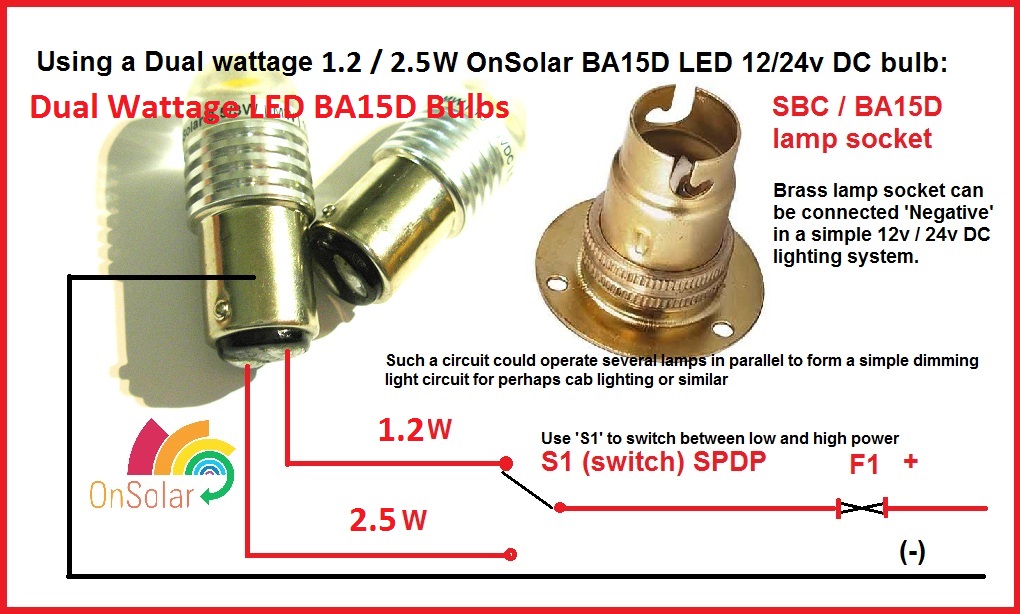
If it's a staggered bayonet pin, that implies that it is a dual 'filament' bulb to be used with a changeover switch.

Dual-1.2-2.5W-SBC-lamp-circuit.jpg
 
I don't think that BA15d bulbs generally have two filaments. I have some on the boat that clearly only have one. Here's a website with loads of BA15d bulbs, most of which are single filament The advantage of this type of bulb for LED is it can only be fitted one way round so no chance of reverse polarity.
 
Nav lights bulbs are most likely BAY 15d , which has offset pins,

The driver circuit in led nav ,light bulbs is usually fed via a bridge rectifier which makes them non-polarity sensitive.
 
None of these are anything like mine. It is a silver coloured cylinder 50mm tall plus the small diameter bayonet. It has 12 vertical rows of 5 LEDs.
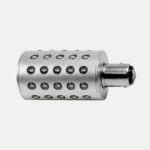
1633801621881.png

That is not polarity sensitive.
See the description and explanation on Boatlamps website
 
Last edited:
None of these are anything like mine. It is a silver coloured cylinder 50mm tall plus the small diameter bayonet. It has 12 vertical rows of 5 LEDs.
Is it a single central contact like an old winker bulb, or two contacts like a brake/tail bulb or mains bulb?

One feature of many LEDs is that they are not actually specified to block much voltage at all, so if you reverse bias it with 12V , and it dies, tough!
Luckily many 12V LED bulbs are protected.
And in practice, most LEDs will block 12V or more.
 
Has anyone said use a multimeter?
But having said that I do find they only work up to a certain number of LEDS..........go figure
 
Top