LED Navigation replacement lamps warning.

I'm still trying to figure out how the holder can loose a lamp contact unless lamp is shorter and holder was bent to get it in ? That's what happened to me - with normal festoon bulbs ... they were a mm or so shorter - I got them in but contacts were bent to do it ... I had trouble maintaining contact. I added a thick washer in the end to make up that small difference.

Interested to see photo's of the lamps and holder so we can identify for our own use to check ...

Maybe a side by side of the LED and normal lamp with weights ?

This is Practical Boat Owner .... !!

They OP refers to lamps with BAY15D fittings ....... see #1 .... not festoon bulbs

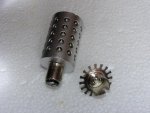
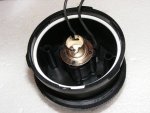
I did photograph mine before i fitted it, together with the original holder. Unfortunately I did not weigh it, but I would have done if I'd known you would be asking .

New LED tricolour "bulb" and the new holder:
DSCF0956.jpg

Old holder before removal:
DSCF0957.jpg
 
The OP stated that the fitting was BAY15D

ITM-610D-3.jpg


My Nav lights are all Aqua Signal using BAY15D

It would be nice if the OP could tell us what are the current Nav lights so we can determine what the fittings are

It is possible that there is a mismatch in BAY!5D bulbs in to BA15D fittings or the other way round. This could the bulb to fall out due to a rough passage.
 
I am not certain, I could not see a brand on them. They look like Hella but they are not exactly the same as the current models. I will take a look at the weekend.
 
They OP refers to lamps with BAY15D fittings ....... see #1 .... not festoon bulbs

I did photograph mine before i fitted it, together with the original holder. Unfortunately I did not weigh it, but I would have done if I'd known you would be asking .

New LED tricolour "bulb" and the new holder:
View attachment 82053

Old holder before removal:
View attachment 82054

My apologies.
 
I fitted the fully waterproof hella lights a few years ago, and apart from checking they work, have forgotten about them. IP67 i think. I got the higher power commercial ones ?5nm visibility, cannot remember exactly.

The old ones were crap. And often underwater, mounted on the top of the pulpit. An easy job, and it took a lot less time than i had set aside for it.
 
Sorry, but that's not true. The "warmness" of an LED is no measure of its frequency response. LEDs can be very peaky, and if your peak doesn't match the peak of the coloured filter, all bets are off.

The CRI or TLCI value tell you how broad spectrum the LED is.

CRI and temperature are 2 differents things

You can have high CRI and HIGH temperature and LOW CRI and LOW temperature

CRI is a index calculation , measuring the difference in color rendering in % , on a palet of 100 colors lighted by a halogen light. So CRI70 means the average color rendering for the 100 colors is around 70% of the sames colors lighted by an halogene, ( measured bu a color meter )

You can have a good CRI of 90 with a 4500°K LED , and a poor CRI70 with a 3000°K LED
 
My Nav lights are all Aqua Signal using BAY15D

The BAY15D has two nubbins on the bottom and the Aqua Signal fittings apply pos and neg across these nubbins rather than using the base as the neg. I have observed that some cheaper BAY15D LEDs aren't wired in this way, so they don't work on Aqua Signal fittings..
I only use one on an unfiltered light. The light output is good, though sometimes looks a touch blue.

It has become quite challenging to buy halogens here. An LED bulb costing 2 quid is well over a tenner for the halogen equivalent at a nautico and most of those don't stock the odd Aqua Signal format.. I may have to replace the holders...
 
The BAY15D has two nubbins on the bottom and the Aqua Signal fittings apply pos and neg across these nubbins rather than using the base as the neg. I have observed that some cheaper BAY15D LEDs aren't wired in this way, so they don't work on Aqua Signal fittings..
I only use one on an unfiltered light. The light output is good, though sometimes looks a touch blue.

It has become quite challenging to buy halogens here. An LED bulb costing 2 quid is well over a tenner for the halogen equivalent at a nautico and most of those don't stock the odd Aqua Signal format.. I may have to replace the holders...

This is the warm white I use,

https://www.ebay.com/itm/2pcs-Offse...e=STRK:MEBIDX:IT&_trksid=p2057872.m2749.l2649

Also available in cool white for white Nav lights.
 
This is typically the problem with LED bulb

The red is getting pink , the green is getting blue , far from the COLREG colors , and with a lot of light absorbtion trough the colored lenses

There was an interesting test published by French montly “ Voiles & Voiliers” 4 years ago, done by a Veritas approved lab, showing that very very few products were OK for both colors and visibility in a Hella housing

It is very difficult to get very high CRI Led in order to obtain colors ( especially red ) inside COLREG standards . The second problem is very high CRI Led are low lm/W efficiency which . Thus it is difficult to compensate absorbtion by colored lenses to fulfill the 5,4 Cd minimum intensity for 2NM visibility

The more powerfull LED you put inside , the higher are EMI noises , that pertubate VHS and AIS reception . There is a second marine norm EN60945 that gives the limits for EMI noise for electronic devices used on the deck

So if you want to make sure to get LED nav lights bulb, insurring really you security at night , make sure the bulb you buy have passed successfully EN14744 ( for sail boat and not motor boat ) and EN60945 . ( CE labelling is just a big joke because self attributed )
 
CRI and temperature are 2 differents things

You can have high CRI and HIGH temperature and LOW CRI and LOW temperature

CRI is a index calculation , measuring the difference in color rendering in % , on a palet of 100 colors lighted by a halogen light. So CRI70 means the average color rendering for the 100 colors is around 70% of the sames colors lighted by an halogene, ( measured bu a color meter )

You can have a good CRI of 90 with a 4500°K LED , and a poor CRI70 with a 3000°K LED

Indeed, that's why I wrote the objection to the statement that a "warm" LED was what was needed.
 
Top