LED lights / Significant energy savings with LED lamps

My Princess was built with most systems 24V, but the lights were all wired in series pairs, using 12V halogen bulbs, not a nice system IMO. I re-wired everything to parallel.
Congratulations.
You're making me wonder if there's any trick for doing that which I'm missing, because my boat was also built with all 12V halogen lights in pairs, and I also would have liked to rewire everything in parallel, but with almost 70 lights overall, I lost the will to live just at the thought of dismantling all ceiling panels.
So, I fitted voltage regulated and not polarity dependent LED bulbs into the existing wiring, and called it a day.
In fact, I also didn't bother replacing the 16 breakers protecting each zone with lower capacity ones, which is another thing advisable after replacing halogen bulbs with LEDs. But I'm a preach water and drink wine kind of boater... :LOL:
 
Congratulations.
You're making me wonder if there's any trick for doing that which I'm missing, because my boat was also built with all 12V halogen lights in pairs, and I also would have liked to rewire everything in parallel, but with almost 70 lights overall, I lost the will to live just at the thought of dismantling all ceiling panels.
So, I fitted voltage regulated and not polarity dependent LED bulbs into the existing wiring, and called it a day.
In fact, I also didn't bother replacing the 16 breakers protecting each zone with lower capacity ones, which is another thing advisable after replacing halogen bulbs with LEDs. But I'm a preach water and drink wine kind of boater... :LOL:
I only had 30 or so to alter, did involve some panel dropping though.

No need to change the breakers, they protect the wiring, which is the same as when the boat was built.
 
Agreed, but I heard (just hearsay, mind) of defective LED bulbs drawing much more current than normal, before overheating and eventually sparking a fire.
I guess in such situation a more sensible breaker could possibly save the day.
Well, hope dies last, anyway... :)

Good going for parallelizing your lights, I don't think it's a job I would have tackled even if they were "only" 30 in my boat!
 
) of defective LED bulbs drawing much more current than normal, before overheating and eventually sparking a fire.
Yes this is possible, and the breaker should protect the weakest component, changing the breaker will still protect the cable because you would infact be giving the cable more protection.
 
Personally, I reckon that any of the Wago type connectors are way better than those awful screw choc blocks.
All my life, I've had problems with those little screws not making contact properly and coming loose.
The only problem with these new Wago style connectors is that they can really only hold a single core so you have to have a range of connectors available.
Come on guys, this is progress.

I prefer Wago ... but I just had a battle with one of my car trailers ..... all lights were working until a few weeks ago. Left front white, left rear red / white and normal rear left not working ...

I spent hours tracing / identifying the wires going off to each unit .... finally gave up and disconnected the offending lights and applied 12v to each .. worked - so it was cabling problem - not lights.
Turned out to be the 3 cable Wago ... one connector had failed ... when removed - you could see the plastic tab had broken away from the spring tab that made the connection ...

Just posting to show that even Wagos can fail !!
 
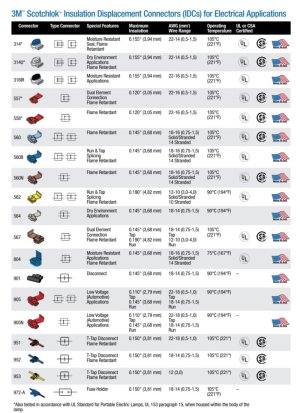
I know some people don't like them, but proper Scotchloks are useful connectors when used correctly.
They have no place on a boat and no place being used with fine stranded cable. The cut through the insulation and thin thin blade makes contact with the outer few strands of wire, well, those that don't get cut. Because the strands are fine, not only can they get cut, but they can move, giving a poor connection which can case heat in the wiring and/or intermittent electrical problems.
 
Just commenting ....

Its interesting that many of the recc'd products .. such as the Victron Charger I have fitted to two of my boats ... along with many other items for boats have connection blocks with a variation of the 'choc-block' system ... OK - improved by usually having a flat plate under the screw to bear down onto the wire. Also the metal used is I suspect better resistant to the environment.
 
Just commenting ....

Its interesting that many of the recc'd products .. such as the Victron Charger I have fitted to two of my boats ... along with many other items for boats have connection blocks with a variation of the 'choc-block' system ... OK - improved by usually having a flat plate under the screw to bear down onto the wire. Also the metal used is I suspect better resistant to the environment.
Yes, the Victron chargers (and other products) do have the leaf under the screw, or variations of, to stop the screws chewing the wire and they don't go rusty. The ones to be avoided are the ones without the leaf and mild steel screws.
 
They have no place on a boat and no place being used with fine stranded cable. The cut through the insulation and thin thin blade makes contact with the outer few strands of wire, well, those that don't get cut. Because the strands are fine, not only can they get cut, but they can move, giving a poor connection which can case heat in the wiring and/or intermittent electrical problems.
As I said, if you don't know how to use them correctly, then you shouldn't use them.

I don't know why this is so important to you Harry.
 
Back to Choc Blocks ....... years ago when Choc Blocks were the standard ... if the wire was thin and possibly damaged by use of the screws .,... then it was advised to solder (tin) the wire so it was stronger in the connector.

Or as I have done several times crimp a pin crimp on to the wire, so the screw tightens on to the pin and not he wires
 
Back to Choc Blocks ....... years ago when Choc Blocks were the standard ... if the wire was thin and possibly damaged by use of the screws .,... then it was advised to solder (tin) the wire so it was stronger in the connector.
When i'm fitting Victron stuff, with the screw lamp you mentioned, i use bootlace ferrules.
 
They’re intended for solid core, ie telephone and cat5/6 wire. And if your cat cable is stranded you should be shot….. Wagos all the way for lighting. Choc block lasts until you cast off🤣
I can understand why you don't like Scotchloks if you have been using the solid core versions on multi strand wires.

If you get the correct genuine 3M versions for your application, they work just fine.

Now if you and Harry don't want to use them then that is of course fine, but stop telling everyone else you don't want to do it like that.IMG_20250806_150229.jpg
 
Top