
Leaking stern Gland

TomP

New Member
Joined
20 Feb 2021
Messages
2
Visit site
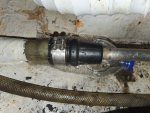
Hi, I went to check on my Father-in-Laws (who unfortunately passed away) boat yesterday and found that the stern gland is leaking excessively. I would really appreciate any help in identifying the type of stern gland and if/how to tighten. And what to expect to find if I took the rubber cover off. See photo below (I placed the bottle underneath to check how quickly it was leaking).
20210219_155001.jpg

I don't know much about the boat having inherited looking after it and have no idea when the stuffing was last replaced.

Thanks in advance.

Tom
 
If you undo the clip you will sink, looks like a Volvo seal, if you look on line , try Stuffing Box Seal for 35mm Volvo Penta Prop Shaft you will see the internal seals. Have you tried rotating the shaft a bit. You may find the internal lip seal damage due to standing still and the seals are not repairable and the whole rubber unit needs to be replaced. Needs to be out of the water though.
 
Yes it is a Volvo seal. suggest you squirt some waterproof grease, preferably the type that Volvo sell inside the open end to lubricate the seal. There may well be a tube on the boat as it is a normal maintenance item to have. it really only needs doing once a year but if it has been run dry and the seals have worn adding grease may stop the drip. The grease tube has a nozzle on the end to help get it in past the seals (there are 2) but some people find it easier to fill a drinking straw and flatten the end to push past the seals.
 
Sorry to learn of the loss of your Father in Law.

A plastic drinking straw pushed into the grease tin to fill a few cm, then insert the end into the seal and squeeze along the straw to squirt the grease right into the seal.

The lips on these Volvo Blackjack seals are situated in the first 30mm, so don't push the straw in too far.

Several squirts rotating the shaft a bit after each to spread the grease around- note should be waterproof grease.

What boat ?
 
Volvo reckon on 5 or 7 years' life, depending on which source you find, before replacement. There are other suppliers, Radice for example, have air release and a greasing ports - the Volvo needs "burped" when boat has been dried out to let water to the seals.
Changing the seal while afloat is possible, but not for those of a nervous disposition! Release the shaft from its coupling, ensure there is sufficient clearance to get the seal off, undo the clamp screws and with the new seal to hand remove the old, slide on the new, remove the orange clip, (hope you remembered to grease it first) and tighten the clamp. No more than a few litres of water should enter. Take care not to push the prop-shaft out (on some boats you can lose it).
If it is just a gentle drip I'd leave it until the boat is lifted for anti-foul and/or anodes.
 
When next on the boat check that the shaft appears to be sitting centrally in the seal as although it might be an illusion , on my screen i loos like the engine is sitting low pulling the shaft downwards. Some grease will help but the engine should be realigned when possible.
 
We changed one when in the water, I say 'we' I got somebody else to do who'd done it before, and that was nerve wracking enough! Our problem was the travel hoist was out of action, so we had no choice.
 
When next on the boat check that the shaft appears to be sitting centrally in the seal as although it might be an illusion , on my screen i loos like the engine is sitting low pulling the shaft downwards. Some grease will help but the engine should be realigned when possible.
In the event that the engine isn’t sitting in line, it would be worth checking that the engine mountings haven’t given way allowing the engine to drop out of line. Having said that I have changed my mountings twice due to them collapsing and the seal hadn't dripped a drop.
I’ve found the Volvo seal to be very reliable. Mine did 1200 hours before I changed it, and I only did it because it was way over the recommended hours, not because it was leaking. Perhaps the seal in question is very old, in which case best to lift out and check for wear on the shaft.
I'd be happy to try changing the seal in the water on someone else’s yacht but perhaps not my own ?
 
In the event that the engine isn’t sitting in line, it would be worth checking that the engine mountings haven’t given way allowing the engine to drop out of line. Having said that I have changed my mountings twice due to them collapsing and the seal hadn't dripped a drop.

My 'Volvo type' starting dripping after a very short time (2 years perhaps) due to the shaft sitting on the bottom of the stern tube at the seal end. I agree with Bilgediver - well worth checking.

To the OP - when replacing, worth going for a Radice seal (or similar) - similar to the Volvo, but includes a vent.
 
I seem to remember reading about using a hose clamp/jubilee clip to stop seal leaking as a temporary fix but can't remember if that was on a Volvo or other make. Obviously, engine can't be used when clamped.
No, that is a Deep Sea Seal - very different design.
 
Last edited:
Do, that is a Deep Sea Seal - very different design.

That would work there if necessary. However something I can now see using my lappy is that the shaft is displaced about 30mm forwards and the lip is now sitting on a pitted area of the shaft. I wonder what has happened and is the engine in place? Just putting the shaft back in the running (shiny) position might stop it for now?
 
That would work there if necessary. However something I can now see using my lappy is that the shaft is displaced about 30mm forwards and the lip is now sitting on a pitted area of the shaft. I wonder what has happened and is the engine in place? Just putting the shaft back in the running (shiny) position might stop it for now?

The shiny ring could be where the original stuffing box gland used to sit.
 
That would work there if necessary. However something I can now see using my lappy is that the shaft is displaced about 30mm forwards and the lip is now sitting on a pitted area of the shaft. I wonder what has happened and is the engine in place? Just putting the shaft back in the running (shiny) position might stop it for now?
No way you could clamp it - very solid rubber. Don't think it should be moved either as that could put the lips on what seems to deposits on the shaft. The suggestion that the engine might have dropped so distorting the seal is worth investigating.
 
Top