Leaking daggerboard case - fibreglass Skipper dinghy

electricmonk

New Member
Joined
8 Oct 2016
Messages
17
Visit site
Hi all,

I was hoping to seek some advice on repairing the daggerboard case on my fibreglass Skipper dinghy.

The other day I pumped theatrical smoke into the hull through an inspection port to try and find any leaks because it was taking on a bit of water. The hull was nice and warm from the sun so the smoke wouldn't simply pool in the bottom. Anyway, wisps of smoke soon started coming out of the daggerboard case. I think people use this trick to find vacuum leaks in engines. When I took a closer look, I discovered that the inside of the daggerboard case is lined with a wooden box made of some kind of hardwood. Is this normal for a fibreglass boat? I assume it is so that the daggerboard can bump up against wood rather than fibreglass when it's shoved into the slot.

The wood in there is a bit rotten, which I think happened when the boat was stored with water in the hull by the previous owner for a considerable length of time. So I feel like eventually I'll have to replace it which seems like a tedious and fiddly task, involving removing the old wood, cleaning up the surfaces and lowering in and clamping new wooden planks while only being able to access the area through the upper and lower slots. I suppose I'll also have to replace the plastic slot gasket to help keep the water out.

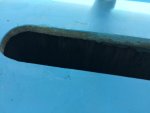
The leak is actually coming from the corner of the wooden box, however. The corner of the box has simply come apart towards the upper section, so when the daggerboard case fills with water it leaks over the top and flows into the hull. Any suggestions for filling this gap so I can have fun sailing for the duration of the season before doing a proper job over winter? I feel like squirting in some sort of sealant along the length of the edge join with a long tube might be the go.

The leak is in the bottom left corner in the photo, mostly at the upper end slightly outside the frame of the picture...
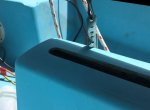
inside case.jpg
 
If you can get it bone dry, then epoxy will probably work.
Otherwise a moisture curing glue? polyurethane wood glue?
 
Nice one, thanks for that tip about different adhesives in relation to moisture in the wood.

Just out of shot there's a gap between the edges of about 1-2mm - you can see the fibreglass through it. Polyurethane glue needs clamping doesn't it? Would you be inclined to steer me away from squirting Sikaflex down the length of the crack?
 
IMHO, the problem with any attempt at a quick fix will be that the surfaces you are trying to stick to will be damp and dirty, and no way of cleaning anything to get a fresh surface to bond to.
Sikaflex may well stick, but just pull off a layer of degraded wood?
Personally, epoxy is my favourite, but it has limitations.

A proper repair would not be that hard.
Build a new dagger box, cut out the old one and epoxy in the new one.
A flange on the bottom of the box epoxies to the inside of the hull.
A panel around the top of the box connects it to the deck/thwart moulding?
 
Fair point. The only issue is that I will have to insert the new box into the fibreglass daggerboard case piece by piece and glue the pieces together like making a ship in a bottle, so I guess I'm looking to postpone this until the end of summer... it's not at all clear from the photo I posted earlier that the daggerboard case is part of the one-piece deck moulding, apologies.

Unless you were suggesting cutting into the fibreglass?

case closeup.jpgdaggerboard case.jpg
 
Last edited:
I don't suppose anyone has any thoughts on accessing the affected wood? It seems odd that the water-tightness of the daggerboard case would be dependent on this wooden box trapped between the outer and inner fibreglass skins... I'd love to know if the two skins are connected at the base of the daggerboard case but I can't find out without tearing all the wood out and creating a big job for myself. Might be easier to glue a small piece into the corner rather than trying to clamp the edges for gluing
 
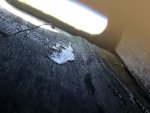
Here are some photographs taken from underneath the boat - I removed the plastic daggerboard slot gasket to get a better look. You can see the corner from which smoke started to pour when I filled the boat with smoke, and you can see the warped surface of the wood. It looks like the outermost layer of wood in the marine ply is delaminating. Unless there is some other kind of wood which would flake away like this? It feels solid under the layer which is peeling off. I think there was rainwater in the boat for an extended period before I got it because I had to repair a soft spot on the rudder too, which was stored in the boat. So the water has affected it somehow...

from below 1.jpgfrom below 2.jpg

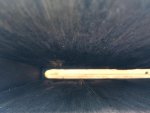
In the third photograph you can see how tight the wood is to the top of the daggerboard case and how much of a pain in the arse it would be to remove and replace it.

from below 3.jpg

My current plan is to araldite some string to the two sides which have come apart and use the string to clamp the corner together. Or maybe I should just fill in the crack with putty.

I could peel off the top layer of wood, sand the next layer down to nice clean wood and paint it or something.

Unless anyone has any ideas about how to replace the wood without removing and reattaching the top of the daggerboard case, of course...
 
Last edited:
I hope you don't mind me being a little blunt here, I am trying to help, honest !

The thing is, the Skippers were never exactly brilliant boats, even when new; pedestrian performance, poorly designed rig with low quality sails, lack of buoyancy ( in normal floating / sailing trim, not built in safety tanks for swamping ) in the forward hull shape, the undrained well to collect any seawater going, and that double skin just asking to trap water - I think there's foam in there to worry about becoming waterlogged ?

You might consider simply moving to a better dinghy, there are loads of really good ones everywhere going for buttons.

However, I don't like abandoning faithful boats still offering heaps of fun - the Skipper does have a certain versatile appeal of rugged simplicity, and if the gunter rig, the short spars are a boon if trailing.

I don't think squirting sealant at it is going to cut the mustard; if you're keen on the boat, do a complete casing repair, if necessary cut off the old one and fit a new one of epoxied wood - this would give the opportunity to remove any waterlogged foam between the skins too.
 
Oh I appreciate blunt advice for sure. Thanks for your reply. Yes it's a very pedestrian sort of boat, it doesn't have the original Richmond Marine rig though, the sails are white, the mast has fore- and side-stays and the mainsheet block is deck mounted rather than being somewhere up the back as in the original Skipper. It's an "Alglas Skipper", which is presumably a version licence-built in Australia.

So it's not quite as bad as the original version... the main advantages for me over a Heron or a Pacer are that it's big and roomy. The ludicrous amount of freeboard means it's not very good to windward but it also means that I can't easily capsize it and scare off my sailing buddy.

Thing is, the fibreglass daggerboard case is pretty solid, it's about 7-8mm thick, it's just got this shitty wood in there which needs to be tidied up and sealed to keep the water from entering between the skins. If I sawed the top of the daggerboard case off to access the wood I could then reattach the fibreglass top and maybe paint it white in line with the cut, which might not be too hideous. It seems like it might be weakening it to cut into the fibreglass though.
 
1st post

I've a skipper and we regularly have 2 adults and 2 kids on my 12. It had water between the skins when I got it, so I fitted inspection hatches for storage and to get to the hull for repairs (polystyrene not foam in the gap between the skins btw). For a 40+ year old dinghy they're great. There isn't any wood in the daggerboard though, maybe there was years ago. I'd be tempted to make a hole and get rid of the wood and fibreglass it, a keyhole surgery repair sounds painful.
 
My Skipper 14 sometime in the early 1970s was a brand new Richmond Marine one with bermudan rig, forestay and shrouds, I then added reef points to the main, toestraps and a self-bailer, and did a few little mods to beef up some suspiciously thin GRP areas. The resultant boat was actually quite good, singlehanded it could get round a club race course about evens with Enterprises and GP14s, losing out to windward (poor sails mainly) but catching up well offwind when it planed easily and cleanly as long as there was a decent wind. Considerably less sail area than either of these, but a lot less weight too and an inherently faster hull shape.

It came with a road trailer and I towed it round when working away from home so I could sail in lots of different places. I liked the light weight: on a beach I could wrap a bit of mainsheet through the toestrap and lift the whole boat on my own, so didn't have to drag the hull over gravel or sand.

I remain surprised so many are still around, as they were pretty flimsily built. The "poor performance" thing seems to be due to most having pretty horrible gunter rigs. I deliberately capsized mine on the first sail, and had no trouble righting it and then sailing out the water through the self-bailer.
 
Hi Terry, that's interesting. Can you see the join between the deck moulding and the hull when you peer down the daggerboard slot in your Skipper 12? Curious as to where it joins up. It's possible this wood is concealing the actual leak.
 
Hi Terry, that's interesting. Can you see the join between the deck moulding and the hull when you peer down the daggerboard slot in your Skipper 12? Curious as to where it joins up. It's possible this wood is concealing the actual leak.

I cant remember and its in my sons garden so cant take a look for a while. Maybe the wood was a spacer to make the dagerboard a snug fit.
 
Top