Lazyjacks are hard work

that is so bloody obvious I am embarrassed I even asked the question now, :D thank you for putting me right:encouragement:
You can clip off just one side as well sometimes, then don't need to get dead head to wind but hoist with wind off to one side. Easier to clear the battons where there you don't have a slot to get them through.
 
I take it that you have a stacking arrangement. I have a 'proper' sailcover, which means that it is necessary to stow the lazyjack at the mast, though I have seen covers with grooves which obviate this need. Since we all have different arrangements, this often gives rise to a variety of suggestions, all mutually contradictory, which if nothing else provides entertainment.

If you you use lazy jacks then I would suggest that you do not so much have a "proper sail cover" but a half arsed system.
Lazy jacks work well with a combined sail drop bag & a fully battened sail if everything is correctly adjusted. Of course one has to know how to set it up & use it.
But to each his own & what suits one does not have to suit another:encouragement:
I
 
Last edited:
I've found two tweaks that have really helped our lazyjacks do what they're supposed to, which is principally to allow me to drop the main without leaving the cockpit. The first is an additional pair of vertical lines on the LJs that keep the top batten from hooking them. It isn't foolproof, but it reduces the chances.

The second is a downhaul on the main, led back to the cockpit (we have all lines aft). The sail drops most of the way without a problem, but if it's breezy, it does tend to leave more than I want flapping around. The downhaul allows me to get it all the way down and hold it there.
 
Ours are fine and don't catch for weeks on end then give us total grief another time - with no obvious difference in conditions or our technique. This year I am going to try attaching cord to a couple of the rings to pull the lazyjacks a bit forward towards the mast - and only deploy this if it's a sticky day.
 
Steve, downhaul is something we are definitely going to add. Rupert, I think adding any adjustability has to be a good idea, I will have fun experimenting.
 
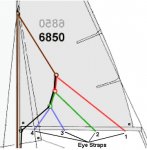
I use the system detailed here. Picked up from the internet.

lazyjacks.JPG

The lines are color coded in this description only for the purpose of making it easier to explain
First pop rivet four eye straps to the bottom of the boom. Position the aft most eye strap just a few inches forward of the clew of the mainsail. Then measure the distance from there to the mast. Divide that distance by 4 and space the remaining three eye straps along the boom using that result. (EXAMPLE: Assuming the aft most eye strap is ten feet from the mast. Ten divided by four equals two and a half. Space the remaining three eye straps two and a half feet apart.)
The brown line is spliced to the brown ring and runs up to a block located on the mast just below the spreader. From there it runs down the mast and is then secured to a cleat on the mast (alternately it could be run back to the cockpit). The red line is spliced to eye strap number 1 on the bottom of the boom. From there it runs up to and through the brown ring and is spliced to the red ring. The green line is spliced to eye strap number 2 on the bottom of the boom. From there it runs up to and through the red ring and is spliced to the green ring. The blue line is spliced to eye strap number 3 on the bottom of the boom. From there it runs through the green ring and is spliced to eye strap number 4 on the bottom of the boom. The black line is spliced to the brown ring and runs through the red and green rings and then passes through a ring which is secured near the boom's goose neck. The black line then runs down to a cleat on the mast (alternately it could be run back to the cockpit). This set up is duplicated on each side of the boom.
In front of the mast, the two brown lines are joined together. Actually, I use a single line to create both brown lines and then form an eye at the mid point. From that eye, I splice on a single line which leads down the front of the mast
To hoist, release the black line, pull down on the brown line and secure it to a cleat at the mast or in the cockpit.
To lower, release the brown line and pull in the black line and secure it to a cleat at the mast or in the cockpit.
Adjust the lengths of the red, green and blue lines so that when the lazy jacks are lowered, all lines will be pulled taught along the boom. The lengths of the brown and black will depend on how high the blocks near the spreaders are mounted.
I use one inch stainless steel rings. I wanted the rings to be thick enough to give a relatively
smooth transition for the line running through them.
The most important length setting is such that they all pull taught when retracted. Don't worry
about their lengths when deployed (that will work out automatically).
When Sailing in heavy winds (which might get worse quickly), I often leave the lazy jacks
deployed so that I can drop the main without having to wait to raise the lazy jacks. And if I
decide to leave them hoisted while racing, I slack off the hoisting line enough so that the lines
do not disturb sail shape. I single hand a LOT, so these have been a life saver in heavy winds.
I had concerns about the lines flapping against the mast and boom. But I have not had any
noticeable problem with that. The upper blocks can be attached to the spreader rather than to
the mast so that the lines along the mast are generally a good distance from the mast except
where they either tie off or run through turning blocks.
Assuming that the system is set up perfectly, some things I have noticed myself are:
1. The sail will still have a tendency to fall off the boom near the outer end of the boom. I don't worry too
much about that because it is only a small amount of sail. And as soon as I have time, I secure the sail
to the boom with my sail ties. Remember, lazy jacks primary purpose is to keep the main sail from
falling all over the deck and these do that quite well.
2. If you need to raise and lower the mast a lot, it helps if the brown line is attached to the brown ring
with a carabineer. For lowering the mast, unclip both brown lines from their rings, then clip them to
each other and hoist them to the pulleys at the spreaders and secure the hoisting line to a cleat on the
mast. I use a boat hook to pull these lines down after raising the mast. Or you could either attach a
small line to retrieve the lines after raising the mast or clip the carabineers to a pad eye lower on the
mast..
3. After lowering the sail, do not pull the brown line forward of the bolt rope (luff of main sail). Leave
them behind the bolt rope. That will make hoisting the main from the cockpit easier. When you remove
the sail cover and get ready to hoist the main, make sure the brown lines are not forward of the bolt
rope. I used to pull the brown line forward to the mast before putting on the sail cover. But then I had
to remember to pull them aft of the bolt rope before hoisting.
4. The tighter you can pull on the hoisting line the better the lazy jacks will catch the leech of the sail
when dousing. I usually center the boom with the mainsheet but keep the sheet somewhat slack. Then I
hoist the lazy jacks as tight as I can until it lifts the boom a little ways. Then I snug up the down haul
lines to add more tension to the lazy jacks.
I have installed this system on a Catalina 34, Catalina 30, Catalina 250, several Catalina 22s
and a Gulf 29. And I know a Catalina 30 sailor in California who has it on his boat. He has
also installed this system on many other boats. And many Catalina 22 sailors have installed
this system on their boats.
Skip Meisch.
 
that is so bloody obvious I am embarrassed I even asked the question now, :D thank you for putting me right:encouragement:

To make it easy to pull the lazy jacks forward I threaded a line through the lower rings tying it to the aft lower ring and taking to forward to the mast the mast.

Both the lazy jack lines and the hall forward could he taken to the cockpit if so desired.
 
I use the system detailed here. Picked up from the internet.

View attachment 69546

The lines are color coded in this description only for the purpose of making it easier to explain
First pop rivet four eye straps to the bottom of the boom. Position the aft most eye strap just a few inches forward of the clew of the mainsail. Then measure the distance from there to the mast. Divide that distance by 4 and space the remaining three eye straps along the boom using that result. (EXAMPLE: Assuming the aft most eye strap is ten feet from the mast. Ten divided by four equals two and a half. Space the remaining three eye straps two and a half feet apart.)
The brown line is spliced to the brown ring and runs up to a block located on the mast just below the spreader. From there it runs down the mast and is then secured to a cleat on the mast (alternately it could be run back to the cockpit). The red line is spliced to eye strap number 1 on the bottom of the boom. From there it runs up to and through the brown ring and is spliced to the red ring. The green line is spliced to eye strap number 2 on the bottom of the boom. From there it runs up to and through the red ring and is spliced to the green ring. The blue line is spliced to eye strap number 3 on the bottom of the boom. From there it runs through the green ring and is spliced to eye strap number 4 on the bottom of the boom. The black line is spliced to the brown ring and runs through the red and green rings and then passes through a ring which is secured near the boom's goose neck. The black line then runs down to a cleat on the mast (alternately it could be run back to the cockpit). This set up is duplicated on each side of the boom.
In front of the mast, the two brown lines are joined together. Actually, I use a single line to create both brown lines and then form an eye at the mid point. From that eye, I splice on a single line which leads down the front of the mast
To hoist, release the black line, pull down on the brown line and secure it to a cleat at the mast or in the cockpit.
To lower, release the brown line and pull in the black line and secure it to a cleat at the mast or in the cockpit.
Adjust the lengths of the red, green and blue lines so that when the lazy jacks are lowered, all lines will be pulled taught along the boom. The lengths of the brown and black will depend on how high the blocks near the spreaders are mounted.
I use one inch stainless steel rings. I wanted the rings to be thick enough to give a relatively
smooth transition for the line running through them.
The most important length setting is such that they all pull taught when retracted. Don't worry
about their lengths when deployed (that will work out automatically).
When Sailing in heavy winds (which might get worse quickly), I often leave the lazy jacks
deployed so that I can drop the main without having to wait to raise the lazy jacks. And if I
decide to leave them hoisted while racing, I slack off the hoisting line enough so that the lines
do not disturb sail shape. I single hand a LOT, so these have been a life saver in heavy winds.
I had concerns about the lines flapping against the mast and boom. But I have not had any
noticeable problem with that. The upper blocks can be attached to the spreader rather than to
the mast so that the lines along the mast are generally a good distance from the mast except
where they either tie off or run through turning blocks.
Assuming that the system is set up perfectly, some things I have noticed myself are:
1. The sail will still have a tendency to fall off the boom near the outer end of the boom. I don't worry too
much about that because it is only a small amount of sail. And as soon as I have time, I secure the sail
to the boom with my sail ties. Remember, lazy jacks primary purpose is to keep the main sail from
falling all over the deck and these do that quite well.
2. If you need to raise and lower the mast a lot, it helps if the brown line is attached to the brown ring
with a carabineer. For lowering the mast, unclip both brown lines from their rings, then clip them to
each other and hoist them to the pulleys at the spreaders and secure the hoisting line to a cleat on the
mast. I use a boat hook to pull these lines down after raising the mast. Or you could either attach a
small line to retrieve the lines after raising the mast or clip the carabineers to a pad eye lower on the
mast..
3. After lowering the sail, do not pull the brown line forward of the bolt rope (luff of main sail). Leave
them behind the bolt rope. That will make hoisting the main from the cockpit easier. When you remove
the sail cover and get ready to hoist the main, make sure the brown lines are not forward of the bolt
rope. I used to pull the brown line forward to the mast before putting on the sail cover. But then I had
to remember to pull them aft of the bolt rope before hoisting.
4. The tighter you can pull on the hoisting line the better the lazy jacks will catch the leech of the sail
when dousing. I usually center the boom with the mainsheet but keep the sheet somewhat slack. Then I
hoist the lazy jacks as tight as I can until it lifts the boom a little ways. Then I snug up the down haul
lines to add more tension to the lazy jacks.
I have installed this system on a Catalina 34, Catalina 30, Catalina 250, several Catalina 22s
and a Gulf 29. And I know a Catalina 30 sailor in California who has it on his boat. He has
also installed this system on many other boats. And many Catalina 22 sailors have installed
this system on their boats.
Skip Meisch.

thanks for that, I will fully digest it tonight when I finish work
 
To make it easy to pull the lazy jacks forward I threaded a line through the lower rings tying it to the aft lower ring and taking to forward to the mast the mast.

Both the lazy jack lines and the hall forward could he taken to the cockpit if so desired.

taking it all to the cockpit is a must :encouragement:
 
taking it all to the cockpit is a must :encouragement:

Not really. The angles shown in that drawing should make things much easier as the leech clears the lines very quickly when hoisting. When lowering the sail may want to drop over the outside of the lines so there will be a bit of a balance to be found by experimentation. Full length battens solve a lot of problems.
However, whilst the shape is good one cannot help but feel that the system is unnecessarily complicated & properly setup should never need adjustment. If you are new to the boat you will be on a steep learning curve. This has been demonstrated by your posts:encouragement: . Nothing wrong with that- It is all part of the fun. But I would suggest that, at this stage at least, you want to have as little to adjust as possible. More so if you are sailing in limited areas
 
If, as many seem to find, lazy-jacks prevent you from hoisting sail unless you are heading directly into wind's eye, I would find that unacceptable since my boat, like all others, cannot do that without using the engine.
 
Hi,
I sail single handed and the boat is not set up for this, everything is done at the mast. I don't find it too difficult too often and I find it much more simple to deal to work with. . I try to make sure I have everything in place and just try and plan ahead. I think Lazy Jacks for me would just complicate things. When I raise the main all I have to worry about is pointing in to the wind or let the boom out. Lowering the main, well it just comes down. I have the sail ties ready and do the best I can.
I am going to treat myself to a tiller pilot just to make things a little easier, but In my situation I just try and plan what I'm going to do. I'm sure I'm going to get caught out at some point though.
Glad your both enjoying your sailing, sounds great fun.

Steveeasy
 
Not really. The angles shown in that drawing should make things much easier as the leech clears the lines very quickly when hoisting. When lowering the sail may want to drop over the outside of the lines so there will be a bit of a balance to be found by experimentation. Full length battens solve a lot of problems.
However, whilst the shape is good one cannot help but feel that the system is unnecessarily complicated & properly setup should never need adjustment. If you are new to the boat you will be on a steep learning curve. This has been demonstrated by your posts:encouragement: . Nothing wrong with that- It is all part of the fun. But I would suggest that, at this stage at least, you want to have as little to adjust as possible. More so if you are sailing in limited areas

thanks chap, the wanting the controls in the cockpit is for Karen's benefit. It is a PITA that the only limited bit of area is just after we leave the jetty, a combination of mudbanks, wrecks, and moored commercial vessels and pontoons make getting downriver to the Itchen bridge a pain if the wind isnt right. Great fun in a dinghy though

And yes, very much enjoying the learning curve
 
Last edited:
Surely one shouldn't have to head directly into the wind to avoid fouling lazy jacks. The whole lj system weathercocks along with the boom and sail, so within a reasonably wide angle the sail should drop...unless, you're not sheeting the main in tight then trying to drop the sail are you?
 
Surely one shouldn't have to head directly into the wind to avoid fouling lazy jacks. The whole lj system weathercocks along with the boom and sail, so within a reasonably wide angle the sail should drop...unless, you're not sheeting the main in tight then trying to drop the sail are you?

dropping isnt the problem chap, they tip over the jacks fine, its raising
 
thanks for all the input. If I cannot make them work then I will bin them off. Ironic as I always thought they were a miracle cure to sails all over the place and Karen disappearing under them, so they were aspirational. I will persist for now just because I would like them to work, but messing about the other day with the tangle really hacked me off - I really could not live with that long term
 
thanks for all the input. If I cannot make them work then I will bin them off. Ironic as I always thought they were a miracle cure to sails all over the place and Karen disappearing under them, so they were aspirational. I will persist for now just because I would like them to work, but messing about the other day with the tangle really hacked me off - I really could not live with that long term

There's always a way... keep at it :cool:
 
Top