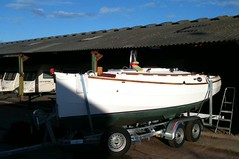
Launching a biggish yacht off a trailer- advice/encouragment please!

Looking ahead to the spring and wondering whether to get the boat craned in, like everyone else, or to float off the trailer directly.
The boat is an Albin Vega, so very much on the large side for a trailerable yacht. Draft of about 3'10 and the total combined weight of the trailer and boat is about 3250kg.
My plan would be to use a landrover, or even a tractor, for the towing, and park the boat down the slip and then wait for the tide to come up. I have a choice of slips and they both have rings for tying to. I am also thinking about using a chain between the trailer and vehicle, to avoid the vehicle having to back onto the sloping slipway (in which case I would launch at high tide).

The main reason I am contemplating this is that I would like to get the boat in the water around Easter time, and if I book the crane on my own it would cost a fotune.
I also know that the prevous owner of the trailer launched his 27ft Jeanneau off it into a lake and never considered using a crane.

Anybody done this with this size of boat, and any videos etc?

Not a problem to launch off a trailer, done by many every year as the crane is too expensive.
Don't park on the slip wait till the tide is high enough to launch an then lower the trailer in, use an extended to bar or rope to lower her down into the water, once she lifts off draw the trailer out, motor the yacht off. Same for recovery, just opposite of above.
 
Be careful !

" I am also thinking about using a chain between the trailer and vehicle, to avoid the vehicle having to back onto the sloping slipway (in which case I would launch at high tide)."

Even if yours is a 4-wheel trailer, letting it run down a slip may end in tears if a wheel hits a stone and the whole thing tips over backwards. The C of G will be very high and the effect of the slope may bring it perilously close to a position behind the back wheel.
Yes - I have seen it happen !
Ken
 
Take Care

Many boats in our Club are launched from trailers and some of them are larger than yours. The most frequent problem and the greatest danger by far is the boat slipping of the back of the trailer as it goes down the slip.
 
I would check the slip @ low tide to make sure that it's free of stones etc, and just have a good look to see what it's like. As steep as the tow vehicle can manage is best, too shallow and gravity won't pull the rig through the water, and it'll be a long way in before the boat floats. You can pull it in with a rope but it's easier if you don't have to.

A solid bar is good, especially with a front mounted tow ball. They can be a bit short for a 3'6" draught boat though. Consider that the Windermere tractor probably went in a good way but not so the bloke on the front got his feet wet!

I use a 10m strop and the car gets quite close to the water, with your draught a 15m one could be better. I had mine made for £8 by a place advertising ratchet straps but it has a loop either end instead of the ratchet, breaking strain 4Te IIRC.

You can steer a trailer as the vehicle reverses down the slip by pulling the rope/strop sideways, not perfect but minor corrections are possible.

The boat won't float off the trailer if it's still securely tied on. It's best to pull the whole lot back out instead of trying to reach across from the jetty to untie the boat in this situation ;)

Make sure that the crew has a long enough rope attached to the bow so that she doesn't get her feet wet as the boat goes in, or make it plain that she can go down the jetty alongside the launching boat, ;)

If you rush and unhitch the boat and connect the strop between the trailer and car then just let off the trailer brake, having released the boat from the trailer, the boat will launch it's self when the strop becames taut whether the boat is floating or not. It's not a big problem if it's nearly afloat, like the trailer length extra you would have if you lowered the trailer in with the car.

You need to jetwash the trailer ASAP after launching. The bearings will need drying out and repacking. Having the boat on the trailer doesn't make much difference to working on the bearings/brakes, it's still a jacking up job. I use a Hallfords 2Te bottle jack but have used a trolley jack in the past.

If you rig up guide bars with the boat on the trailer you will have the option of recovering yourself if you need to, it's not impossible without but guide bars make it much easier.

HTH
 
The boat won't slip off if you run a strop back to the vehicle tow ball from the foredeck cleat. This allows you to let go without getting your feet wet.
Ferry Nab's launch tractor has a cleat on the man platform for this. This shot doesn't have a strop, but it works just as well when there is one.

Recovering%20First285.jpg
 
used to do both launch and recovery of a 33ft catamaran every year using a trailer and the club tractor on a 1:10 slip. Obvious issue was to keep the boat on the trailer which meant long ropes from the sheet winches to the front of the trailer - that way allows for the stern to rise / sink as the boat and trailer goes into / out of the water.

Always lowered into the water rather than left her on the slip and allowed the tide to come in. Better that way - weather can change quickly and in any case you are blocking the slip.

Wheel bearings didnt last long but then bearings are cheap.
 
Just for some more info, here's the boat being craned onto the trailer. I can see that too steep a slipway could lead to the trailer tipping over backwards, which would be pretty scary! Also gives an idea of just how deep the trailer and boat will need to go before floating off- I haven't measured it yet but it must be close to 2m. The boat itself draws 1.2m.
 
I have a 26ft sailboat with a 4'7" draft. It's 6,000 Ib plus weight of twin axle trailer.
I launch and retrieve it on the trailer every year - just me and the pickup driver.
I know I'm in a foreign country - Canada - but it's real common over here to do it with a solid trailer extension and a pick-up truck.
my marina has a trailer extension that 1/2 the boat owners use.
I suspect if you ask around, someone has one they'll lend you. It can't be that difficult or nobody would bother to own a bigger boat!
sam :-)
 
......Hadn't thought about the length of time immersed. This will affect brakes and bearings only, as the electrics are just a trailer board which I would obviously remove......
#

And if you do this make sure you hose out the suspension units that the wheel attaches to.

I speak as one who wasn't that rigorous about these (but always did breaks and wheels) and has just had to replace them at huge cost, but a lot less than it could have been as one disintegrated while towing. Thank god it happened 10 yds from a layby.
 
#

And if you do this make sure you hose out the suspension units that the wheel attaches to.

I speak as one who wasn't that rigorous about these (but always did breaks and wheels) and has just had to replace them at huge cost, but a lot less than it could have been as one disintegrated while towing. Thank god it happened 10 yds from a layby.

The suspension units are indepsension axles with bonded rubber- do these still need hosed out and if so, how?
 
Just for some more info, here's the boat being craned onto the trailer. I can see that too steep a slipway could lead to the trailer tipping over backwards, which would be pretty scary! Also gives an idea of just how deep the trailer and boat will need to go before floating off- I haven't measured it yet but it must be close to 2m. The boat itself draws 1.2m.

Judging by the waterline and the people stood around you'll need about 6ft at the trailer wheels.
I can hardly think you can find a steep enough slip to unbalance a close-coupled trailer, but if you use an extension drawbar make sure it's like my sketch above with the bar located in a hoop under the trailer drawbar (or clamp it on) and a second point of attachment (I used a second towball on the extension). This will make the trailer and extension rigid and avoid any embarrassing tipping events. You could try jacking the trailer drawbar up and seeing if it starts to go light and at what angle. The trailer chassis will stop it going too far.

It's wise to think of these matters before getting there. I would think you are fairly safe though.
 
+1

I don't think there's any risk of the trailer tipping over.

A 4 wheel trailer should be loaded with the COG between the two axles.

So you would have to tip the trailer backwards down a very steep slope indeed to move the COG to behind the back axle. Only then will it tip backwards.

Much more of an issue with a single axle trailer.
 
I'd go down the slipway with a spirit level and a ruler and find out exactly what angle it slopes at. Make a few checks, the one nearest me levels off halfway down which is a real pain! Then you can sketch it and work out how far from dry concrete you will be when the boat floats. All the talk of extension bars will be pie in the sky if its fifty feet!
 
Yuk! Nasty. That's exactly the same design as I have on my trailer, the difference being that everything is brand new.
Would a spray of ACF50 (or whatever it is that's supposed to be much better than WD40) all around the wheels immedately prior to the dunking act as a protective barrier? Or would it just make the brakes fail!?
 
5452024676_b5d695f94e_m.jpg

I've been lowering my boat/trailer combo from the car tow hitch using a rope and figure 8 climbing descendeur. Once deep enough to almost float, I tie the rope off, climb aboard at the bow and reverse off. I quickly get back to retrieve the trailer (using said rope attached) and thoroughly jet wash and flush the hubs. Retrieval is the same process - lower trailer on rope to sufficient depth, drive boat on until it 'bites' on the bunks, leave engine fwd as I climb off at bow and attach winch strop. The rest is easy.
 
Last edited:
Top