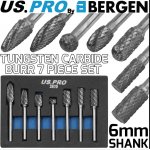
larger high speed rotary Rasps, or burrs?

Neeves

Well-Known Member
Joined
20 Nov 2011
Messages
14,070
Location
Sydney, Australia.
Visit site
I took some advice here on YBW PBO and bought some high speed rotary rasps to 'machine' higher tensile steel and aluminium. They have a 6mm shaft, which I thought at the time I ordered them - a bit small. They are actually not that much different to some wood routers I used to have in the UK and are the same shaft size. The ones I bought are fine, for grinding small areas - they are really just a size up from a Dremel

I am sure these devices come in bigger sizes (with bigger heads). It the larger heads I'm looking for. I'm making prototype devices for a yacht not a model airplane.

I might be using the wrong keywords -but I'm not coming up with anything sensible.

Any suggestions.

With thanks.

Jonathan
 
I know them as rotary burr. I used them with an air Desoutter grinder in the 1970s. They were considered a tool of last resort as their splinters were easy to pick-up, extremely painful and hard to remove.

6mm shank is the norm. If the jobs needs something bigger, I’d look for a different tool, better suited to the need.

I make model aeroplanes and would not put a rotary burr anywhere near one.
 
Just picked up a carbide loaded steel disc for the 125 angle grinder. Idea is to clean years of old paint off the stones on the front of the house. It looks pretty course, but might also be useful for rough shaping of metal. Normally use flap discs for that.
Watched a bloke use an electric die grinder to tidy up a welded crank that he had done still in the engine! Ford V8 in a Sunbeam Tiger.
 
What are you actually trying to make Neeves?

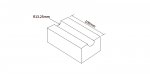
I want to have a recess whose profile will accept the crown of an 8mm chain. So the slot, or channel, needs needs to have semicircular 'base'

I could take a large lump of steel, drill quite a large hole in it, I have a set of high tensile hole saws that would do this, and the cut the lump in half - giving two slots - but I am sure there must be another way.

Skylark - I chose the wrong example :)

I could use an angle grinder - but its a bit agricultural and the result is going to be decidedly rough (and lots of room for error - and having to start again)

Jonathan
 
I want to have a recess whose profile will accept the crown of an 8mm chain. So the slot, or channel, needs needs to have semicircular 'base'

I could take a large lump of steel, drill quite a large hole in it, I have a set of high tensile hole saws that would do this, and the cut the lump in half - giving two slots - but I am sure there must be another way.

Skylark - I chose the wrong example :)

I could use an angle grinder - but its a bit agricultural and the result is going to be decidedly rough (and lots of room for error - and having to start again)

The steel is 800 MPa (and will be galvanised) the aluminium is 600 MPa and will be anodised.

Jonathan
 
I want to have a recess whose profile will accept the crown of an 8mm chain. So the slot, or channel, needs needs to have semicircular 'base'

I could take a large lump of steel, drill quite a large hole in it, I have a set of high tensile hole saws that would do this, and the cut the lump in half - giving two slots - but I am sure there must be another way.

Skylark - I chose the wrong example :)

I could use an angle grinder - but its a bit agricultural and the result is going to be decidedly rough (and lots of room for error - and having to start again)

Jonathan

Don't really understand what you mean, but it sounds like a job for a milling machine.
 
I'm sure it would be easy on a milling machine - I don't have a milling machine (nor likely to acquire one) and I am simply exploring the options.

Maybe there are no options - but if you don't ask....... :)

Jonathan
 
Don't really understand what you mean, but it sounds like a job for a milling machine.

8mm metric chain has a crown 26.5mm in diameter. Imagine a lump of steel with a 2.65cm diameter hole drilled through it and then the piece of steel cut in half so that each half had a semicircular slot. :). I can actually drill such holes but only about 50mm long - which is not long enough. I know I could drill two holes from each end giving me a 100mm slot but cutting the steel with any accuracy with an angle grinder would be a real challenge.
 
8mm metric chain has a crown 26.5mm in diameter. Imagine a lump of steel with a 2.65cm diameter hole drilled through it and then the piece of steel cut in half so that each half had a semicircular slot. :). I can actually drill such holes but only about 50mm long - which is not long enough. I know I could drill two holes from each end giving me a 100mm slot but cutting the steel with any accuracy with an angle grinder would be a real challenge.
A perfect job for rounded bits like this, and 6mm collet will be fine. Don't use the cheapest chinesium burrs, a decent set is only about 30 quid.

IMG_4799.jpg
 
8mm metric chain has a crown 26.5mm in diameter. Imagine a lump of steel with a 2.65cm diameter hole drilled through it and then the piece of steel cut in half so that each half had a semicircular slot. :). I can actually drill such holes but only about 50mm long - which is not long enough. I know I could drill two holes from each end giving me a 100mm slot but cutting the steel with any accuracy with an angle grinder would be a real challenge.
I'd go the double drilling route and cutting it rough with the angle grinder and "polishing" up the flat surface, much easier than trying to do the curvy bits out of nowhere (imho)
 
Thanks for all the replies

I have a reasonable 5 piece set, 6mm. But they are really for quite detailed work being so small (or I think them small). I could live with Dankilb's 15.8mm dome its a bit bigger than mine, which are all around 10mm.

I'll find someone locally, tool shop, now that I know there are sets with bigger pieces, and have a look. Certainly the 6mm sets of 5-8 are really not expensive.

I think the obvious answer is casting - but that's simply prohibitively expensive for prototypes. The molds cost US$500. People who CNC machine are not interested in 'one offs', as I have found. Most people would have an 'in house' machine shop to make prototypes :(. I just have a relatively well equipped workshop but nothing as exotic as a milling machine.
Again many thanks.

Jonathan
 
Does it need to be solid? If you are prototyping you could make up your solid from layers of steel plate cut to shape then welded together, it would offer most of the strength of solid and be much cheaper/easier to fabricate. A sketch would help(if you aren't protecting IP).
 
Is this it or an approximation thereof?

Drawing.jpeg
Can you drill and tap? Two pieces of steel sandwiched and screwed together, drill your 26.5mm hole down the join line from opposite ends. Can you soft solder? Same process, but with solder instead of a bolted joint. Even epoxy would do the job, then heat to release afterward.
 
Last edited:
Top