
Lanolin vs lanolin and extra hot chilli powder - the results

I can understand the case against TBT for large commercial vessels, I can even understand the case against TBT in leisure vessels. But the case against use on a propellor? Like dead seahorses - I doubt that there has been a study that will stand scrutiny.

Jonathan
 
I tried an additive called TBT ( tributyl tin oxide) once; it worked really well, Not allowed to be used anymore in antifoul apparently, but still readily available for use in home chemistry experiments !

I think you'll find TNT far more effective, though there is a side effect..
 
Arguably TBT and a clean prop is better than a fouled prop and using more fuel, or the energy implications of slipping to clean etc

Jonathan


One of the nastier side-effects of TBT is to mess up the gender of affected organisms. It accumulates up the food chain, and has been implicated in the deaths of mammals such as sea-otters and dolphins. It acts as an immunosuppressant in vertebrates. It persists in the environment for around 20+ years. If you allow it for propellers, how are you going to stop its wider use?

TBT is seriously nasty stuff, and the ban was brought in because it was beginning to affect commercial fisheries, both by causing population declines and by accumulating to potentially toxic levels in commercially caught fish.
 
I do not doubt the science, at all, for the ban for wholesale use of TBT - but on props. We are, or some are, willing to pay a fortune for PropSpeed/Gold (and have not had time for any environmental impact (but the primer itself is very unpleasant). If a small tin of TBT prop paint cost Stg'a lot' and it were allowed then economy would dictate its limited usage. Restrict sale to 250ml max?

It is difficult to believe it could not be restricted in its application - and if that is the only reason not to use it then someone somewhere lacks imagination.

its whether science has been conducted on such a small item and looking at the benefits of its usage in that application over the alternatives.

Jonathan
 
I do not doubt the science, at all, for the ban for wholesale use of TBT - but on props. We are, or some are, willing to pay a fortune for PropSpeed/Gold (and have not had time for any environmental impact (but the primer itself is very unpleasant). If a small tin of TBT prop paint cost Stg'a lot' and it were allowed then economy would dictate its limited usage. Restrict sale to 250ml max?

It is difficult to believe it could not be restricted in its application - and if that is the only reason not to use it then someone somewhere lacks imagination.

its whether science has been conducted on such a small item and looking at the benefits of its usage in that application over the alternatives.

Jonathan


ALL antifouling formulations are subject to tight regulation; they are only allowed to use permitted substances. The cost of things like Propspeed etc. is because they a) don't contain much, if any, poison (they act by creating a surface fouling organisms can't attach to) and b) because of the research and testing required to ensure they meet the regulations.

Given the lengths some people (no one reading this, I'm sure!) will go to to be competitive, how long do you think it would be before someone bought lots of the 250ml tins you propose to treat their hull? If you want a ban to stick, the only safe way is to make it absolute.

All this is moot. TBT is banned by International treaty, not merely national law, so there is no chance of it being legal anytime soon.
 
TBT was never a successful antifouling for props. It is a biocide that needs to be added to a resin to get it onto the surface to be protected. It was known about for a long time but only took off commercially when a couple of chemists at International came up with the daft idea of a paint resin that slowly dissolved in water in a controlled way. At first the idea was canned as too ridiculous but eventually appeared as the first SPC, self polishing copolymer. International were a strong marine paint company before but this allowed them to clean up the market worldwide but only after some difficult sales pitches. On hulls of ships and yachts it was fantastic. On propellers it was a non starter. A polishing paint resin gets eroded far too quickly at the tips of the blades and not enough to release the TBT around the hub. More importantly the vortexes that form around the tips of propeller blades destroy pretty much any paint system in a very short time. The coating is simply ripped from the surface. Which brings us onto why the primer for Propspeed needs to be so unpleasant.....
 
Thanks Pasarell,

proves a number of things

There are very few new and good ideas

And we really have not solved the prop problem:(, unless you think Propspeed a good idea.
Jonathan

edit, I'm not forgetting Velox, the jury here will take a long time to come to a decision.
 
edit, I'm not forgetting Velox, the jury here will take a long time to come to a decision.

image.jpg

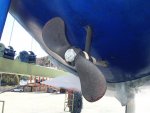
Third successful season with Velox. This taken yesterday before pressure washing. Absolutely nothing on it, whereas in previous years it would have been heavily coated with tube worm. This is two coats on top of previously applied Hammerite primer, sanded down. Slight pitting of the top coat due to cavitation but much better that when i applied four coats as recommended. After three years I still have well over half a tin of velox left, so a pretty economical treatment.

Edit: P bracket also perfectly clean, compare with prop shaft in the background.
 
This is the prop on Eynhallow after 6 month.

The prop was just polished with Autosol, until it had a nice shine. I had the same result last year.

oops, I don't seem to be able to get "manage attachments" to work.

trying photobucket.

http://s296.photobucket.com/user/Eynhallow/media/prop_zpsbb86235c.jpg.html

Having tried most things (Trilux, lanolin,udder cream, grate-black), I've found polishing the prop and then regular use is the best method of keeping it clear - mine's an Autoprop not a folder or a Maxprop but even more likely to malfunction due to fouling.
The only problem with polishing is that sooner or later the blades will need replacement - that painful moment has just arrived, after 22 years, they'll cost 25% more than the new prop did!!
 
Last edited:
The generic term is "tube worm", but this refers to pretty much any kind of worm that secretes a mineral tube around its body. These are most likely Serpulid worms. They are worms (phylum Annelida), but the term "worm" itself isn't very taxonomically helpful, as the worm body shape isn't restricted to one Phylum; things called worms are found in several phyla. They aren't corals, though in the natural state they may well grow on coral.

One gets them toward the end of every summer in the E Med - usually they gang up on the log paddle-wheel, though this year in 1483nm I haven't had to clear the paddle-wheel. I find the easiest way to clean them of is to put the paddle-wheel in a solution of sulphamic acid and leave it for 24 hrs, then shake out all the little bodies. On prop sprague and boss they're easy to clean off by scraping but more of a problem on zinc anodes (I now use a wire-brush on an electric drill). This gets off the zinc-oxide as well as tube-worms.
 
View attachment 46368

Third successful season with Velox. This taken yesterday before pressure washing. Absolutely nothing on it, whereas in previous years it would have been heavily coated with tube worm. This is two coats on top of previously applied Hammerite primer, sanded down. Slight pitting of the top coat due to cavitation but much better that when i applied four coats as recommended. After three years I still have well over half a tin of velox left, so a pretty economical treatment.

Edit: P bracket also perfectly clean, compare with prop shaft in the background.

Your prop looks real clean, but then so does the hull.

How long were you in the water? Has the hull been washed down and if not what AF are you using.

Jonathan
 
Oh no it isn't. TBT is now banned. Completely. Everywhere. Has been for a number of years and in practice European / US / Japanese ship owners stopped using it many years ago so it was off the majority of deep sea vessels by about 2000.
I'm sure you can still find it in some 3rd world countries for use by fishermen and coastal traffic but try going into any major port with TBT on the bottom and there will be a shed load of trouble, including the ship arrested.
 
Top