ketch rig mainmast lowering

alanojones

New Member
Joined
19 Jul 2005
Messages
21
Visit site
I am just about to have the standing rigging replaced on the new-to -me boat, and it makes sense to our plans if we can put the masts up and down ourselves. Does anybody know of a system that a ketch can use ? /forums/images/graemlins/smile.gif
 
My boat was designed to lower her own masts, but I dont know of a method of doing it, without the special shrouds my boat has, but I'm sure a way could be devised, using the fore stay and ropes and winches, couldnt say without seeing the problem, sorry.
 
Mast lowering is common around here because of low bridges. At least one 70 footer lowers 100ft of mast on the run twice a day for a day race in ocean.
You need firstly a suitable mast tabernacle. You need a crutch near the stern for both masts. (As high as possible) I imagine your main mast would lay above the mizzen when down. on a crutch over the mizzen.
Mast lowering comes in 2 stages. The first is to lower the mast on to a crutch to a level low enough for bridges or for you to reach the top while standing on a high jetty on a ladder.
The second stage takes muscle to lift the mast out of the tabernacle carrying the base forward to the pulpit and lowering the mast down to deck level or even on to the ground.

Dealing with first stage you tip the mast back by releasing the forestay andf using a tackle to lower it pivotting in the tabernacle.
Because the forestay ends up paralell to the mast you must improve the angle by having jib or prop. The most common form is 2 spin poles or purpose built poles whic attach to the bottom of the forestay and pivot at apoint near the gunwhale aprox abeam the mast. So picture the mast is horizontal these poles are near vertical and the forestay goes up to the end of the poles where a 4 part tackle goes down to the bow. (then to a winch). You can use just one pole attached to the base of the mast and stayed sideways to the gunwhale but most people use 2 poles.

Obviously your mizzen can be easily lowered by a halyard from the main mast attached to the top of the mizzen.

Now in lowering masts it is essential that the mast be supported sideways by stays as it descends. On a boat like yours the usual way is to maintain the cap shrouds tight through the descent arc.
This can be easily efficiently done by extending the chain plates up to a point exactly inline across the baot with the mast pivot. The chain plate extension (stiff tube) is often stayed forward to hold it vertical even though stays are pulling aft. (The cap shrouds must pivot back in line with the mast pivot as the mast goes down)
Alternative rickety arrangements use halyards as side stays which are tightened as the mast goes down. Or you can attach tackles to the sidestays to pull them forward from a point level with the pivot point.
One interesting new developement around here is another pair of poles pivotted on the deck about half way from mast to transom near the gunwhale which connect to a car which slides up the mainsail track. The car is controlled by the halyard and a down haul line. As the mast comes down the car goes up the track. The mast is centred laterally at all times. If the car reaches the top of the mast and the geometry is correct the poles can form a support for the top of the mast when down. It has been suggested that the mast can be lowered and particularly raised by control of this car but I think the pull on the forestay with poles has better power/ strength. i would suggest use both.

Once the mast is down on a crutch at the stern then if moved aft and suitably stayed fore and aft the poles which went to the forestay can be used as a crane with a tackle to hoist the weight of the middle of the mast to facilitate moving the mast forward. In both functions the poles have a large compression force so must be stout and the pivot needs to be designed to take end load. It is important that the crutch at the stern be braced fore and aft so that you can slide the mast foreward on the crutch once it is removed from the tabernacle. The mast at this point is balanced possibly even top heavy on the aft crutch so be carefull. A roller on the top of the crutch may be usefull for a heavy mast.

Yes it is very satisfyig to be able to lower your mast without proffessional help. But do get some stout hearted lads to help you at least on first few tries until you are confident. Having said that a few people manage to damage the base of their mast because it is not secured sideways sufficiently and a passing mobo causes the boat to roll.
One guy near me with a 40 fter lowers and raises his mast to go under bridges on the run and single handed. You just have to get organised. and practice.
Good luck, PM me if you don't understand anything olewill
 
cheers,I'm passing that to the boatyard. I thought that some effort would be required and the teamwork will have to be excellent. thanks
 
The boats 33ft and the mainmast is longer. I can't say for sure because we have not lowered the mast yet, but I guess about 38-40 ft
 
Many Dutch boats lower their masts to pass under bridges. As William H says, the secret is to have the mast pivot point and the shroud bases on a straight line. However, a further refinement is often seen.

A pair of metal poles is formed to lie just inside the bow toe rails to form a wishbone shape. The aft ends are attached to the deck with a fitting that allows them to swing upwards. The forward ends are joined together. When mast lowering commences the forestay is attached to the forward end of the wishbone. A line is taken downwards from the same point, through the bow roller or a snatch block and back to a sheet winch. As the mast angle from vertical increases it becomes increasingly difficult to control its rate of descent, as the angle between mast and forestay is reducing. Using the wishbone prevents this reducing angle from occurring and also gives increased lateral stability.

The wishbone seems not to be too obtrusive on most foredecks, less so than the poles described by William H.
 
A Dutch boat I saw had developed this idea and used the top rail of his pulpit as a wishbone 'jib'. Obviously a bit more involved unless, as he had done, the whole this was designed into the boat from the start.

Nick
 
hello Viv The wishbone you speak of is a better described device which is emulated by 2 spinnacker poles. In many cases they can stay in situ attached to the forestay and deck.
The other device of another pair of poles is perhaps more appplicable to a fractional rig where all side stays go very loose as soon as the mast goes back and down. It is not so popular because mast head rigs stilll seem to predominate. olewill
 
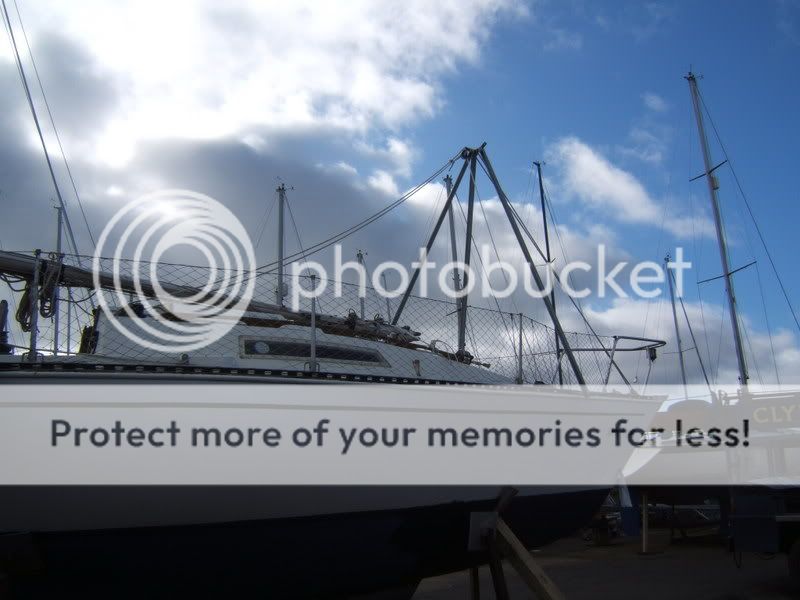
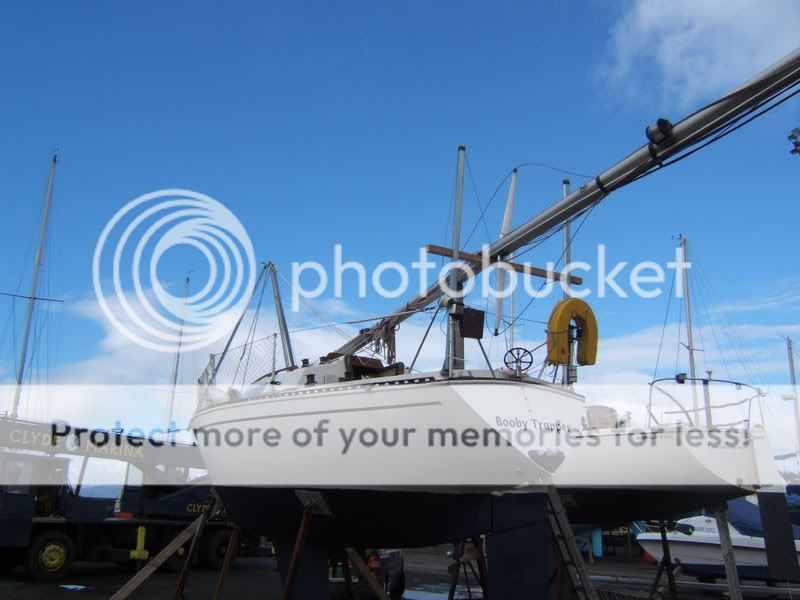
I imagine you could use the main mast to lower the mizzen then you could set up some sort of A frame or as in my case a tripod.
I have lowered my 10m mast with the help (and advice /forums/images/graemlins/mad.gif) of Mrs Spyro.
I raised it myself without her advice!!

see pics.
2007_0303003.jpg


2007_0303006.jpg
 
Top