Keel Cooler Sizing

ducked

Well-Known Member
Joined
6 Oct 2024
Messages
2,019
Location
Tainan, Taiwan
Visit site
Roughly how long would, say, a 15mm copper domestic water pipe (assuming such would withstand seawater) have to be to transfer the heat from a 1GM10 operating at full power into the sea?

 
Keel cooling is not really practical on a seawater only cooled engine unless you have a way of dealing with the hot dry exhaust
 
Would this affect cooling of the exhaust?
Well, it wouldnt effect the cooling of the exhaust. I'd have to do that separately, with an electric, or mechanical pump, or gravity feed for testing.

I doubt a dry exhaust is practical in the space, though it'd be a lot simpler and more reliable.

The hoped-for advantage would be keeping salt mostly out of the engine, and running a hotter thermostat
 
you can probably get a very rough idea if you look at the design of the heat exchanger on small fresh water cooled engines. Often something like 20x ~4mm diameter tubes, and ~20cm long - so a total surface area of ~ 500cm^2. So you would need about 10m of pipe but that's in a very turbulent / high flow system with strainers on the sea water side so minimal growth problems. A simple piece of straight copper pipe would be less efficient.
 
Well, it wouldnt effect the cooling of the exhaust. I'd have to do that separately, with an electric, or mechanical pump, or gravity feed for testing.

I doubt a dry exhaust is practical in the space, though it'd be a lot simpler and more reliable.

The hoped-for advantage would be keeping salt mostly out of the engine, and running a hotter thermostat
The 1GM is very simple and really does not suffer from cooling problems or need to run hotter if you follow some simple rules. The weak points of the cooling system are the rubber pipes that take the coolant from the pump to the T piece into the block and then up to the thermostat. Keep these clear - maybe every couple of years. Check and replace the anode if necessary every year.

Not sure your pumped system for exhaust cooling would work. The volume required is a function of engine speed and only needed when the engine is running. Foe example if you set your pump at a rate for steady running it would be too high for tickover and without the higher exhaust pressure water would fill the system.

My 1GM had been in use for over 10 years before I stripped it down (for reasons other than cooling) and the waterways apart from the pipes were still clear.
Not sure a pumped system for water ito the
 
I investigated a keel cooled Bukh DV24 a while ago. For the 24 hp motor, Bukh specify 2 in parallel 22 X 19 mm copper pipes 1.574 m long. Maybe your Yanmar would be happy with one pipe only? Yoy would need a heat proof exhaust pipe, though.

 
I investigated a keel cooled Bukh DV24 a while ago. For the 24 hp motor, Bukh specify 2 in parallel 22 X 19 mm copper pipes 1.574 m long. Maybe your Yanmar would be happy with one pipe only? Yoy would need a heat proof exhaust pipe, though.
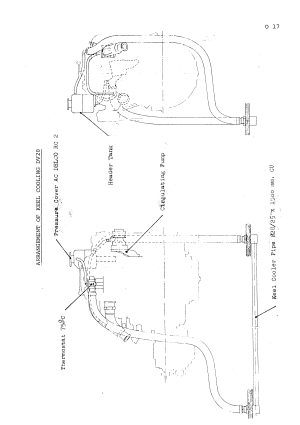
The dimensions given in the DV10 and DV20 workshop manual are a little confusing. The diagrams only appear to show a single pipe. Maybe 'bottoms' only means the pipes running down to the cooler
1773246990399.png

1773247371452.png
 
The dimensions given in the DV10 and DV20 workshop manual are a little confusing. The diagrams only appear to show a single pipe. Maybe 'bottoms' only means the pipes running down to the cooler
View attachment 207630

View attachment 207631
In the same ball park? Cross sectional area for the twin pipes is 568 mm2 and for the single, it's 490. The twin pipes are for a more powerful motor, I guess the twin pipes would have more surface area, too. I got the info from the Bukh user's manual for the DV24. I dallied with the idea of buying one of those ex lifeboat engines from India!
 
I had such an arrangement on my Commando, a design by Angus Primrose built in triple diagonal mahogany by Blanks Boatyard during the 1960s. The engine was a BMC Captain, a 1500cc diesel often found in vans and taxis at the time. On the boat it was cooled by fresh water/antifreeze mixture circulating through an external heat exchanger to get rid of the waste heat. There was also a separate engine-driven pump which supplied seawater to the injection point in the exhaust. There was also a freshwater cooled exhaust manifold.

The Captain was a more powerful engine than yours but from memory it consisted of two fourway manifolds with four 18 mm brass tubes about 6 feet long between them. Dealing with corrosion in this assembly was a headache and I was glad when the boat was sold.
 
I took the head off to clear the exhaust port. LOTS of salt, hence the motivation. I suppose matching the injection rate to the engine speed might indicate an engine driven pump, which might be
tricky to arramge.
That said, Id think there might be quite a lot of spare capacity in a given low-flow, based on how much water was turned to steam, A pure steam exhaust might go superheated and might also contain erosive solid salt, but as long as the exhaust is wet Id think it should be fairly safe.
 
Last edited:
you can probably get a very rough idea if you look at the design of the heat exchanger on small fresh water cooled engines. Often something like 20x ~4mm diameter tubes, and ~20cm long - so a total surface area of ~ 500cm^2. So you would need about 10m of pipe but that's in a very turbulent / high flow system with strainers on the sea water side so minimal growth problems. A simple piece of straight copper pipe would be less efficient.
Well that, if accurate and applicable, which I assume is the case, makes it impractical, unfortunately, which I suppose shouldnt be a surprise since everyone isnt doing it

OTOH it seems a BUKH 24 can manage with mote practical pipe lengths, suggesting a wee GM10 could go smaller still. Since I would be pumping exhaust cooling brine separately, perhaps that could countercurrent the internal part of the antifreeze loop to scavenge a bit
more heat.
 
Last edited:
Top