ducked
Well-Known Member
Roughly how long would, say, a 15mm copper domestic water pipe (assuming such would withstand seawater) have to be to transfer the heat from a 1GM10 operating at full power into the sea?


Well, it wouldnt effect the cooling of the exhaust. I'd have to do that separately, with an electric, or mechanical pump, or gravity feed for testing.Would this affect cooling of the exhaust?
The 1GM is very simple and really does not suffer from cooling problems or need to run hotter if you follow some simple rules. The weak points of the cooling system are the rubber pipes that take the coolant from the pump to the T piece into the block and then up to the thermostat. Keep these clear - maybe every couple of years. Check and replace the anode if necessary every year.Well, it wouldnt effect the cooling of the exhaust. I'd have to do that separately, with an electric, or mechanical pump, or gravity feed for testing.
I doubt a dry exhaust is practical in the space, though it'd be a lot simpler and more reliable.
The hoped-for advantage would be keeping salt mostly out of the engine, and running a hotter thermostat

The dimensions given in the DV10 and DV20 workshop manual are a little confusing. The diagrams only appear to show a single pipe. Maybe 'bottoms' only means the pipes running down to the coolerI investigated a keel cooled Bukh DV24 a while ago. For the 24 hp motor, Bukh specify 2 in parallel 22 X 19 mm copper pipes 1.574 m long. Maybe your Yanmar would be happy with one pipe only? Yoy would need a heat proof exhaust pipe, though.

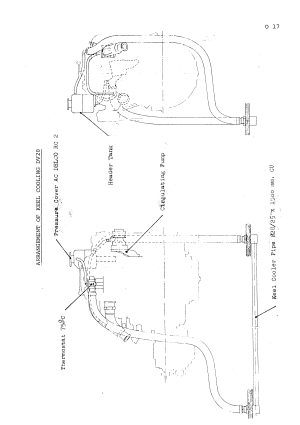
In the same ball park? Cross sectional area for the twin pipes is 568 mm2 and for the single, it's 490. The twin pipes are for a more powerful motor, I guess the twin pipes would have more surface area, too. I got the info from the Bukh user's manual for the DV24. I dallied with the idea of buying one of those ex lifeboat engines from India!The dimensions given in the DV10 and DV20 workshop manual are a little confusing. The diagrams only appear to show a single pipe. Maybe 'bottoms' only means the pipes running down to the cooler
View attachment 207630
View attachment 207631

Well that, if accurate and applicable, which I assume is the case, makes it impractical, unfortunately, which I suppose shouldnt be a surprise since everyone isnt doing ityou can probably get a very rough idea if you look at the design of the heat exchanger on small fresh water cooled engines. Often something like 20x ~4mm diameter tubes, and ~20cm long - so a total surface area of ~ 500cm^2. So you would need about 10m of pipe but that's in a very turbulent / high flow system with strainers on the sea water side so minimal growth problems. A simple piece of straight copper pipe would be less efficient.
